

Business Model Canvas: The Ultimate Guide to Building a Winning Business Model
What separates companies that scale from those that stall? More often than not, it comes down to one thing: clarity of business model. The Business Model Canvas gives you that clarity – on a single page, in under four hours.
In this definitive guide, you will master all 9 building blocks of the Business Model Canvas, explore step-by-step instructions for building your own, study real-world case studies from Netflix, Airbnb, and Apple, and discover the most common mistakes to avoid. Whether you are an entrepreneur, product manager, consultant, or student – this guide delivers everything you need.
Play the Business Model Canvas Audio in Tamil
1. What Is the Business Model Canvas?
The Business Model Canvas is a one-page strategic management template that maps out how a business creates, delivers, and captures value. It replaces the bloated 50-page business plan with a visual, collaborative, living document that any team can understand instantly.
Quick Definition
- A visual chart with 9 interconnected building blocks
- Created by Alexander Osterwalder & Yves Pigneur (2010)
- Used by over 5 million practitioners in 190+ countries
- Applicable to startups, SMEs, and enterprise corporations
- Fits on a single sheet of paper or whiteboard
Unlike static documents, the BMC is designed to be challenged, updated, and iterated. Sticky notes replace paragraphs. Collaboration replaces solo planning. Speed replaces bureaucracy.
2. Why the Business Model Canvas Outperforms Traditional Business Plans
| Comparison Factor | Winner |
|---|---|
| Traditional Business Plan | Business Model Canvas |
| 50-100 pages of text | 1 visual page |
| Weeks to months to produce | Hours to complete |
| Static - hard to update | Dynamic - easy to iterate |
| Written for banks and investors | Built for teams and founders |
| Siloed creation | Collaborative workshop format |
| Focuses on documentation | Focuses on assumptions and learning |
3. The 9 Building Blocks of the Business Model Canvas
THE 9 BUILDING BLOCKS AT A GLANCE
| Building Block | Core Question |
|---|---|
| 1. Customer Segments | For whom are you creating value? |
| 2. Value Propositions | What value do you deliver? |
| 3. Channels | How do you reach your customers? |
| 4. Customer Relationships | How do you engage and retain them? |
| 5. Revenue Streams | How does the business earn money? |
| 6. Key Resources | What assets does the business need? |
| 7. Key Activities | What must the business do every day? |
| 8. Key Partnerships | Who helps the business succeed? |
| 9. Cost Structure | What are the biggest costs? |
Block 1: Customer Segments
The five types of Customer Segments are:
- Mass Market - One large group with broadly similar needs (e.g., Facebook targeting all internet users)
- Niche Market - Highly specialized segment with precise needs (e.g., Rolls-Royce targeting ultra-high-net-worth individuals)
- Segmented - Multiple segments with slightly different needs (e.g., a bank serving students, employees, and businesses)
- Diversified - Two or more unrelated segments (e.g., Amazon serving retail shoppers and enterprise cloud clients via AWS)
- Multi-Sided Platform - Two interdependent segments simultaneously (e.g., Google serving users and advertisers)
Block 2: Value Propositions
Block 3: Channels
Block 4: Customer Relationships
Block 5: Revenue Streams
| Revenue Model | Description | Real-World Example |
|---|---|---|
| Subscription | Recurring monthly/annual fee for access | Netflix, Spotify, Salesforce |
| Freemium | Free tier + paid premium features | LinkedIn, Dropbox, Zoom |
| Usage Fee | Pay only for what you consume | AWS, Uber, hotel stays |
| Licensing | Fee for use of intellectual property | Microsoft, patent holders |
| Brokerage | Commission on transactions between parties | Airbnb, eBay, real estate |
| Advertising | Revenue from selling audience attention | Google, Facebook, YouTube |
Block 6: Key Resources
Block 7: Key Activities
Block 8: Key Partnerships
Block 9: Cost Structure
4. Business Model Canvas: Key Statistics & Data
- Over 5 million practitioners have been trained on the Business Model Canvas methodology since 2010.
- Strategyzer, the official BMC platform, is used by 80% of the world's top business schools.
- Startups using structured business model tools like the BMC are 2x more likely to attract venture capital investment.
- The Business Model Generation book by Osterwalder has sold over 1.5 million copies and has been translated into 37 languages.
- Companies that revisit and iterate their business model quarterly grow 3x faster than those that do it annually.
- 70% of strategy failures are attributed not to poor execution but to a flawed or untested business model - precisely the risk the BMC is designed to eliminate.
5. Step-by-Step Guide: How to Build Your Business Model Canvas
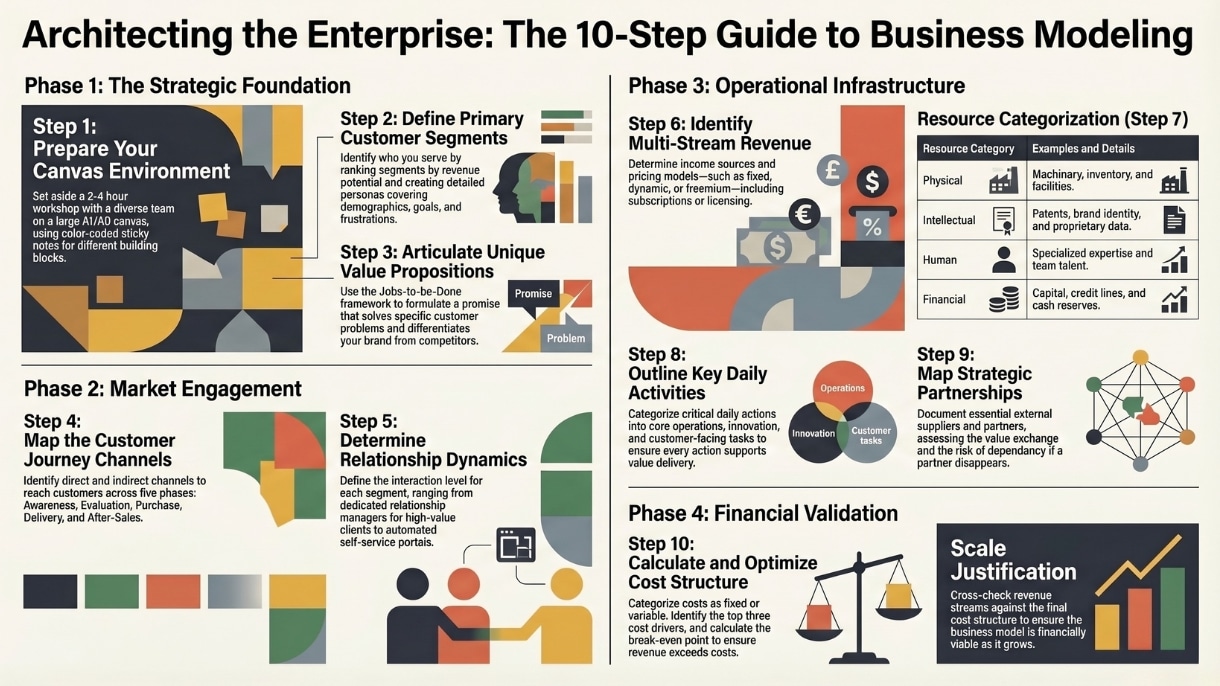
Step 1: Prepare Your Canvas Environment
- Print the BMC template on A1/A0 paper or use a digital tool (Miro, Strategyzer, Canva, Lucidchart)
- Assemble a diverse team: founders, product managers, sales leads, and finance
- Use sticky notes in different colors for each building block
- Set aside 2-4 hours for a focused first-pass workshop session
Step 2: Start with Customer Segments - Not Your Product
- List every potential customer group your business could serve
- Rank segments by revenue potential and strategic importance
- Write a brief persona for each: demographics, behaviors, goals, frustrations
- Example: 'Urban professionals aged 25-40 who need fast, healthy lunch options'
Step 3: Define Your Value Propositions
- For each segment: What problem are you solving? What need are you meeting?
- Use the Jobs-to-be-Done framework: Functional, Social, and Emotional jobs
- State your VP as a promise: 'We help [segment] achieve [goal] by [unique offering]'
- Validate with real customers before finalizing - never assume
Step 4: Map Your Channels
- List channels covering all 5 phases: Awareness, Evaluation, Purchase, Delivery, After-Sales
- Distinguish direct (own) vs. indirect (partner) channels
- Evaluate each channel: Is it cost-efficient? Does it reach the right segment effectively?
Step 5: Determine Customer Relationships
- Define what type of relationship each segment expects
- New customers: Focus on acquisition and smooth onboarding
- Existing customers: Build loyalty programs, cross-sell, and upsell pathways
- High-value segments: Assign dedicated relationship managers
Step 6: Identify Revenue Streams
- List all ways your business generates income from each Customer Segment
- Choose the right pricing model: fixed, dynamic, freemium, or negotiated
- Estimate the relative contribution of each stream to total revenue
- Explore beyond core products: subscriptions, data licensing, advertising
Step 7: List Key Resources
- Work backwards from your Value Proposition: What assets are essential?
- Categorize as Physical, Intellectual, Human, or Financial
- Identify which resources are unique, defensible, or difficult to replicate
Step 8: Define Key Activities
- List the most critical daily operations the business must execute
- Align every activity directly to value delivery — if it does not support your VP, reconsider it
- Identify activities that represent genuine competitive advantage
Step 9: Map Key Partnerships
- List all external partners and suppliers essential to operations
- Define what they provide: resources, capabilities, risk reduction, or market access
- Assess dependency risk: what happens if a key partner disappears?
Step 10: Calculate Your Cost Structure
- List all costs required to operate the model from Steps 6-9
- Categorize as Fixed (salaries, rent, licences) vs. Variable (per unit, per customer)
- Calculate your break-even point: At what revenue level do costs equal income?
- Revisit Revenue Streams to ensure revenues exceed or justify costs at scale
6. Real-World Case Studies: BMC in Action
The real power of the Business Model Canvas becomes evident when you apply it to real companies. The three case studies below – Netflix, Airbnb, and Apple – illustrate how the 9 building blocks interact in practice and reveal why these companies dominate their industries.
PROBLEM
SOLUTION
RESULT
PROBLEM
SOLUTION
RESULT
PROBLEM
SOLUTION
RESULT
7. Business Model Canvas Checklist: Build It Right the First Time
Complete this checklist before finalising your BMC
- You have clearly identified and named at least one primary Customer Segment
- Your Value Proposition is written as a benefit to the customer, not a feature of your product
- You have mapped channels to all 5 phases: Awareness, Evaluation, Purchase, Delivery, After-Sales
- You have defined a specific Customer Relationship type for each segment
- You have listed at least two distinct Revenue Streams with pricing models
- All Key Resources have been categorized (Physical, Intellectual, Human, Financial)
- Your Key Activities align directly with your Value Proposition delivery
- You have identified at least 3 key partners and what they provide
- You have separated Fixed Costs from Variable Costs in your Cost Structure
- You have calculated or estimated your break-even point
- You have validated at least your top 3 assumptions with real customers
- You have mapped at least one competitor's BMC to identify gaps and opportunities
- The entire team has reviewed and agreed on the BMC - not just one person
- You have set a date to review and update the BMC (recommended: quarterly)
8. Top 10 Business Model Canvas Mistakes (And How to Fix Them)
| Common Mistake | How to Avoid It |
|---|---|
| Treating all customers as one segment | Identify distinct groups with different needs, behaviors, and willingness to pay |
| Confusing features with value propositions | Focus on outcomes and benefits, not product specifications |
| Building the BMC alone | Run a collaborative workshop — diverse perspectives prevent costly blind spots |
| Using vague, generic language | Be specific and measurable. Bad: 'Good service'. Good: '30-minute guaranteed delivery' |
| Skipping customer validation | Test every assumption with real customers before building anything |
| Ignoring connections between blocks | A change in Channels must trigger review of Costs, Relationships, and Resources |
| Filing it away after one session | Revisit the BMC quarterly — business models must evolve with markets |
| Confusing Revenue Streams with profit | Revenue is inflows; profit is revenue minus costs. Track both separately |
| Overcrowding each block with text | Use short phrases and keywords. Each block should fit on 3-5 sticky notes |
| Not analyzing competitor BMCs | Map your top 3 competitors' models to identify strategic gaps and opportunities |
9. Frequently Asked Questions (FAQ)
What is the Business Model Canvas and who created it?
What are the 9 building blocks of the Business Model Canvas?
How is the Business Model Canvas different from a business plan?
How often should I update my Business Model Canvas?
What free or paid tools can I use to create a Business Model Canvas?
Where should I start when filling in the Business Model Canvas?
10. Conclusion: Your Business Model Is Your Competitive Advantage
Key Takeaways
- The BMC maps your entire business on one page across 9 interdependent building blocks
- Always start with Customer Segments - everything else flows from who you serve
- The right side (customers, channels, revenue) and left side (resources, activities, costs) must be in balance
- Validate every assumption with real customers before building at scale
- Revisit and iterate your BMC quarterly - business models are living documents
- Map competitor BMCs to identify gaps and build a defensible strategic position