
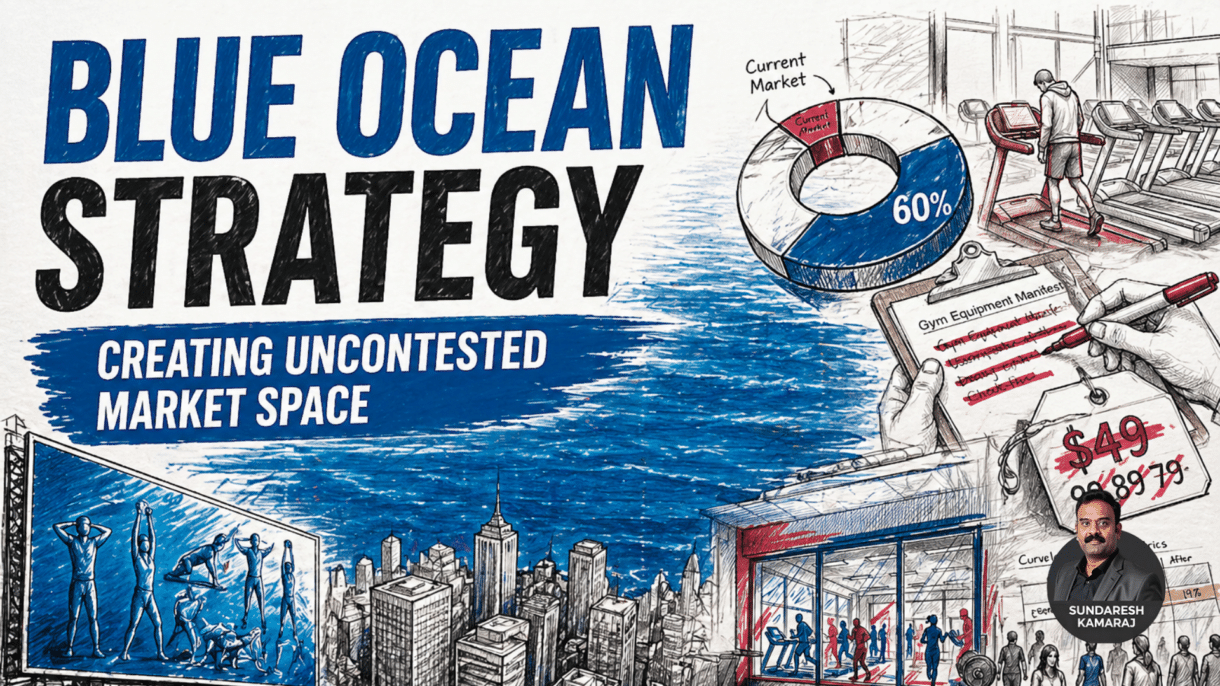

Blue Ocean Strategy: How to Create Uncontested Markets and Make Competition Irrelevant
Built on more than a decade of research by W. Chan Kim and Renée Mauborgne at INSEAD, Blue Ocean Strategy reframes how you think about growth. Rather than treating differentiation and low cost as a trade-off, it treats them as a single, integrated pursuit called value innovation. In this guide, you will learn the full framework, the diagnostic tools, a step-by-step methodology, real case studies, and exactly how to apply it to your business — starting today.
Key Insight
1. What Is Blue Ocean Strategy?
Play the Blue Ocean Strategy Audio in Tamil
2. Red Ocean vs. Blue Ocean: The Core Difference
| Dimension | Red Ocean | Blue Ocean |
|---|---|---|
| Market Space | Compete in existing, defined markets | Create new, uncontested market space |
| Competition | Beat existing rivals | Make competition irrelevant |
| Demand | Exploit existing demand | Create and capture new demand |
| Value vs. Cost | Choose differentiation OR low cost | Pursue differentiation AND low cost |
| Strategic Logic | Align with chosen trade-off | Align entire system to break the trade-off |
| Outcome | Shrinking margins, commoditization | Profitable growth, category leadership |
3. Value Innovation - The Cornerstone Concept
Why It Matters
Value without innovation is incremental — it improves what already exists but rarely breaks through. Innovation without value is technology for its own sake — buyers reject it. Value innovation is the rare alignment of utility, price, and cost that creates breakaway market leaders.
4. The Strategy Canvas Explained
The Strategy Canvas is the central diagnostic tool of Blue Ocean Strategy. It is a chart and a conversation starter. The horizontal axis lists the factors your industry competes on. The vertical axis shows how much of each factor buyers receive. Plot your company and your competitors, and you instantly see whether you are stuck in a red ocean.
The Three Signatures of a Winning Value Curve

Focus
The curve emphasizes a few high-impact factors rather than spreading thin across everything.

Divergence
The shape of the curve is visibly, obviously different from competitors

Compelling Tagline
The strategy can be communicated in one clear, memorable sentence.
Quick Test
5. The Four Actions Framework and ERRC Grid
Once you can see your industry on the canvas, the Four Actions Framework gives you the levers to redesign it. Every blue ocean strategy answers four questions in concrete, specific terms.
Common Mistake
Eliminate (Lower Cost)
- Industry-standard factors no one truly values
- Legacy features inherited from past competitive cycles
- Costly add-ons that buyers ignore in surveys
Raise (Lift Buyer Value)
- Pain points the industry has chronically under-served
- Trust signals that make hesitant buyers commit
- Quality dimensions that justify a premium feeling
Eliminate (Lower Cost)
- Industry-standard factors no one truly values
- Legacy features inherited from past competitive cycles
- Costly add-ons that buyers ignore in surveys
Create (New Demand)
- Entirely new factors no rival currently offers
- Emotional or convenience layers buyers crave
- Bridge experiences that pull in non-customers
6. The Six Paths Framework
Where do blue oceans come from? Not from staring harder at your competitors. Kim and Mauborgne identified six structured lenses for looking outside your industry’s accepted boundaries.
| # | Path | What It Means in Practice |
|---|---|---|
| 1 | Look Across Alternative Industries | Compare products and services that solve the same underlying job (cinema vs. restaurants for an evening out). |
| 2 | Look Across Strategic Groups | Study why customers move between price tiers within the same industry (luxury vs. budget hotels). |
| 3 | Look Across the Chain of Buyers | Shift focus from the usual buyer to influencers, purchasers, or end users who are underserved. |
| 4 | Look Across Complementary Offerings | Capture value in the experience before, during, and after your product is used. |
| 5 | Look Across Functional vs. Emotional Appeal | Move an emotional industry toward function (or vice versa) to unlock new demand. |
| 6 | Look Across Time | Identify trends that will shape the market and design strategy around how they will play out. |
7. The Three Tiers of Non-Customers
Most companies obsess over current customers. Blue Ocean Strategy flips this. The biggest growth often hides in non-customers — the people who tolerate, refuse, or have never even considered your industry. Three tiers map this hidden demand.
| Tier | Description | Example |
|---|---|---|
| First Tier | Soon-to-be non-customers who use the offering minimally while waiting for something better. | Office workers who tolerate vending coffee but buy good coffee on the way to work. |
| Second Tier | Refusing non-customers who consciously reject your industry. | People who avoid gyms because they feel intimidating, expensive, or judgmental. |
| Third Tier | Unexplored non-customers in markets no one has considered serving. | Children, seniors, or rural buyers in a category aimed only at urban young adults. |
8. Step-by-Step Implementation Guide
Step 1: Assemble the Right Team
Step 2: Draw the As-Is Strategy Canvas
Identify 7–12 competing factors in your industry. Plot your company and major competitors. Most teams are stunned to see how identical their value curves actually are.
Step 3: Explore the Six Paths
Step 4: Map the Three Tiers of Non-Customers
Step 5: Apply the Four Actions Framework and Build the ERRC Grid
Step 6: Draw the To-Be Strategy Canvas
Convert the ERRC Grid into a new value curve. Stress-test it for focus, divergence, and a compelling tagline. If your curve still resembles competitors, return to step 3.
Step 7: Test the Idea with Customers and Non-Customers
Step 8: Run the Blue Ocean Sequence
Step 9: Execute, Measure, and Renew
9. Implementation Checklist
Preparation Phase
- Executive sponsor identified with visible commitment
- Cross-functional core team of 6–8 assembled
- Scope defined: business unit, product line, or market in focus
- Existing customer research, market data, and financials collated
- 8–12 week workshop calendar locked in
Analysis Phase
- As-is Strategy Canvas drawn with 7–12 validated competing factors
- At least three competitors plotted on the canvas
- Six Paths Framework explored with documented observations
- Three tiers of non-customers mapped with interview insights
- Pain points, workarounds, and unmet needs catalogued
- Set a clear deadline for the research phase to prevent analysis paralysis
Design Phase
- ERRC Grid completed with concrete factors in all four quadrants
- To-be Strategy Canvas drafted and compared against competitors
- Focus, divergence, and tagline tests passed
- Target customer segment and value proposition articulated
- Business model implications mapped: revenue, cost, channels, partners
Validation Phase
- Prototype or concept tested with real customers
- Non-customer feedback gathered and incorporated
- Exceptional buyer utility confirmed across the experience cycle
- Strategic price point accepted by the target mass of buyers
- Target cost achievable with healthy margins verified
- Adoption hurdles identified with clear mitigation plans
Execution & Renewal Phase
- Execution roadmap with owners, milestones, and KPIs published
- Organizational structure and incentives aligned to new strategy
- Tipping point leadership applied to high-impact levers
- Fair process ensured: explanations given, expectations set
- Strategy canvas reviewed at least annually
- Next blue ocean exploration scheduled before current one matures
10. Real-World Case Studies
Theory is useful. Application is decisive. Here are two illustrative case studies — one fictional and detailed, one drawn from a familiar everyday context — that show Blue Ocean Strategy in action.
Curvelane Fitness — From Crowded Gym Wars to a New Category
Problem:
Curvelane Fitness operated 14 mid-tier gyms across three Indian cities. It competed on the standard factors — equipment, hours, locations, celebrity trainers, discounts — yet monthly churn exceeded 8%, memberships were flat, and margins were squeezed. Of every 100 members, only 34 were still active after a year. Meanwhile, over 60% of urban adults in its cities had never held a gym membership.
Solution : A 12-week Blue Ocean Strategy initiative reframed the entire offering. Curvelane eliminated bodybuilding-style equipment zones and intimidating mirrored walls. It reduced equipment variety, location size, and contract length. It raised beginner-friendliness, structured coaching, hygiene, and community warmth. And it created 45-minute coach-led beginner classes, a “pause” feature, body-positive branding, and a buddy mentor system. The new tagline: “Fitness that meets you where you are.”
Result: Curvelane did not win by outspending rivals. It won by changing what it competed on — lowering cost while lifting value for an enormous, ignored audience. That is value innovation in practice.
| Metric | Before | After (Year 2) |
|---|---|---|
| Active Members | 3,200 | 18,400 |
| Average Monthly Fee | ₹3,200 | ₹1,490 |
| 12-Month Retention | 34% | 71% |
| Annual Revenue | ₹12.3 Cr | ₹32.8 Cr |
| Operating Margin | 6% | 19% |
| First-Time Gym-Goers (% of new joins) | 8% | 52% |
Priya's Place — A Cafe That Stopped Watching Its Rival
Problem: Two cafes sat across from each other on a busy high street. Bean Street Coffee, run by Anil, and Mocha Corner, run by Priya. For three years, every move was a copy of the other — same drinks, same prices, same Wi-Fi, same five pastries. Margins shrank, loyalty thinned, and both owners felt like they were drowning.
Solution: One Saturday, Priya stopped watching Anil and started watching the street. She noticed a young mother with a toddler walk away. A group of students looking for a study spot. An elderly gentleman drinking coffee from somewhere else. A delivery driver in a hurry. She realized she had been competing for the same small group while ignoring a much larger one. She redesigned Mocha Corner using the Four Actions Framework: she eliminated the bloated 40-drink menu, reduced table density and chronic discounting, raised cleanliness and signature-drink quality, and created a silent-study corner, a toddler nook, a window reader’s seat, and a 60-second takeaway counter.
Result: Priya relaunched as “Priya’s Place” with the tagline: “A seat for every kind of morning.” Prices rose modestly. Visit frequency, dwell time, and average revenue per customer all jumped. Students paid by the hour. Parents drove across town. The elderly reader had a favorite chair. The driver got his espresso in a minute. Anil tried to copy two study tables — but his layout, training, and atmosphere were built for casual coffee, not focused work. The copy fell flat. Priya did not beat Anil at his game; she changed the game
11. Connecting with Other Business Frameworks
| Framework | How It Connects | Best Use Together |
|---|---|---|
| Porter's Five Forces | Diagnoses why the current red ocean is unprofitable. | Run Five Forces first to confirm the pain, then apply Blue Ocean to escape it. |
| PESTLE Analysis | Surfaces macro trends that feed the Six Paths (especially Path 6). | Use PESTLE to inform the "Look Across Time" path and long-range design. |
| SWOT Analysis | Reveals strengths to leverage and weaknesses to fix. | Use SWOT after the to-be canvas to pressure-test execution capability. |
| Business Model Canvas | Translates the new value curve into a coherent operating model. | Apply right after the ERRC Grid to convert strategy into a workable business. |
| Value Proposition Canvas | Sharpens understanding of jobs, pains, and gains for target buyers. | Use it to validate exceptional buyer utility in the Blue Ocean Sequence. |
| Jobs-To-Be-Done | Reveals what non-customers "hire" alternatives to do. | Power Six Paths and non-customer interviews with JTBD discovery. |
| OKRs / Balanced Scorecard | Provides execution discipline behind the new strategy. | Set OKRs against the factors raised and created on the new value curve. |
12. Common Mistakes to Avoid
Even disciplined teams fall into predictable traps. Recognize these early and you will avoid the most common reasons Blue Ocean initiatives stall or fail.
- Treating it as a brainstorm. Blue Ocean Strategy is a disciplined process, not a creativity workshop. Skipping the canvas, paths, or sequence almost always leads to weak strategies.
- Skipping non-customers. If your interviews only include current customers, you will miss the largest pools of demand. Talk to people who have rejected or ignored your category.
- Loading only Raise and Create. Without aggressive Eliminate and Reduce decisions, your cost structure bloats and the strategy fails the price-and-cost tests.
- Confusing differentiation with blue ocean. Differentiation alone is still red ocean play. A true blue ocean breaks the value-cost trade-off.
- Underinvesting in execution. Beautiful strategies die in old org charts, old incentives, and old habits. Tipping point leadership and fair process are non-negotiable.
- Forgetting blue oceans turn red. Imitators always arrive. Build a permanent practice of scanning the canvas and exploring the next blue ocean.
13. Frequently Asked Questions
These are the questions readers, founders, and strategy teams ask most often about Blue Ocean Strategy. Each answer is concise, snippet-friendly, and FAQ-schema ready.
What is Blue Ocean Strategy in simple terms?
Who created Blue Ocean Strategy?
What is the difference between a red ocean and a blue ocean?
What is value innovation in Blue Ocean Strategy?
What is the ERRC Grid and how do I use it?
How is Blue Ocean Strategy different from differentiation?
Can small businesses use Blue Ocean Strategy?
How long does a Blue Ocean Strategy project take?
14. Conclusion: Stop Fighting. Start Creating.
What makes the framework so durable in 2026 is its insistence on the integrated whole. Technology alone does not create blue oceans. Creativity alone does not. Lower prices alone do not. Blue oceans are created when utility, price, cost, and organizational capability are designed together in service of a single, compelling strategic choice.
The companies that thrive over decades almost always do two things at once: they run a disciplined operation in the red oceans they occupy today, and they patiently build the blue oceans that will define their tomorrow. This guide has given you the vocabulary, the tools, and the process. The next move belongs to you.
Your Next Step
Pick one product, service, or business unit. Block four hours this week. Draw the As-Is Strategy Canvas with your team. That single act will reveal more about your competitive position than a year of dashboards — and it is the first real step into your next blue ocean.