
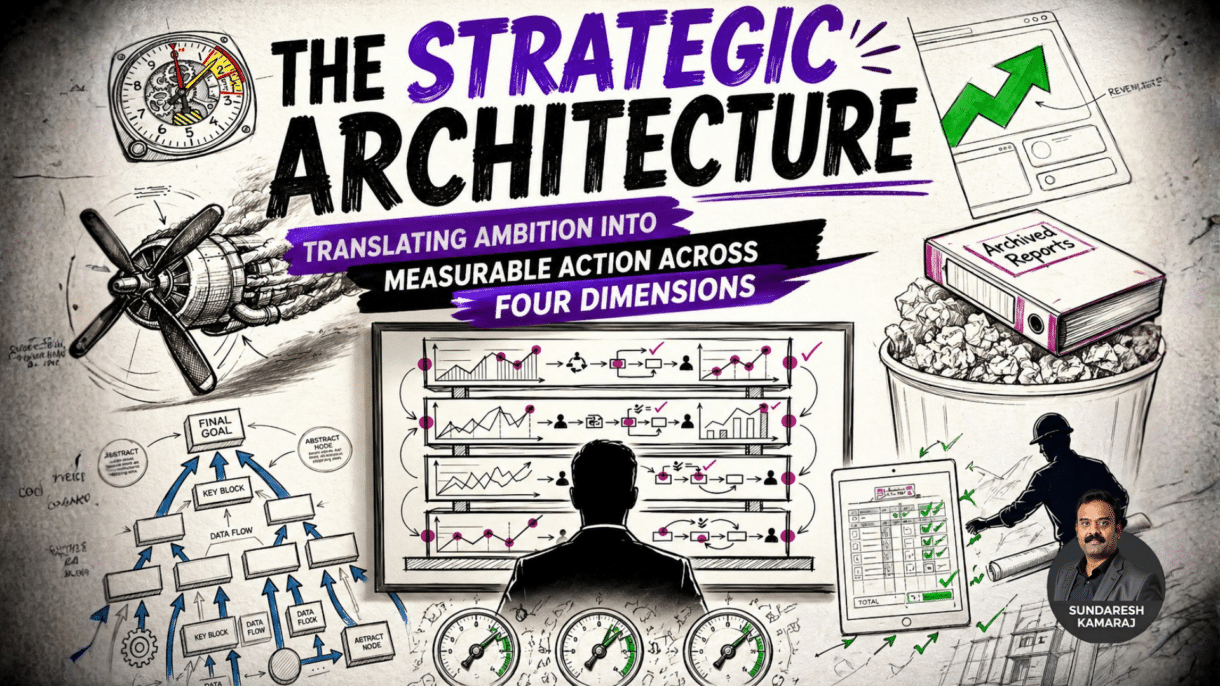

The Balanced Scorecard is the single most influential strategy framework of the last three decades — and for good reason. When your company reports strong quarterly profits but loses key employees, disappoints customers, or falls behind on innovation, you are flying with a broken instrument panel. You see one dial, and you miss the rest.
Developed by Harvard’s Dr. Robert Kaplan and Dr. David Norton in the early 1990s, the Balanced Scorecard transformed how organizations measure success. Instead of relying on financial numbers alone, it guides leaders through four complementary perspectives: Financial, Customer, Internal Processes, and Learning and Growth. Together, these perspectives reveal whether your business is winning today — and whether it is building the muscles to win tomorrow.
This in-depth guide walks you through everything you need to implement the Balanced Scorecard framework with confidence. You will discover the four perspectives in detail, learn how to build a strategy map, follow a ten-step implementation roadmap, and see two case studies that show the framework in action. By the end, you will have the clarity to turn your strategy into measurable, everyday results.
Play the Balanced Scorecard Audio in Tamil
What Is the Balanced Scorecard?
The Balanced Scorecard is a strategic planning and performance management framework that translates an organization’s vision and strategy into a coherent set of objectives and measures across four perspectives. Think of it as both a measurement system and a management system — one that shows you where you stand today while guiding your choices about tomorrow.
At its heart, the Balanced Scorecard answers a deceptively simple question: How do we know our strategy is working? Traditional financial statements tell you what happened last quarter, but they rarely explain why. The Balanced Scorecard bridges that gap by combining lagging indicators (like profit and revenue) with leading indicators (like employee skills and process quality) that actually drive future financial results.
Key Insight
A Balanced Scorecard is not a dashboard full of metrics. It is a carefully chosen set of measures, linked by cause and effect, that tells the story of how your organization creates value — from people, to processes, to customers, to profit.
The 4 Perspectives of the Balanced Scorecard
The four perspectives of the Balanced Scorecard work together like the four legs of a table — remove one, and everything wobbles. Each perspective asks a different strategic question, targets different objectives, and uses different measures. Let’s explore each in depth.
Quick Reference: The Four Perspectives
| Perspective | Strategic Question | Example KPIs |
|---|---|---|
| Financial | How do we look to shareholders? | Revenue, ROI, net margin, cash flow |
| Customer | How do customers see us? | NPS, CSAT, retention rate, market share |
| Internal Processes | What must we excel at? | Cycle time, defect rate, on-time delivery |
| Learning & Growth | Can we keep improving? | Training hours, engagement, skill coverage |
1. The Financial Perspective
The Financial Perspective answers the ultimate shareholder question: Are we delivering value to the owners of the business? For most for-profit organizations, financial outcomes remain the final proof that strategy is working. This perspective focuses on revenue growth, profitability, cost management, and capital efficiency.
However, the Balanced Scorecard does not treat financial measures as drivers — it treats them as outcomes. You cannot simply wish for higher revenue. Revenue grows because customers love you, processes run smoothly, and employees innovate. That is why the financial perspective sits at the top of the strategic chain, representing the destination rather than the engine.
Typical Financial Objectives:
- Revenue Growth — expanding market reach, launching new products, or entering new segments.
- Profitability — improving gross and net margins through pricing, mix, and cost control.
- Cost Management — reducing waste, streamlining supply chains, and automating repetitive work.
- Asset Utilization — improving return on invested capital and working capital efficiency.
2. The Customer Perspective
The Customer Perspective forces leaders to step outside their internal view and see the business through the eyes of the market. It covers four critical areas: customer acquisition, retention, satisfaction, and profitability. Done well, it defines the target segments and the specific value proposition offered to each.
A common trap is to confuse this perspective with marketing metrics alone. Customer experience is much broader — it includes product quality, service responsiveness, brand perception, and the total value customers receive compared with alternatives.
Typical Customer Objectives:
- Customer Satisfaction — ensuring interactions meet or exceed expectations (measured via CSAT or NPS).
- Customer Retention — reducing churn, increasing repeat purchases, and deepening relationships.
- Customer Acquisition — attracting new customers efficiently through targeted campaigns and referrals.
- Market Share — growing the share of spend within chosen segments relative to competitors.
3. The Internal Processes Perspective
The Internal Processes Perspective focuses on the operational capabilities that deliver the customer value proposition. It asks: Which processes must we excel at to satisfy our customers and shareholders? These processes generally fall into four categories — operations, customer management, innovation, and compliance.
The distinctive feature of this perspective is that it encourages leaders to design new processes at which the organization must excel, not merely to measure existing activities. A company competing on speed might introduce an expedited-fulfillment process, while one competing on innovation might build a structured idea-to-market pipeline.
Typical Process Objectives:
- Operational Excellence — improving quality, reducing defects, and shortening cycle times.
- Customer Management — acquiring, retaining, and growing target customers through tailored processes.
- Innovation — developing new products, services, and business models ahead of demand.
- Compliance & Sustainability — meeting regulatory, environmental, and social responsibility commitments.
4. The Learning and Growth Perspective
The Learning and Growth Perspective — sometimes called the People Perspective — focuses on the intangible assets that fuel every other part of the scorecard: human capital, information capital, and organizational capital. It answers: Are we building the capabilities we will need to sustain performance in the future?
This perspective is the most neglected in practice because returns appear in the long term. Yet it is arguably the most important. A skilled, engaged workforce supported by strong systems and a healthy culture can consistently improve processes, delight customers, and generate financial results. No amount of marketing can compensate for disengaged employees.
Typical Learning & Growth Objectives:
- Human Capital — closing skill gaps, building leadership pipelines, and investing in training.
- Information Capital — deploying technology, data platforms, and digital tools that support decisions.
- Organizational Capital — shaping culture, values, teamwork, and knowledge sharing for execution.
- Employee Engagement — measuring and improving motivation, satisfaction, and retention.
Why the Balanced Scorecard Still Dominates Strategy
More than three decades after its invention, the Balanced Scorecard remains the world’s most widely adopted strategy framework. It has stood the test of time because it solves three enduring business problems that no amount of digital transformation can eliminate.

01
It Balances Short-Term Results with Long-Term Capability
Most measurement systems reward quarterly performance at the expense of long-term health. The Balanced Scorecard forces leaders to invest in people, processes, and innovation — even when markets demand immediate results.

02
It Aligns Diverse Teams Around a Shared Strategy
When every department tracks its own metrics, strategy becomes a Tower of Babel. The Balanced Scorecard gives leaders a common language, so finance, operations, and HR discuss the same priorities in the same meetings.

03
It Translates Vision Into Measurable Action
Mission statements inspire but rarely guide daily decisions. The Balanced Scorecard converts abstract ambition into concrete objectives, KPIs, targets, and initiatives — the ingredients of real execution.
The Strategy Map: Visualizing Cause and Effect
A Balanced Scorecard is most powerful when paired with a Strategy Map — a one-page visual representation of how objectives across the four perspectives cause and reinforce one another. A well-constructed strategy map reads like a logical argument.
Improving employee skills (Learning and Growth) enables faster problem resolution (Internal Processes). Faster resolution increases customer satisfaction (Customer). Happier customers drive revenue growth (Financial). This cause-and-effect chain is the central contribution of the Balanced Scorecard to modern management thinking.
THE GOLDEN RULE OF STRATEGY MAPS
If you cannot connect an objective to any other objective with a clear cause-and-effect arrow, that objective probably does not belong on your scorecard. Every element should be part of the value-creation story.
Step-by-Step Guide to Building a Balanced Scorecard
Building a Balanced Scorecard is not an overnight exercise. It is a structured journey that begins with strategy clarity and ends with a rhythm of review. The following ten steps have been refined through thousands of successful implementations worldwide.

Step 1: Clarify the Vision and Strategy
Before measuring anything, the leadership team must agree on where the organization is going. Review existing mission, vision, and strategy statements. If they are vague, sharpen them first. Ask: What does winning look like in three to five years?
Pro Tip: Run a facilitated workshop to surface assumptions. Disagreement at the strategy stage is far cheaper than disagreement at execution.
Step 2: Identify Strategic Themes
Translate your strategy into three to five strategic themes — broad priorities like Operational Excellence, Customer Intimacy, or Innovation Leadership. Themes bridge the gap between abstract vision and specific objectives.
Common Mistake: Choosing too many themes. If everything is a priority, nothing is.
Step 3: Define Objectives for Each Perspective
For each perspective, articulate three to five objectives that support your themes. Objectives should be short, action-oriented statements like Increase customer retention or Build data analytics capability.
Best Practice: Use verbs that imply movement — increase, reduce, build, improve — so objectives feel dynamic.
Step 4: Construct the Strategy Map
Arrange objectives on a single page with the four perspectives stacked vertically — Financial at the top, Learning and Growth at the bottom. Draw arrows showing how lower perspectives drive outcomes in higher ones.
Pro Tip: If an objective cannot be linked with a cause-and-effect arrow, reconsider whether it belongs on the scorecard.
Step 5: Select Key Performance Indicators (KPIs)
For each objective, choose one or two measures. Use a mix of lagging indicators (outcomes) and leading indicators (drivers) so the scorecard tells you what has happened and what is likely to happen next.
Common Mistake: Measuring what is easy rather than what matters. Resist copying generic KPIs from templates.
Step 6: Set Targets
For each KPI, define a realistic but ambitious target and a target date. Good targets are stretch goals — demanding enough to drive focus, but not so unrealistic that they demotivate teams.
Pro Tip: Set targets at multiple horizons — annual, quarterly, and monthly — so progress can be corrected in time.
Step 7: Define Strategic Initiatives
For each objective, determine the projects and programs that will close the performance gap. Initiatives are the action programs that turn targets into reality. Assign owners, budgets, and timelines to every one.
Best Practice: Rank initiatives by strategic impact and fund the highest-impact ones first.
Step 8: Cascade the Scorecard
Translate the corporate scorecard into department-level and team-level versions. Each should stay aligned with corporate objectives while adapting KPIs to what the team can actually influence.
Common Mistake: Copying the corporate scorecard verbatim to every department. Cascading requires adaptation.
Step 9: Implement Review Rhythms
Establish a disciplined cadence — monthly for operational reviews and quarterly for strategic reviews. The scorecard becomes powerful when it shapes the agenda of senior leadership meetings.
Pro Tip: Focus reviews on learning, not blame. The goal is to understand the data, not to punish missed targets.
Step 10: Refine and Evolve
A Balanced Scorecard is a living tool. As strategy evolves and capabilities mature, objectives and KPIs must evolve with them. Conduct an annual deep review to retire outdated measures and validate alignment.
Best Practice: Treat refinement as a strategic activity, not an administrative one. Executives should lead it.
Balanced Scorecard Implementation Checklist
Use this practical checklist to guide your implementation. Tick items as they are completed and revisit the list periodically to maintain rigor across all four phases.
Preparation Phase
- Executive sponsor identified and fully committed
- Cross-functional Balanced Scorecard team assembled
- Vision, mission, and strategy documents reviewed and refreshed
- Strategic themes agreed (three to five)
- Stakeholder expectations documented and aligned
- Implementation timeline and budget approved
- Communication plan drafted to introduce the framework
Design Phase
- Objectives drafted for each of the four perspectives
- Objectives tested for alignment with strategic themes
- Strategy map created with clear cause-and-effect linkages
- KPIs selected (lagging and leading mix)
- Data sources identified and validated for each KPI
- Targets set with appropriate ambition and realism
- Strategic initiatives scoped, prioritized, and funded
- Owners assigned for every objective, KPI, and initiative
Deployment Phase
- Corporate scorecard approved and published
- Department and team scorecards cascaded
- Performance dashboards built and automated where possible
- Employees briefed on how their work connects to strategy
- Managers trained to run effective scorecard reviews
- Rewards and recognition aligned with scorecard priorities
Review and Improvement Phase
- Monthly operational reviews scheduled and calendared
- Quarterly strategy reviews scheduled with senior leadership
- Review templates and meeting agendas standardized
- Variances analyzed with root-cause discussion, not blame
- Corrective actions assigned with clear deadlines
- Lessons learned documented and shared
- Annual scorecard refresh scheduled and executed
QUALITY CHECK BEFORE LAUNCH
Answer these five questions honestly: Does the strategy map tell a coherent story? Can every employee see where they fit? Do the KPIs measure what truly matters? Are targets ambitious enough to drive change? Has leadership personally committed to a regular review cadence? If any answer is weak, invest more time before full deployment.

Data & Facts: What Research Reveals
The Balanced Scorecard’s endurance is not just anecdotal — decades of management research and industry surveys confirm its impact. Here are the key data points every strategist should know.
Research consistently shows that organizations using a structured strategy framework like the Balanced Scorecard outperform peers on strategy execution and cross-functional alignment. Harvard Business Review named it one of the most influential management ideas of the past seventy-five years — a recognition backed by adoption in thousands of companies, governments, nonprofits, and universities worldwide.
The framework is particularly valued because it reduces the typical gap between strategy formulation and execution, a gap often cited as the reason the majority of well-designed strategies fail to deliver results. By forcing leaders to measure leading indicators alongside lagging ones, it turns strategy from a once-a-year document into a daily operating rhythm.
Real-World Case Studies
Theory is useful, but real decisions come alive in real examples. The following two case studies illustrate how the Balanced Scorecard transforms struggling organizations into market leaders. Names are illustrative but scenarios reflect common patterns seen in real implementations.
| Perspective | Objective | Target |
|---|---|---|
| Financial | Restore operating margin | From 6.2% to 11.0% in 24 months |
| Customer | Top-rated clinic network | Raise NPS from 28 to 60 in 18 months |
| Internal Processes | Same-day appointment availability | Reach 95% in 12 months |
| Learning & Growth | Engaged clinical workforce | Reduce turnover from 18% to under 8% |
The Solution: Over twelve weeks, the leadership team built its first Balanced Scorecard around three themes: Exceptional Patient Experience, Operational Reliability, and Engaged Clinical Teams. The team defined twelve objectives, built a one-page strategy map, and selected just twenty-two KPIs — a deliberate choice to avoid measurement overload. Sample targets included
The Result: Within eighteen months, patient NPS climbed from 28 to 52 (top quartile), same-day slot fill rate rose from 61 percent to 93 percent, and physician turnover dropped from 18 percent to 9 percent. Operating margin expanded from 6.2 percent to 10.4 percent, and revenue grew at twice the prior-year rate. The cause-and-effect chain worked exactly as the strategy map predicted.
The Problem:
Priya owned a small pottery studio called Clay and Craft. For years, she measured success by a single number: monthly revenue. When revenue was strong, she felt successful. When it dipped, she panicked. One month revenue peaked, but her head potter quit. The next month, long-time customers complained about delayed orders. By the third month, revenue had crashed, and Priya could not explain why.
The Solution: A friend introduced her to the Balanced Scorecard. Together they built a simple version for Clay and Craft: Financial (monthly revenue, cash on hand), Customer (repeat orders, complaints, referrals), Internal Processes (order fulfillment time, quality defect rate), and Learning and Growth (team training hours, skill coverage, retention). For the first time, Priya could see her entire business on a single page.
The Result: Within six months, Priya’s customer complaints dropped by seventy percent, repeat orders grew by forty percent, and revenue stabilized while growing steadily. More importantly, Priya replaced anxiety with clarity. Even micro-businesses benefit from balancing perspectives — the Balanced Scorecard framework scales from multinational corporations to family-run studios.
Balanced Scorecard vs Other Strategy Frameworks
How does the Balanced Scorecard compare with other popular strategy tools? Each framework has a role, and the best leaders combine them. Here’s a quick comparison to help you choose the right tool for the right job.
| Framework | Primary Purpose | Best Used For |
|---|---|---|
| Balanced Scorecard | Strategy execution & measurement | Turning vision into daily action |
| SWOT Analysis | Situation assessment | Early-stage strategic diagnosis |
| Porter's Five Forces | Industry analysis | Evaluating competitive intensity |
| PESTLE Analysis | Macro-environment scan | Anticipating external shifts |
| OKRs | Goal-setting cadence | Aligning short-term quarterly focus |
| Business Model Canvas | Business model design | Mapping how value is created |
INTEGRATION TIP
The Balanced Scorecard pairs beautifully with SWOT, PESTLE, and Porter’s Five Forces (for diagnosis) and with OKRs (for quarterly execution). Use SWOT and PESTLE to inform your strategy, then use the Balanced Scorecard to execute it.
Common Mistakes and How to Avoid Them
Even the best framework fails in the wrong hands. Here are the most frequent Balanced Scorecard mistakes — and how to sidestep each one.
- Mistake #1 - Treating the scorecard as a dashboard, not a management system. Metrics without meetings are just decoration.
- Mistake #2 - Measuring too many things. A scorecard with eighty KPIs is noise, not strategy. Aim for fifteen to twenty-five.
- Mistake #3 - Skipping the strategy map. Without cause and effect, you have a list of metrics, not a story of value creation.
- Mistake #4 - Cascading by copy-paste. Every team must adapt KPIs to what they can actually influence.
- Mistake #5 - Ignoring the Learning and Growth perspective. Long-term capability always seems less urgent than short-term results — until it isn't.
- Mistake #6 - Using reviews to punish rather than learn. Blame cultures kill honest data, and dishonest data kills strategy.
Frequently Asked Questions
Below are the most common questions leaders ask about the Balanced Scorecard framework. Answers are structured for both readers and search engines — optimized for voice search and featured snippets.
What is the Balanced Scorecard in simple terms?
The Balanced Scorecard is a strategy framework that measures business performance across four perspectives — Financial, Customer, Internal Processes, and Learning and Growth — so leaders see the full picture of their organization rather than just financial results.
Who invented the Balanced Scorecard?
The Balanced Scorecard was developed in the early 1990s by Dr. Robert S. Kaplan of Harvard Business School and Dr. David P. Norton. Their goal was to help leaders translate strategy into measurable action across financial and non-financial perspectives.
What are the four perspectives of the Balanced Scorecard?
The four perspectives are Financial (shareholder value), Customer (market perception), Internal Processes (operational excellence), and Learning and Growth (people and capabilities). Each perspective asks a different strategic question and uses its own KPIs.
Can small businesses use the Balanced Scorecard?
Absolutely. Small businesses benefit enormously from the Balanced Scorecard because it prevents over-reliance on revenue alone. Even a five-person team can use a simplified scorecard to balance customer experience, processes, people, and finances.
How do you build a Balanced Scorecard?
Start by clarifying your strategy, pick three to five strategic themes, define objectives for each perspective, build a strategy map, select KPIs, set targets, fund initiatives, cascade the scorecard, and review it on a monthly and quarterly cadence.
Is the Balanced Scorecard still relevant in 2026?
Yes. The Balanced Scorecard remains highly relevant in 2026 because it solves problems that technology cannot — aligning diverse teams around shared strategy and balancing short-term results with long-term capability. Thousands of organizations still use it as their primary strategy framework.
What is the difference between a Balanced Scorecard and KPIs?
KPIs are individual metrics, while a Balanced Scorecard is a structured framework that organizes KPIs into four perspectives linked by cause and effect. A scorecard tells a story; KPIs alone are just numbers.
What is a strategy map in the Balanced Scorecard?
A strategy map is a one-page visual that connects objectives across the four perspectives with cause-and-effect arrows. It shows how improvements in people and processes ultimately drive customer and financial outcomes, turning the scorecard into a story of value creation.
Final Thoughts and Your Next Move
The Balanced Scorecard is more than a measurement tool — it is a discipline for turning strategy into daily action. By forcing leaders to see their business across four perspectives, it ends the false debate between financial results and long-term health. Instead, it shows that healthy people, healthy processes, and happy customers are the engines of financial success.
If your organization struggles with misaligned teams, metric overload, or strategies that never reach the front line, the Balanced Scorecard offers a proven path forward. Start small, stay disciplined, and evolve as you learn. The goal is not a perfect scorecard on day one — the goal is a living framework that gets sharper every quarter.
YOUR NEXT STEP
Pick one strategic theme this week. Draft three objectives under each of the four perspectives. Sketch a simple strategy map on a single page. Then share it with your leadership team and invite challenge. That single conversation may be the most valuable hour you spend this quarter.