

Porter's Five Forces: The Complete Guide to Mastering Industry Analysis in 2026
Every great business decision starts with one question: how attractive is this industry, really? If you cannot answer that clearly, every strategy built on top of it will stand on shaky ground.
That is exactly why Porter’s Five Forces remains one of the most powerful strategic frameworks in modern business. Developed by Harvard professor Michael E. Porter in 1979, it has guided Fortune 500 boardrooms, startup pitch decks, and MBA case studies for more than four decades – and in 2026, it is more relevant than ever.
In this complete guide, you will learn what Porter’s Five Forces is, how to apply it in eight clear steps, how to avoid the mistakes that derail most analyses, and how two very different businesses – a regional coffee chain and a neighborhood bakery – used the same framework to protect their margins and unlock growth. Let’s dive in.
Key Takeaway (Read This First)
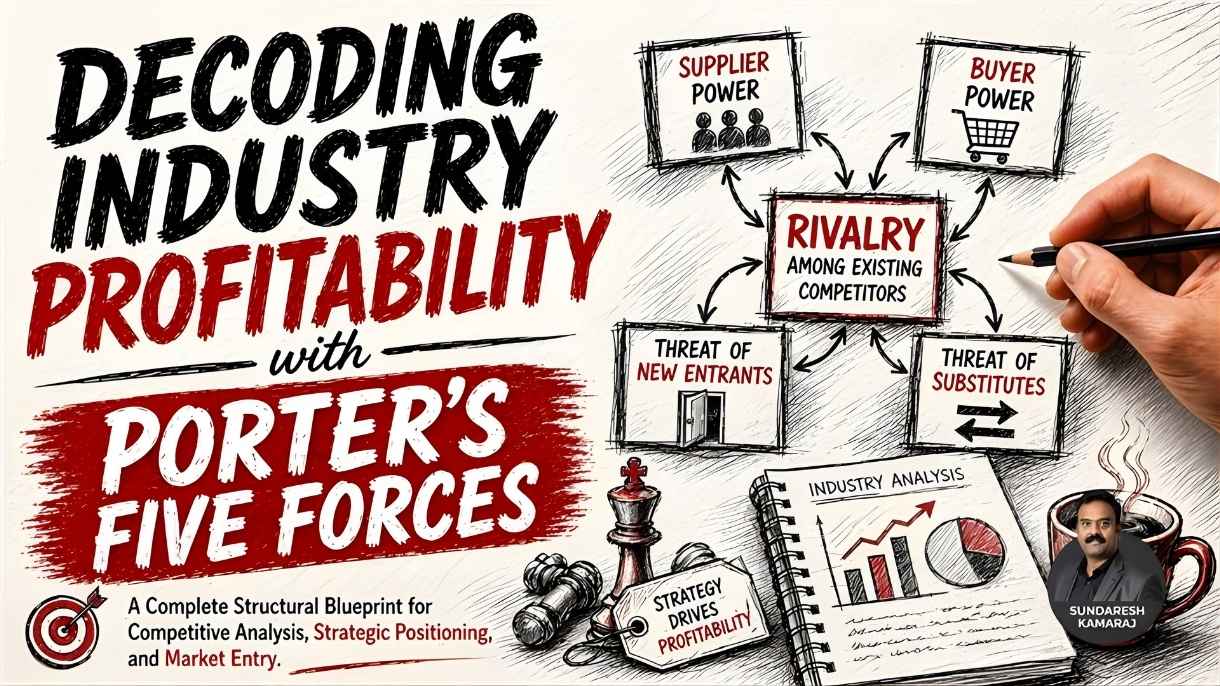
Porter’s Five Forces analyzes the five structural pressures that determine how profitable an industry can be: competitive rivalry, new entrants, supplier power, buyer power, and substitutes. When these forces are weak, profits are sustainable. When they are strong, even great companies struggle.
Play the Porter's Five Forces Audio in Tamil
1. What Is Porter's Five Forces? (Definition & Origin)
Porter’s Five Forces is a strategic analysis framework used to evaluate the competitive intensity and long-term profitability of any industry. Rather than focusing only on direct rivals, it examines five distinct pressures that collectively shape how much money a business in that industry can realistically make.
Michael E. Porter introduced the model in a 1979 Harvard Business Review article titled “How Competitive Forces Shape Strategy.” Since then, it has become a foundational tool for strategic planning, market entry decisions, investment analysis, and competitive benchmarking across industries.
The Five Forces at a Glance
| Force | What It Measures | Indicator of High Power |
|---|---|---|
| Competitive Rivalry | Intensity of competition among existing firms | Many similar-sized players, slow growth, undifferentiated products |
| Threat of New Entrants | Ease with which new players can enter the market | Low capital requirements, weak brands, limited patents |
| Bargaining Power of Suppliers | Influence suppliers exert over price, quality, or terms | Few suppliers, unique inputs, high switching costs |
| Bargaining Power of Buyers | Influence customers exert over price and features | Large buyers, standardized products, low switching costs |
| Threat of Substitutes | Risk that alternatives satisfy the same customer need | Cheaper alternatives, easy switching, shifting preferences |
2. Why Porter's Five Forces Still Matters in 2026
Markets today move faster than ever. Digital disruption, AI automation, shifting customer behavior, and global supply chain volatility have made industry analysis not a luxury – but a survival skill. Here’s why Porter’s Five Forces remains indispensable:
- Two companies with identical capabilities can earn wildly different returns based purely on industry structure.
- It reveals hidden threats - especially substitutes from outside your traditional competitor set.
- It brings structure to decisions that are often made on intuition alone.
- It scales from small businesses to multi-billion-dollar enterprises without modification.
- It pairs naturally with SWOT, PESTLE, and the Business Model Canvas for a full strategic picture.
The Numbers That Prove It
Years in use across global business
0
+
Of MBAprograms teach this framework
0
%
Forces that shape profitability
0
3. The Five Forces Explained (With Real Examples)
Let’s unpack each of the five forces with clear language, practical indicators, and real-world examples you can relate to.
3.1 Competitive Rivalry
Competitive rivalry measures the intensity of competition among existing firms. It is usually the most visible force – price wars, aggressive marketing, frequent product launches, and shrinking margins are all symptoms of high rivalry.
When rivalry runs hot:
- Many competitors of similar size (think: airlines, telecoms).
- Slow or flat industry growth forces players to steal share from each other.
- Products are undifferentiated, so customers choose on price.
- High fixed costs push firms to discount aggressively to keep capacity full.
- High exit barriers trap underperformers in the market.
3.2 Threat of New Entrants
This force examines how easily outsiders can break into the industry. When entry is easy, incumbents face constant pressure to keep prices competitive and invest heavily in defense.
Typical entry barriers include:
- Capital requirements (aerospace, semiconductors).
- Brand loyalty and customer switching costs.
- Economies of scale that favor established players.
- Regulatory approvals, patents, and licensing requirements.
- Access to distribution channels and proprietary technology.
Pharmaceuticals and aerospace have very high entry barriers. In contrast, digital content, online services, and direct-to-consumer e-commerce often have low barriers – which is why these markets are constantly flooded with new brands.
3.3 Bargaining Power of Suppliers
Suppliers provide the inputs your business depends on – raw materials, components, labor, software, or services. When suppliers hold strong bargaining power, they can raise prices, cut quality, or limit supply, directly crushing your margins.
Supplier power rises when:
- There are few suppliers for a critical input.
- Inputs are unique or highly differentiated.
- Switching suppliers is costly, slow, or technically complex.
- The supplier's industry is more concentrated than the buyer's.
It falls when inputs are commoditized, there are many substitutes, or you purchase in large volumes.
3.4 Bargaining Power of Buyers
Buyers are your customers. Strong buyer power forces companies to lower prices, improve quality, add features, or deliver better service – all of which compress profitability.
Buyer power is high when:
- Buyers purchase in large volumes (big retailers, enterprise clients).
- Products are standardized and easily comparable.
- Switching costs are low and alternatives are abundant.
- Buyers have easy access to pricing and market information.
It is lower when products are unique, switching costs are high, or the customer base is fragmented.
3.5 Threat of Substitutes
Substitutes are alternative products or services that meet the same underlying customer need – often from outside your traditional industry. This is where most companies get blindsided.
Consider: video conferencing substitutes for business travel. Streaming services substitute for cable TV. Plant-based products substitute for meat. Ride-sharing substitutes for car ownership. The disruption almost never comes from the competitor set you were watching – it comes from next door.
Substitute threats are high when:
- Alternatives offer comparable (or better) performance at lower cost.
- Switching is fast, cheap, and frictionless.
- Customer preferences are shifting - especially generationally.
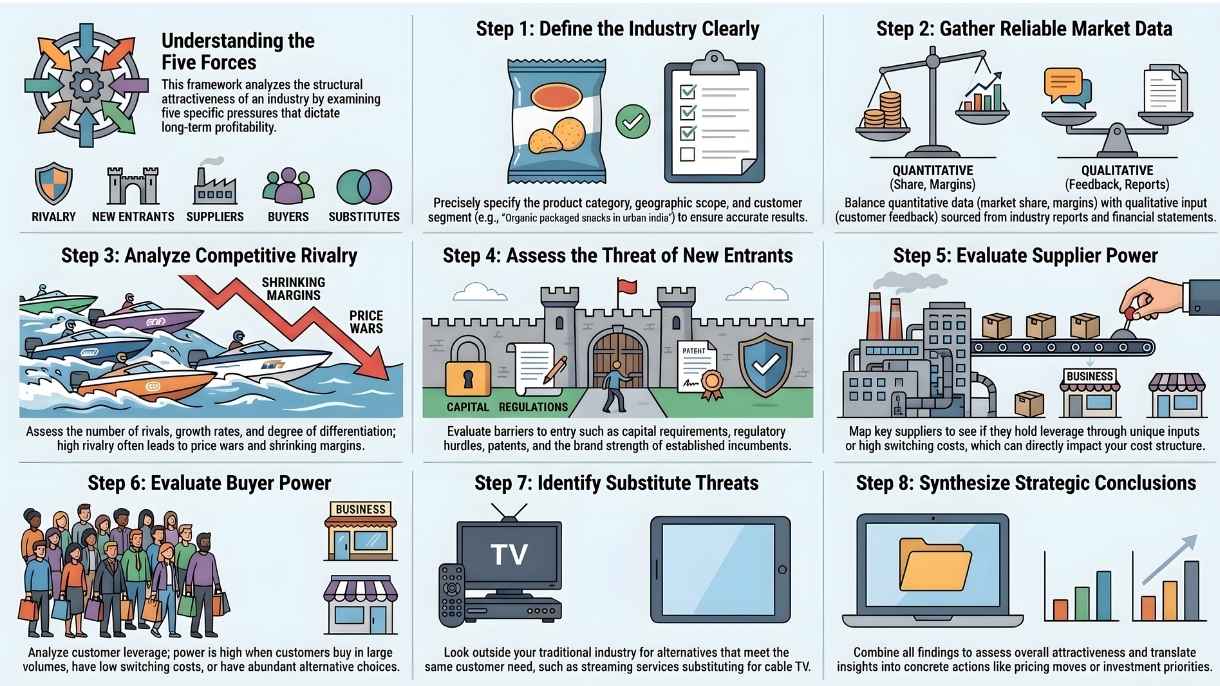
4. How to Apply Porter's Five Forces: 8-Step Guide
Here is the exact process top consultants use to turn the framework into action. Follow each step carefully – skipping any one of them almost always produces misleading conclusions.
Step 1: Define the Industry Clearly
Be precise. Specify product category, geographic scope, and customer segment. Instead of ‘food,’ analyze ‘organic packaged snacks in urban India.’ Poor industry definition is the #1 reason Five Forces analyses fail.
Step 2: Gather Reliable Market Data
Use industry reports, financial filings, customer surveys, competitor websites, and internal sales data. Balance hard numbers (market share, margins, growth) with qualitative input (customer interviews, expert opinions).
Step 3: Analyze Competitive Rivalry
Count the competitors. Measure their relative size, growth rates, and differentiation. Assess the intensity of price competition. Rate the force Low, Medium, or High – backed by evidence, not gut feel.
Step 4: Assess the Threat of New Entrants
Evaluate capital requirements, regulatory hurdles, distribution access, and the brand strength of incumbents. Ask whether technology or digital platforms have recently lowered traditional barriers.
Step 5: Evaluate Supplier Power
Map your key suppliers. Identify their concentration, the availability of substitute inputs, and switching costs. Flag any sole-source dependencies – they are silent risks waiting to surface.
Step 6: Evaluate Buyer Power
Study your customer segments, purchase volumes, price sensitivity, and switching costs. Large enterprise buyers usually exert far more pressure than fragmented individual consumers – plan accordingly.
Step 7: Identify Substitute Threats
Think broadly. Ask ‘what else could the customer do to meet this need?’ rather than ‘who else sells this product?’ Substitutes typically come from adjacent industries or new business models.
Step 8: Synthesize & Draw Strategic Conclusions
Combine your findings. Identify which forces most shape profitability, then translate the insights into concrete moves – pricing changes, investment priorities, partnerships, or exit decisions.
5. Porter's Five Forces Checklist
Use this actionable three-stage checklist to run a rigorous, professional analysis from start to finish.
Preparation Checklist
- Industry boundaries defined (product, geography, customer segment).
- Analysis objectives documented (market entry, strategy review, investment decision).
- Cross-functional team assembled (sales, finance, ops, marketing).
- Data sources identified and accessible.
- Timeline and facilitator agreed.
Execution Checklist
- All five forces analyzed independently.
- Each force rated Low, Medium, or High with supporting evidence.
- Competitors, suppliers, buyers, and substitutes named - not abstract.
- Recent disruptions and industry trends factored in.
- Qualitative insights from customers and experts included.
Review & Action Checklist
- Overall industry attractiveness evaluated.
- Priority forces shaping profitability identified.
- Strategic implications translated into concrete actions.
- Findings shared with leadership and stakeholders.
- Annual review cadence scheduled.
6. Key Facts, Data & Research
Numbers build credibility. Here are the insights every Porter’s Five Forces analyst should keep in mind:
- Published in 1979 in the Harvard Business Review - the article has been cited in thousands of strategy publications since.
- Industry structure accounts for roughly 20–30% of the variation in long-term profitability between companies, according to strategy research.
- Companies that revisit their Five Forces analysis at least annually are more likely to anticipate disruption before it reaches their P&L.
- The framework is industry-agnostic - it has been applied to SaaS, airlines, retail, pharma, banking, hospitality, and even non-profits.
- Modern applications pair Five Forces with real-time competitive intelligence dashboards, turning it from an annual exercise into a living strategic signal.
7. Real-World Case Studies
Theory is helpful. Application is transformational. Here are two case studies – one enterprise, one small business – that show Porter’s Five Forces at work.
Case Study 1 - BrewNest: A Regional Coffee Chain's City Expansion
Business Context
BrewNest, a regional coffee chain with 40 outlets in southern India, was weighing a major expansion into a new tier-1 city. Leadership was considering an investment of approximately INR 15 crore to open 20 stores over 18 months.
The Problem
The target city already had multiple national chains, hundreds of independent cafés, a booming cloud-kitchen beverage scene, and rising real-estate costs. Leadership was uncertain about pricing pressure, loyalty dynamics, and the threat of substitutes like home-brew subscriptions and ready-to-drink coffee.
The Porter's Five Forces Analysis
- Competitive Rivalry - HIGH. Multiple chains and independents fought for the same urban professional segment.
- Threat of New Entrants - MEDIUM. Capital and real-estate requirements deterred small players, but cloud-kitchen models lowered the bar for digital-first brands.
- Supplier Power - LOW-MEDIUM. Coffee beans, dairy, and packaging had multiple suppliers, though specialty bean suppliers had some leverage.
- Buyer Power - HIGH. Customers had abundant choices, low switching costs, and strong price sensitivity driven by app-based discounts.
- Threat of Substitutes - HIGH. Home-brew machines, ready-to-drink coffee, tea chains, and instant coffee all competed for the same daily beverage occasions.
The Strategic Decision & Results
Instead of opening 20 full-format cafés, BrewNest opened 10 flagship cafés in premium locations and 10 smaller kiosk-format outlets in office parks and transit hubs. They launched a region-inspired menu, a personalized loyalty program, and long-term contracts with specialty bean suppliers to lock in pricing.
The Outcome
Within 14 months, BrewNest achieved break-even across 12 of the 20 outlets, captured a 7 percent market share in the target city, and recorded a 22 percent higher average transaction value than competitors. The Five Forces analysis directly shaped the format mix, pricing, and differentiation – and drove the over-performance.
Case Study 2 - Meera's Bakery: The Small Business Story
Meera runs a small neighborhood bakery. Business was steady for years, but her margins were shrinking. She couldn’t figure out why. Her mentor Arjun walked her through the five forces in a single afternoon.
What the Analysis Revealed
Four bakeries within a 10-minute walk (high rivalry). A new bakery under construction nearby (high threat of new entrants). A single supplier for flour and butter (high supplier power). Customers comparing prices and walking out (high buyer power). A food delivery app flooded with cloud-kitchen desserts (high substitute threat).
Meera's Five Moves
She launched a signature product line, started a simple loyalty program, added a second supplier for key ingredients, joined two delivery apps, and raised prices on her differentiated products. Within three months, her average order value rose, customer retention improved, and her margins stabilized.
8. Connecting Porter's Five Forces With Other Frameworks
Porter’s Five Forces is even more powerful when paired with complementary tools. Think of it as the external lens – and combine it with the right partners for a complete strategic picture.
Pair It With These Frameworks
- SWOT Analysis - Use Five Forces insights to populate the Opportunities and Threats quadrants.
- PESTLE Analysis - Five Forces covers the industry; PESTLE covers the broader macro environment. Together they lock down external analysis.
- Value Chain Analysis - Five Forces reveals external pressure; Value Chain shows where internal activities can respond to it.
- BCG Matrix & Ansoff Matrix - Once the industry is clear, these tools help decide where to invest, harvest, or divest.
- Business Model Canvas - Five Forces informs the Customer Segments, Channels, and Key Partners blocks with real competitive evidence.
Connect It to Teams & Workflows
- Marketing: Rivalry and buyer power shape positioning, messaging, and pricing.
- Sales: Buyer power and substitutes help anticipate objections and build stronger value propositions.
- Procurement: Supplier power guides vendor diversification and long-term contracting.
- Product: Substitutes drive innovation priorities and roadmap sequencing.
- Finance & Strategy: Industry attractiveness informs capital allocation and investment decisions.
9. Common Mistakes to Avoid
Even experienced strategists stumble. Dodge these pitfalls and your analysis will land with far more credibility and impact.
- Mistake #1 - Defining the industry too broadly or too narrowly.
- Mistake #2 - Treating the analysis as a one-time exercise rather than an ongoing practice.
- Mistake #3 - Ignoring substitutes from outside the traditional industry.
- Mistake #4 - Confusing high industry growth with high industry profitability.
- Mistake #5 - Relying on intuition without market evidence.
- Mistake #6 - Running the analysis with only one department instead of a cross-functional team.
10. Frequently Asked Questions
Here are the most common questions about Porter’s Five Forces – optimized for featured snippets and voice search.
What are Porter's Five Forces in simple terms?
Porter’s Five Forces is a framework that analyzes five competitive pressures shaping an industry’s profitability: competitive rivalry, threat of new entrants, supplier power, buyer power, and threat of substitutes. When these forces are weak, the industry is attractive; when strong, profits are hard to sustain.
Who created Porter's Five Forces and when?
Harvard Business School professor Michael E. Porter created the framework in 1979, introducing it through a Harvard Business Review article titled “How Competitive Forces Shape Strategy.” It has since become a cornerstone of strategic management worldwide.
Is Porter's Five Forces still relevant in 2026?
Yes. Despite being over 45 years old, Porter’s Five Forces remains highly relevant because it analyzes structural industry dynamics that still determine profitability – regardless of digital disruption, AI, or new business models. It is taught in 90%+ of MBA programs globally.
What is the biggest mistake in a Porter's Five Forces analysis?
The single biggest mistake is defining the industry too broadly or too narrowly. A vague scope produces vague conclusions. Always specify product category, geography, and customer segment before applying the framework.
How is Porter's Five Forces different from SWOT analysis?
Porter’s Five Forces analyzes the external industry environment, while SWOT analyzes both internal (strengths and weaknesses) and external (opportunities and threats) factors. The two are complementary – Five Forces often feeds directly into the Opportunities and Threats sections of a SWOT.
How often should I update my Porter's Five Forces analysis?
At minimum, once a year during strategic planning. For fast-moving industries like tech, fintech, or consumer goods, a quarterly refresh is smarter. Also revisit it any time there is a major market disruption, regulatory change, or new technology wave.
Can small businesses use Porter's Five Forces?
Absolutely. Small businesses benefit enormously from the framework – as shown in Meera’s bakery case study. It helps entrepreneurs see beyond direct competitors, spot hidden threats, and make smarter decisions about pricing, suppliers, and differentiation.
What is the sixth force some people add to Porter's Five Forces?
Some modern analysts add a sixth force: complementors – companies whose products enhance your value proposition (e.g., app developers for smartphones). While Porter’s original model includes only five, the sixth force is a useful extension in ecosystems and platform businesses.
11. Final Thoughts & Next Steps
Porter’s Five Forces isn’t just an academic framework – it is a decision-making system. It forces you to look beyond the competitors in front of you and see the full structure of the industry you’re competing in. That perspective changes everything.
Whether you run a neighborhood bakery like Meera or lead a multi-crore expansion like BrewNest, the framework gives you the clarity to turn competitive pressure into competitive advantage. Markets reward clarity. Porter’s Five Forces delivers it.
Your 3-Step Action Plan
- Run a Porter's Five Forces analysis on your current industry this week using the 8-step guide above.
- Rate each force Low, Medium, or High with evidence - and identify the 1–2 forces most compressing your profitability.
- Translate those insights into 3 specific strategic moves you will execute over the next 90 days.
If you found this guide valuable, share it with a colleague, save it for your next strategy session – and connect with me on LinkedIn for more deep-dive frameworks, SEO-driven content, and real-world business playbooks.