

The Boy at Dawn
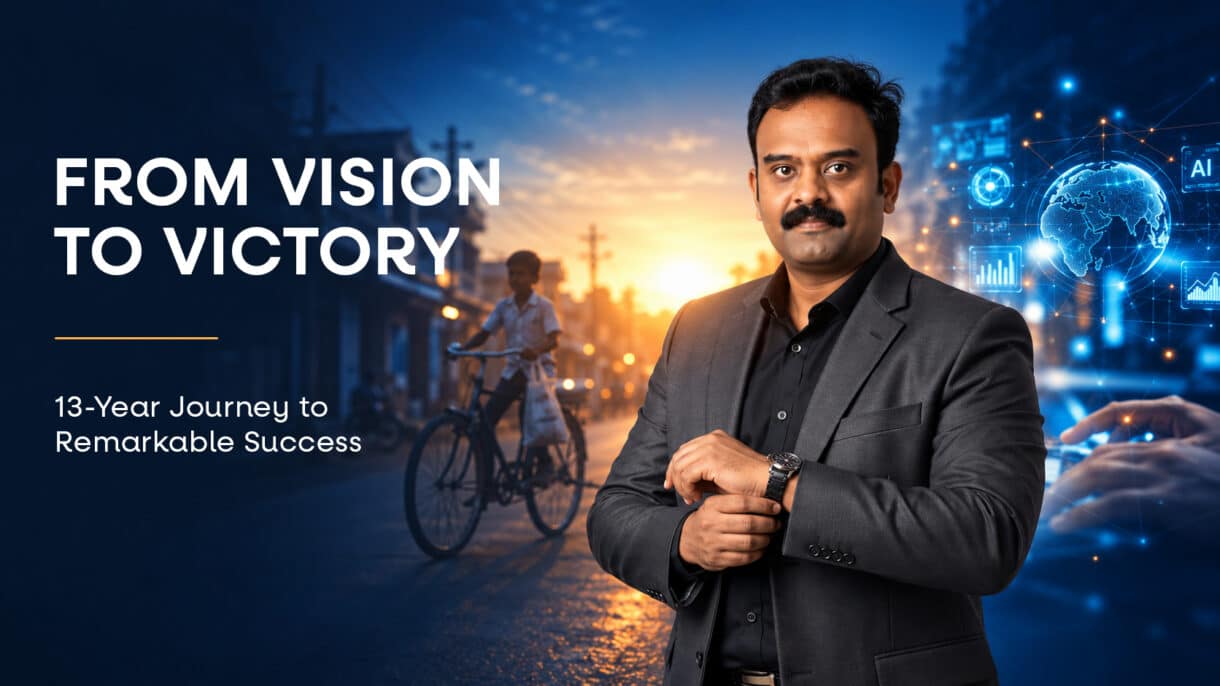
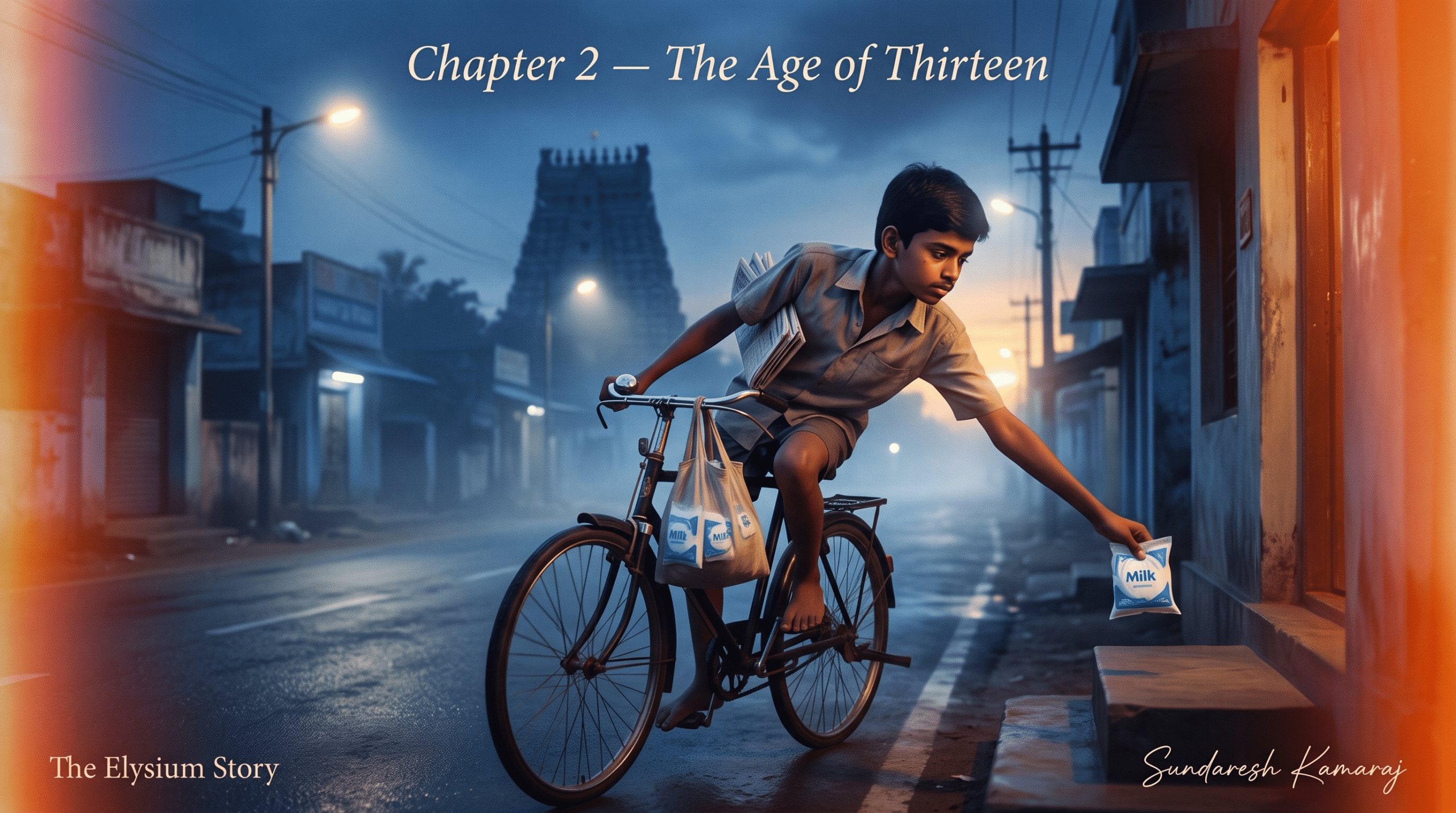
Long before the boardrooms, the flights across continents and the ₹100 crore valuation, there was a thirteen-year-old boy on a bicycle in the grey light before sunrise. A cloth bag heavy with milk packets swung from the handlebar. A bundle of newspapers was tucked under his arm. The streets were still asleep, but he was already at work.
He did not know then that he was building something. He only knew that his family needed help, and that he was old enough to give it. Every doorstep he reached before the school bell was a small promise kept to his mother, his father and himself.
This is the story of that boy — Sundaresh Kamaraj — and of the long, patient, often painful road that turned a village child into the founder of Elysium Groups: six private limited companies, one foundation, sixteen entities, 300+ people, and more than three lakh lives touched across 130+ countries.
It is not a story of luck. It is a story of early mornings, of counting coins at a shop counter under a dim bulb, of an engineer who walked away from a secure job with just ₹20,000 in his pocket — and of a dream that refused to stay small.
I did not start with money.
I started with responsibility.
Responsibility taught me everything money never could.
Chapter 1: Roots in the Soil
Sundaresh Kamaraj was born on 10 July 1977 in Madurai — the ancient temple city of Tamil Nadu, where history is carved into stone and resilience runs in the blood of its people.
His family came from a very small village. Their roots were in agriculture, in land that gave only as much as it was given in sweat. Monsoons decided whether a year would be kind or cruel. Life was measured in harvests, in debts, and in the quiet dignity of people who worked hard and asked for little.
They were a lower-middle-class family. There was love in abundance, but never money to spare. Every rupee had a purpose before it arrived.
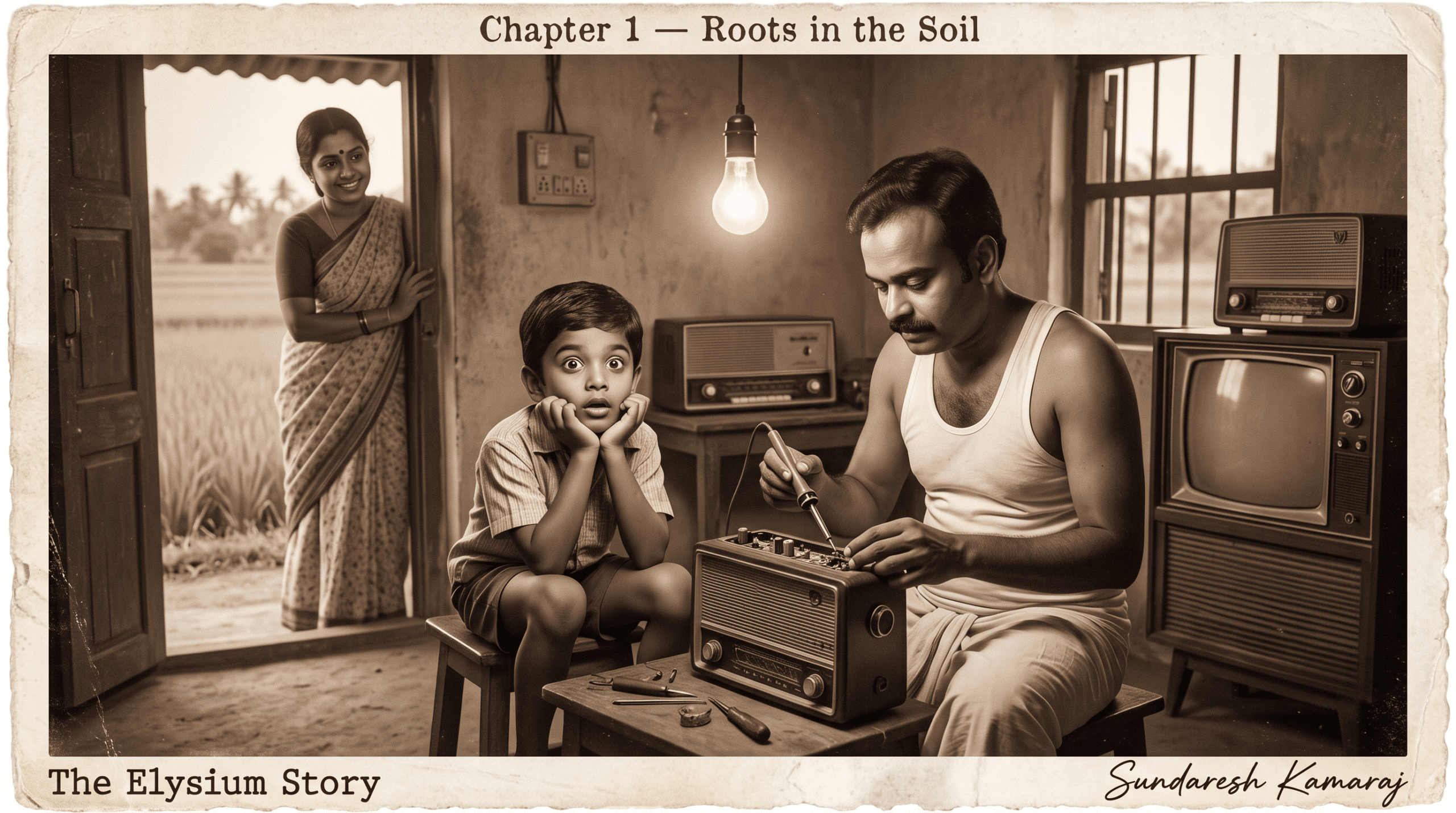
His father was a Radio and TV mechanic. In a small room filled with the smell of solder and warm valves, he brought silent radios back to life and made flickering television screens clear again. Young Sundaresh would sit beside him, watching his hands move through tangled wires with patience and precision.
He did not realise it then, but those evenings were his first classroom in electronics. A broken circuit, his father showed him, is never hopeless — you trace it, you find the fault, you fix it. It was a lesson he would one day apply not just to machines, but to businesses and to life itself.
A Debt of Gratitude: The Gifts of Appa and Amma
Every great building rests on a foundation no one sees. For Sundaresh, that foundation was his father and mother.
They had no degrees to hand down, no property to divide, no bank balance to leave behind. Yet they gave him something no inheritance could ever match. They never sat him down to lecture him on success — they simply lived it, quietly, every single day, in a small home where every rupee was counted and every hour was precious. And a watchful little boy absorbed it all.
Today, when he looks back across every milestone, he knows with complete certainty: none of it would exist without them. These are the gifts they placed in his hands.
The gift of technical work : Beside his father’s repair bench, surrounded by the glow of warm valves and the smell of solder, he learned that skilled hands are a blessing. His father taught him to respect a problem, to be patient with it, and to feel pride in work done with one’s own hands. Appa, every circuit I ever designed began at your bench.
The gift of discipline : Long before the rest of the world woke, his parents were already at work. From them he learned to rise early, to finish what you start, and to do the right thing even when no one is watching.
The gift of money wisdom : He watched his parents stretch a small income across a whole month, and never once let their children feel how thin it was. That silent sacrifice taught him to honour every rupee, to save before spending, and to never waste what was earned with sweat.
The gift of never giving up : Hardships came again and again. His parents never complained, never surrendered — they simply stood up and kept walking. In their home, giving up was not a word anyone used.
The gift of faith : “One day, you must win” — Even in the hardest seasons, when there was little to hope with, they believed their children would rise. They believed in him long before the world did. That faith became the fire that has never gone out.
The gift of truth : “Hard work never fails” — The simplest lesson, and the most powerful. He has tested it for more than 25 years of building Elysium, and it has never once been proven wrong.
Whenever success arrives — an award, a milestone, a proud moment on a global stage — his heart turns first to the two people who made it possible. Every achievement in this story carries their fingerprints. Every door he opens for a young person today is a way of saying thank you to them.
"Appa, Amma — you could not give me wealth, so you gave me something far greater: the character to create it. Everything I have built is simply my thank-you to you. I owe you my every step."
Chapter 2: The Age of Thirteen
At thirteen, most children think about games, friends and the next school holiday. Sundaresh was studying in 8th Standard at a Government High School when he understood that his family’s situation needed more than a child’s sympathy. It needed his hands.
So he began delivering milk and newspapers to houses — before school and after school.
His day started when the rest of the town was still dreaming. By 5:00 in the morning he was out, collecting the milk packets, sorting papers, and pedalling from street to street. Rain soaked his shirt. Winter mornings bit at his fingers. Stray dogs chased his bicycle. Still, the milk had to arrive fresh and the paper had to be on the doorstep before the family inside woke up.
Then he would rush home, wash, put on his school uniform and run to class — often tired, sometimes hungry, but never absent. After school, while classmates went to play, he went back to work.
There were moments of quiet pain. Seeing friends with new clothes and free evenings. Knowing that his own childhood was being traded, one delivery at a time, for his family’s stability. But he never saw it as sacrifice. He saw it as his share of the load.
The small wages he earned went straight into the household. Every coin he brought home was a message to his parents: you are not alone in this.
Those dark mornings taught him three things he still carries today:

Discipline
the work does not wait for your mood.

Reliability
customers trust the one who shows up, every single day.

Dignity of labour
no honest work is
small.
“At thirteen, I learned that the sun rises for everyone — but it rewards the one who is already awake.”
Chapter 3: The Counter in Front of Home
Delivering milk was only the beginning. As the years passed, the boy on the bicycle became a young businessman — without ever having heard the word entrepreneur.
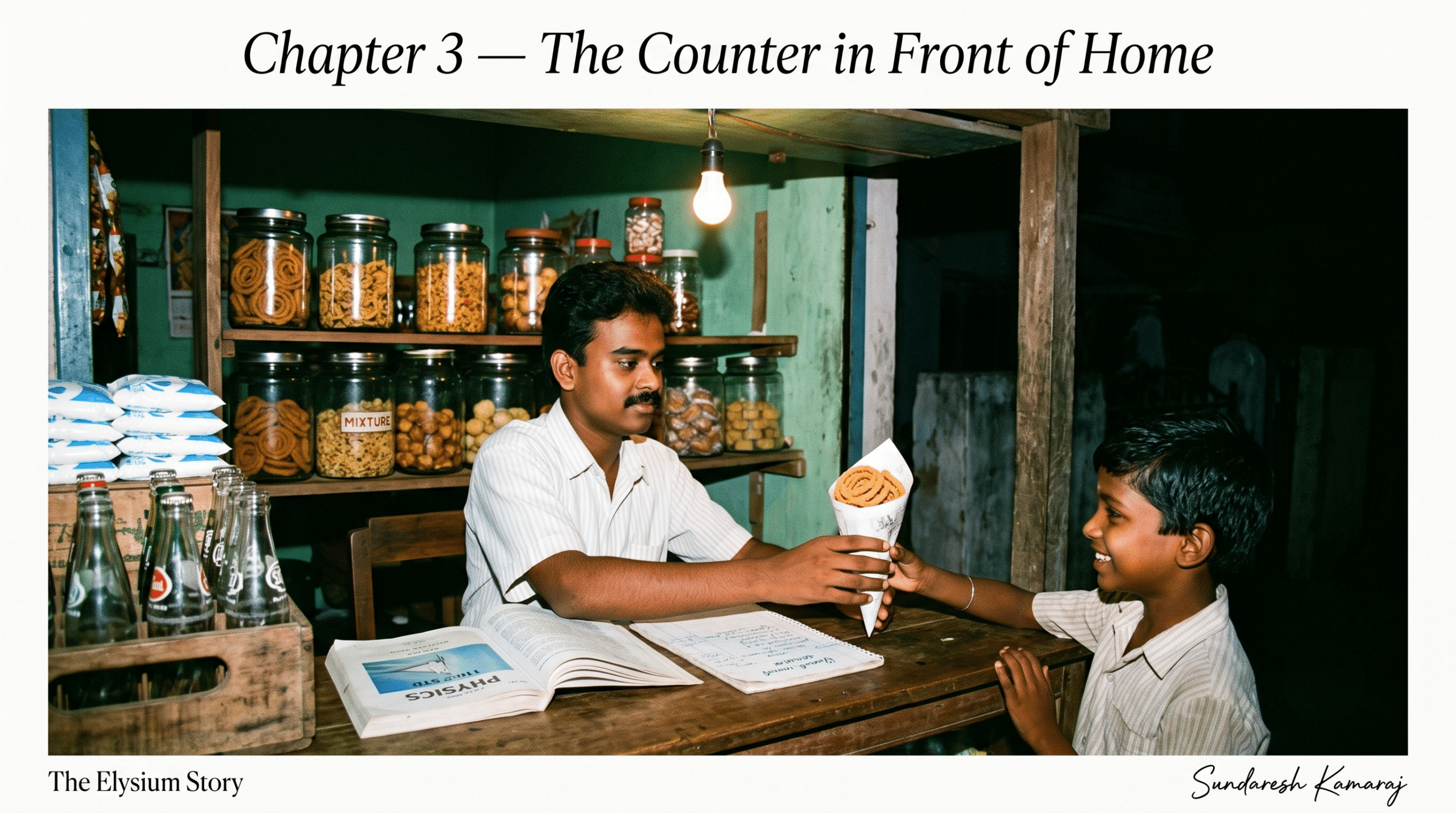
In front of his home, Sundaresh started a small petty shop selling Indian savouries, sweets and cool drinks, and became a milk distributor for the neighbourhood. Glass jars of murukku, mixture and sweets lined the little shelf, and bottles of cool drinks waited for the afternoon heat. He ran it in every spare hour his studies allowed — early mornings, late evenings, weekends and holidays — all the way through his school years and into college.
That little counter became his first business school. There he learned:
Customer relationships
remembering which child loved which sweet, who wanted their cool drink chilled, who needed credit till month-end, and who just needed a kind word.
Cash flow
how to buy stock without starving the household, and how to recover dues without losing goodwill.
Inventory and supply
stocking savouries and sweets in just the right quantity, so nothing went stale and nothing ran out.
Trust
a neighbourhood shop survives only if people believe in the person behind the counter.
He would sit at that counter with a textbook open on one side and the account notebook on the other. A customer would come; he would close the book, pack a paper cone of murukku, open a cool drink, count the change, and return to his equations. His homework was often finished by the light of the shop’s single bulb, long after the street had gone quiet. Friends went to the cinema. He stayed behind the counter. Relatives offered pity. He offered service. And slowly, the shop that began out of necessity became a symbol of the family’s quiet determination to rise.
What others saw as a small shop, he later recognised as the true beginning of Elysium. Every principle he would one day teach to thousands of startups — serve the customer, respect the rupee, never break trust — was first practised at that humble counter in front of his home.
“My first MBA was a small petty shop. My first investors were my neighbours. My first profit was their trust.”
Chapter 4: Circuits and Classrooms
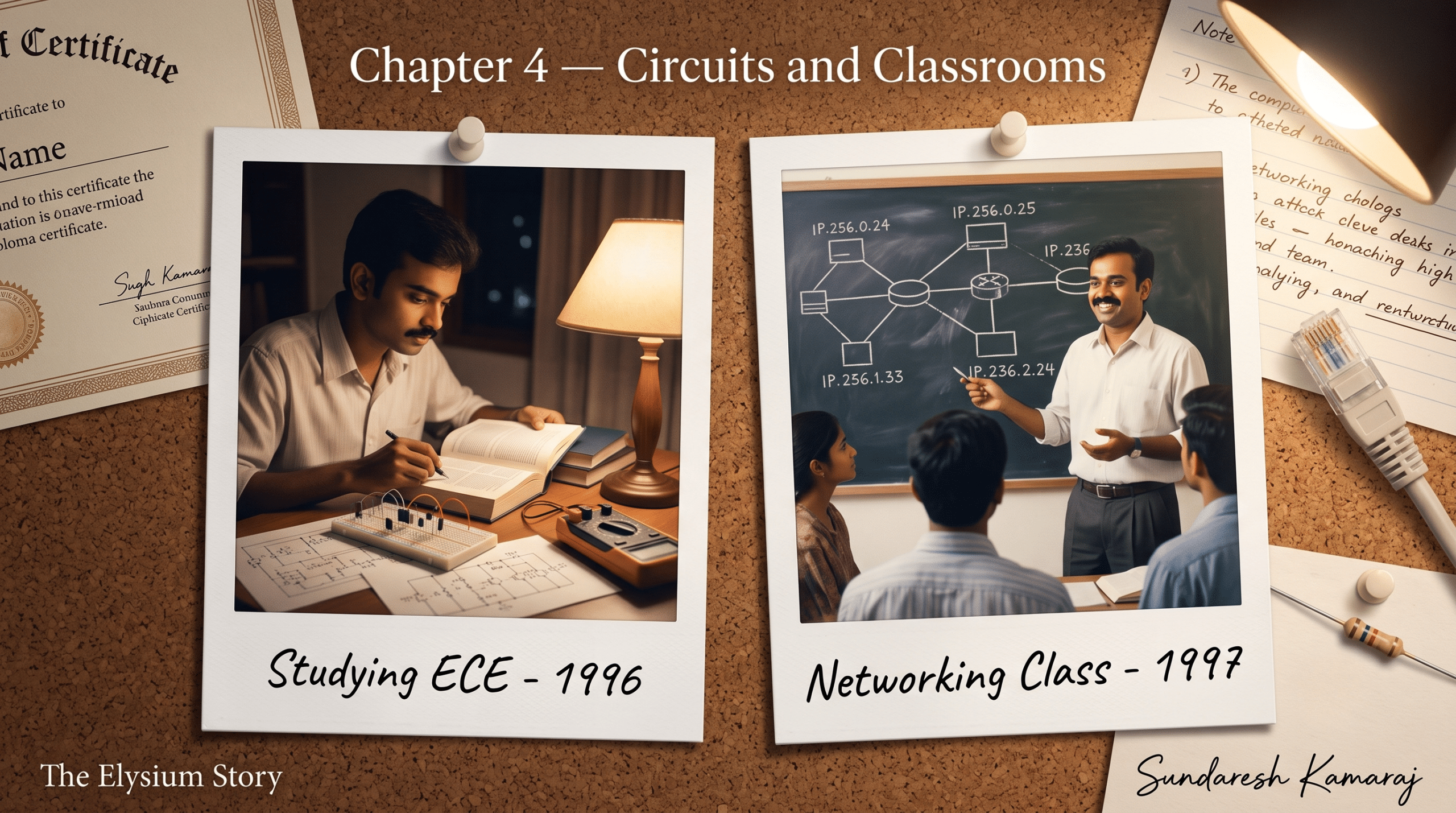
The radio repair bench at home had planted a seed. When it came time to choose a path of study, Sundaresh chose the one that felt like home — electronics.
He completed his Diploma in Electronics and Communication Engineering, and then earned his Bachelor of Engineering (B.E.) in Electronics and Communication Engineering (ECE) through part-time study — because stopping work to study full-time was never an option for his family.
These were not easy years. Studying part-time meant studying after everything else was done. The shop still needed him. The milk still had to be distributed. Fees had to be arranged, books had to be bought or borrowed, and travel to college had to fit around the business. While others studied full-time, he studied in the gaps between customers, late at night and on weekends. Throughout his part-time B.E. years, he also took up a part-time job as a Computer Networking Tutor. After classes, he taught networking concepts to other students — explaining protocols, cabling, IP addressing and how computers talk to each other. The fees he earned helped pay for his own education and eased the burden at home.
Tutoring gave him something even more valuable than money. Every time he explained a difficult concept until a student’s face lit up with understanding, he felt a quiet joy he would never forget. Without knowing it, he was discovering his lifelong calling: teaching. The seed of Elysium’s education mission was planted right there, in those after-class tutoring sessions. There were exams written after sleepless nights. There were days he wondered whether the struggle was worth it. But every time he looked at his father’s worn tools and his mother’s tired eyes, the answer was the same: yes.
Engineering gave him more than a degree. It gave him a way of thinking — breaking big problems into small signals, finding the fault in a system, and designing something better. The boy who once watched his father fix radios now understood why they worked.
The day he held his engineering degree, it was not just his achievement. It belonged to a family that had never had an engineer before. It belonged to every early morning, every counted coin, every sacrifice made quietly at home.
Chapter 5: The Corporate Years
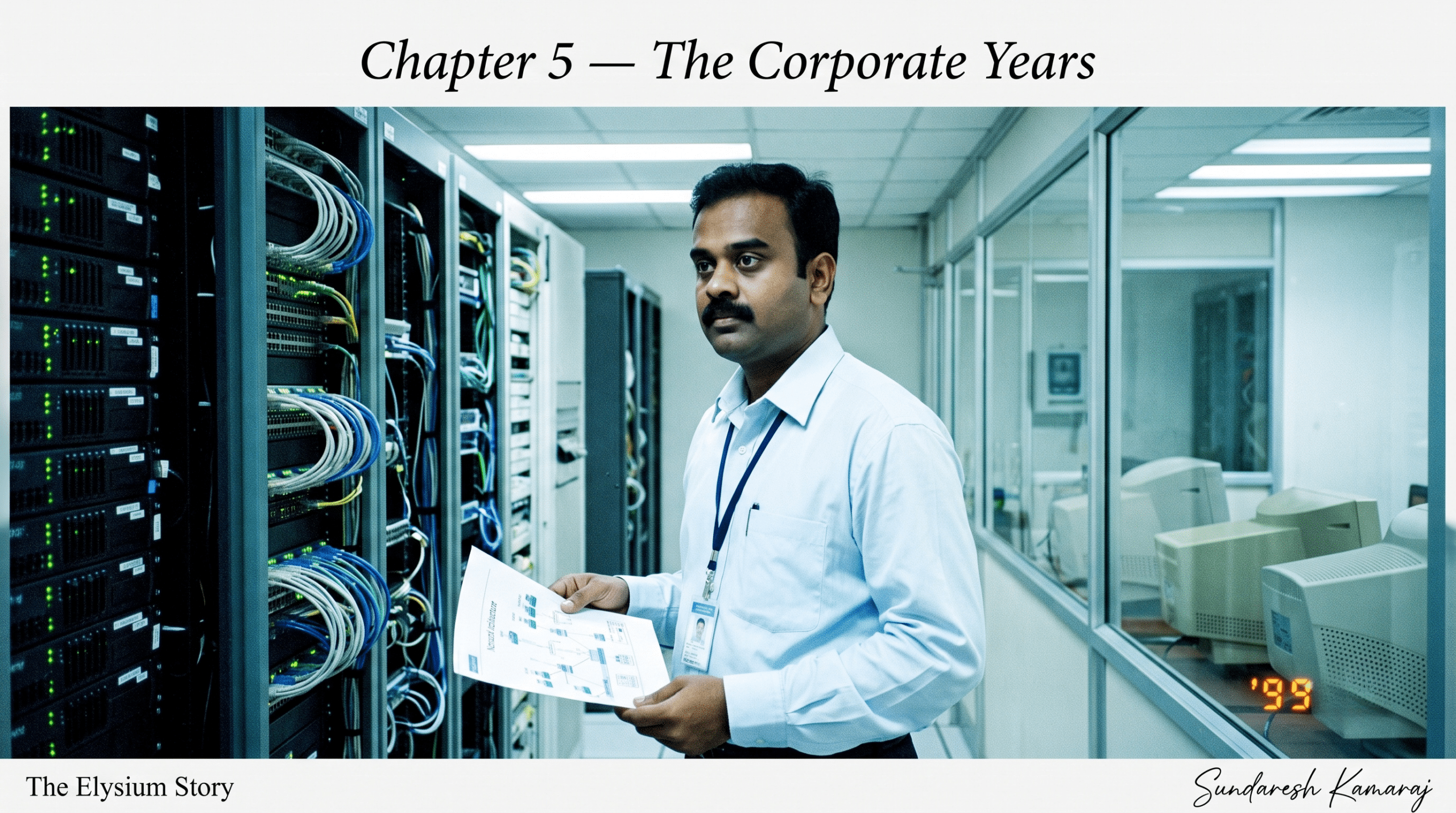
With his engineering education in hand, Sundaresh stepped into the world of technology as a Computer Network Engineer. For a young man from a small village, walking into a corporate office for the first time felt like entering another universe — air-conditioned rooms, humming servers, and colleagues from every corner of the country.
Before he left, there was one last, emotional task. He handed over his petty shop and his milk distributorship to another person. For years, that little counter and that delivery route had been his classroom, his income and his family’s lifeline
On the final day, he stood behind the counter one more time, looking at the jars of savouries and sweets and the neighbours who had trusted him since he was a boy. Handing over the keys felt like saying goodbye to a part of his childhood. But he knew the business was going into good hands — and that he was carrying its lessons with him into a much bigger world.
His corporate years were short, but powerful. His discipline from the milk-delivery years and his problem-solving instinct from the repair bench set him apart quickly. He worked for brief stints at Pioneer Groups and at the IBM Corporation, in Network Architecture and Security — long enough to learn how the world’s best organisations worked, and long enough to realise his real work lay elsewhere.
At IBM, he saw technology at a global scale — how networks connected companies across continents, how security protected the trust of millions of users, and how world-class organisations planned, documented and delivered. He absorbed everything: process, precision, professionalism.
For his family, this was the moment they had prayed for. A stable salary. A respected company name. Security at last. Relatives spoke of him with pride. His parents could finally breathe a little easier.
And yet, deep inside, something was restless.
He would look at the talented young people back home in Madurai and the surrounding villages — bright, hungry, capable — and see that they had no access to the kind of technology education and exposure he had fought so hard to reach. The gap between rural talent and global opportunity troubled him more than any network fault ever could.
He began to ask himself a dangerous question: What if, instead of working for a great company, I built one — at home, for my own people?
Chapter 6: The ₹20,000 Decision
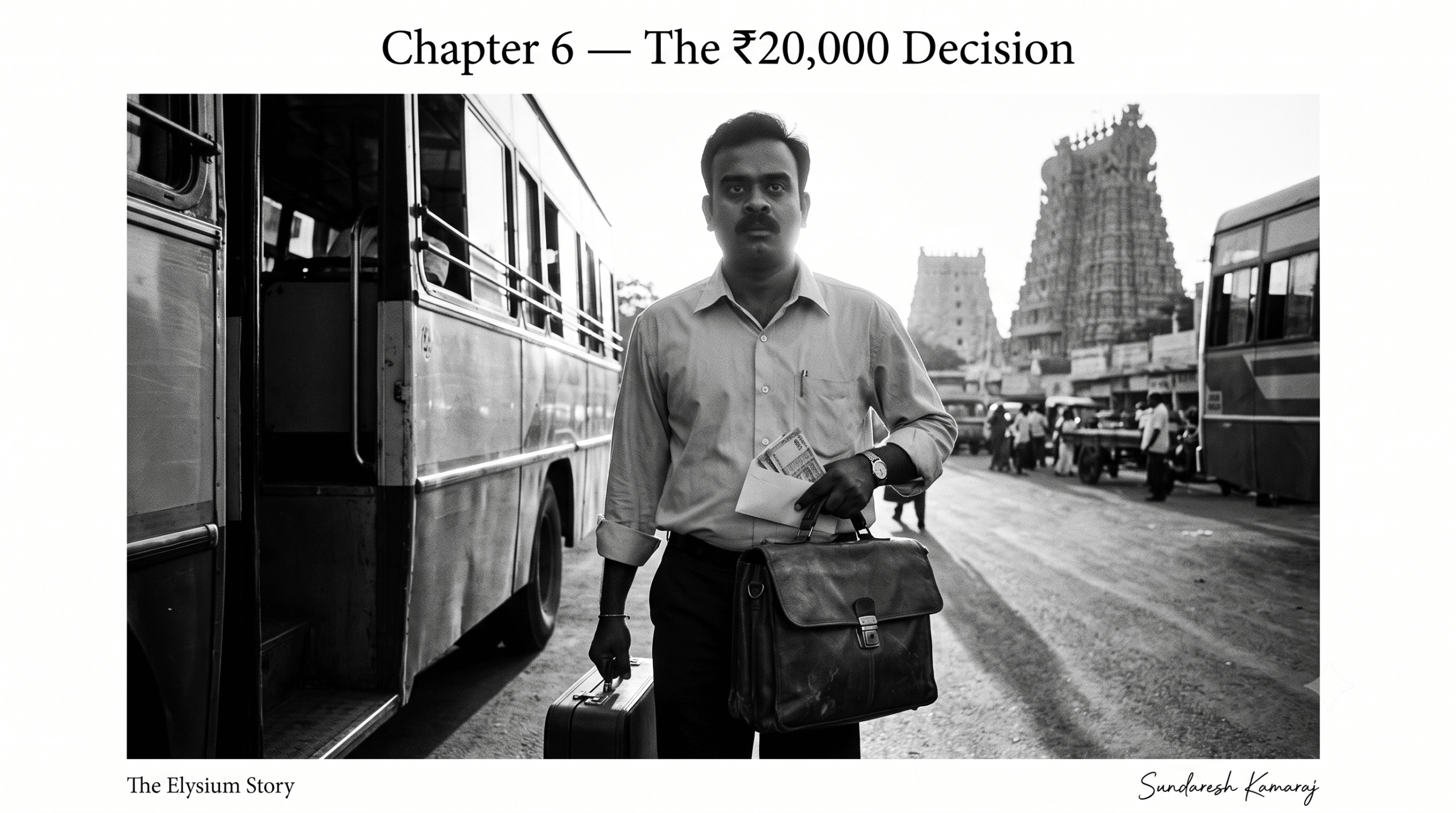
In 1999, Sundaresh made the decision that would define his life. He resigned from his secure corporate career and came back to his native place.
He carried with him just ₹20,000.
No investors. No business partners. No office. No safety net. Only his skills, his experience, and an unshakable belief that world-class technology services and education could be built from Madurai — not only from Bengaluru, Chennai or Silicon Valley.
Not everyone understood. Some called it brave. Many called it foolish.
Why leave IBM to start from zero?
What if it fails?
What will people say?
These questions came from relatives, friends and, on the hardest nights, from within himself.
But Sundaresh had faced harder mornings at thirteen. He had already learned that fear is simply the feeling of standing at the start of something important.
As a solopreneur, he founded Elysium Technologies.
He was the founder, the engineer, the salesperson, the trainer, the accountant and the office boy — all at once. He wrote proposals by night and met clients by day. He knocked on doors of colleges and businesses the same way he once knocked on doors with milk and newspapers — patiently, reliably, one door at a time.
That ₹20,000 was not capital. It was courage, converted into currency.
“I did not quit a job. I chose a mission. The salary was comfortable, but the dream was calling louder.”
Chapter 7: Building Elysium, Brick by Brick
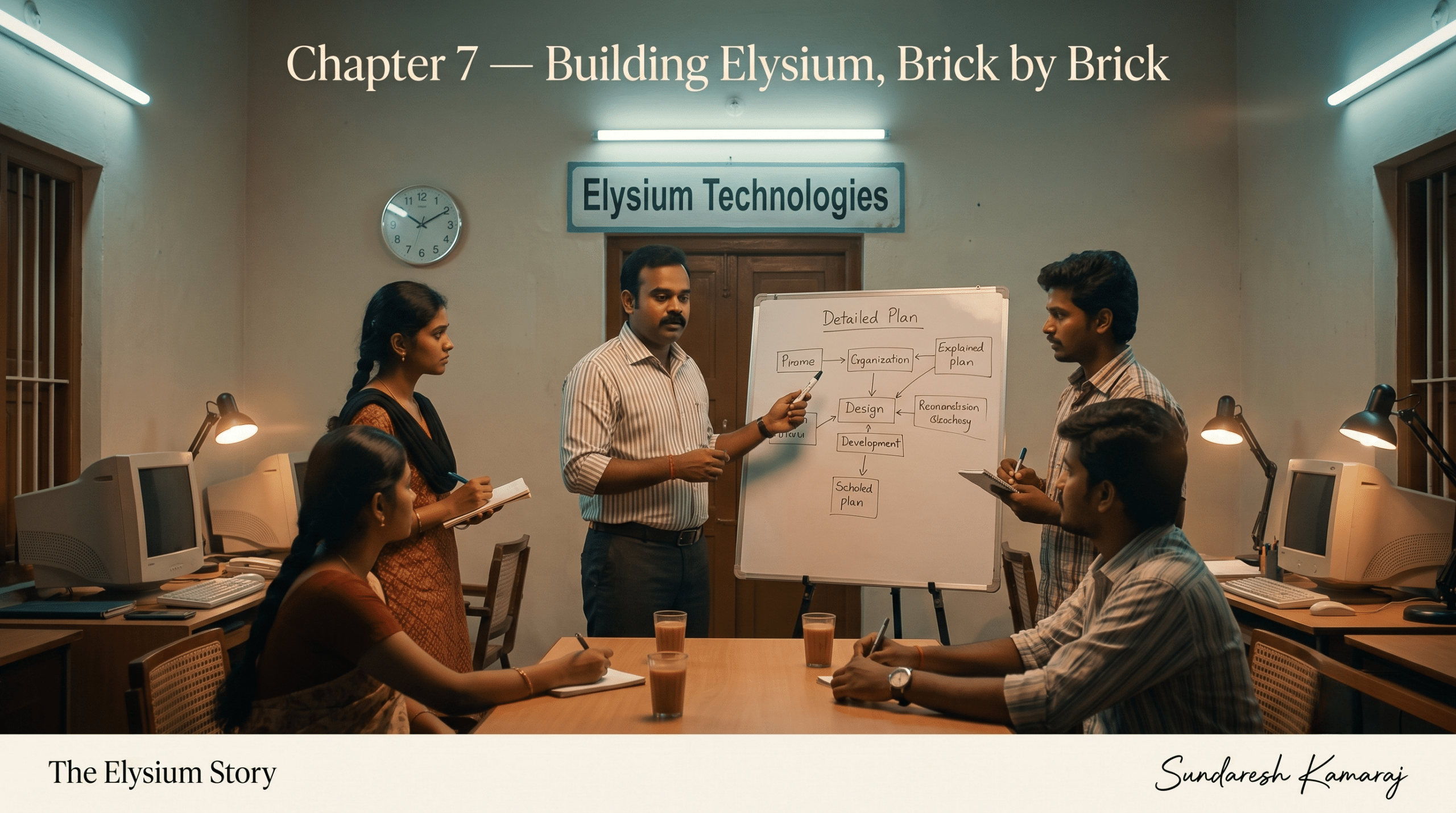
The early years of Elysium were a test of endurance. There were months when revenue barely covered rent. There were clients who delayed payments and projects that demanded all night. There were moments when the ₹20,000 felt very, very small.
But the lessons of the petty shop held firm. He guarded every rupee. He treated every customer as a lifelong relationship. He delivered what he promised, on time, every time. Slowly, word spread: there is someone in Madurai who does it properly.
The first employee joined. Then the second. Then a small team that believed in the founder as much as the founder believed in them. Many of them came from backgrounds just like his — rural, first-generation, full of potential but short of opportunity. In Elysium, they found both.
One vertical became many. Technology services grew alongside education. Training grew alongside research support. Each new entity was born from a real need he saw on the ground:
- Students who needed industry-ready IT skills.
- College learners who needed real project experience.
- Research scholars who needed guidance and support.
- Businesses that needed digital transformation and AI solutions.
- Young innovators who needed a place to build embedded, IoT and AI products.
- Communities that needed skill development to earn a better living.
What started as Elysium Technologies grew into Elysium Groups — a family of companies united by one
Purpose: Tech Education, AI Solutions and Skill Development that change lives.
Through every setback — market slowdowns, changing technologies, the pressures of payroll and growth — he never lost sight of why he began. Every young person trained, every business transformed, every job created was a door he was opening for someone else, the way he once wished someone had opened doors for him.
Chapter 8: The Empire Today
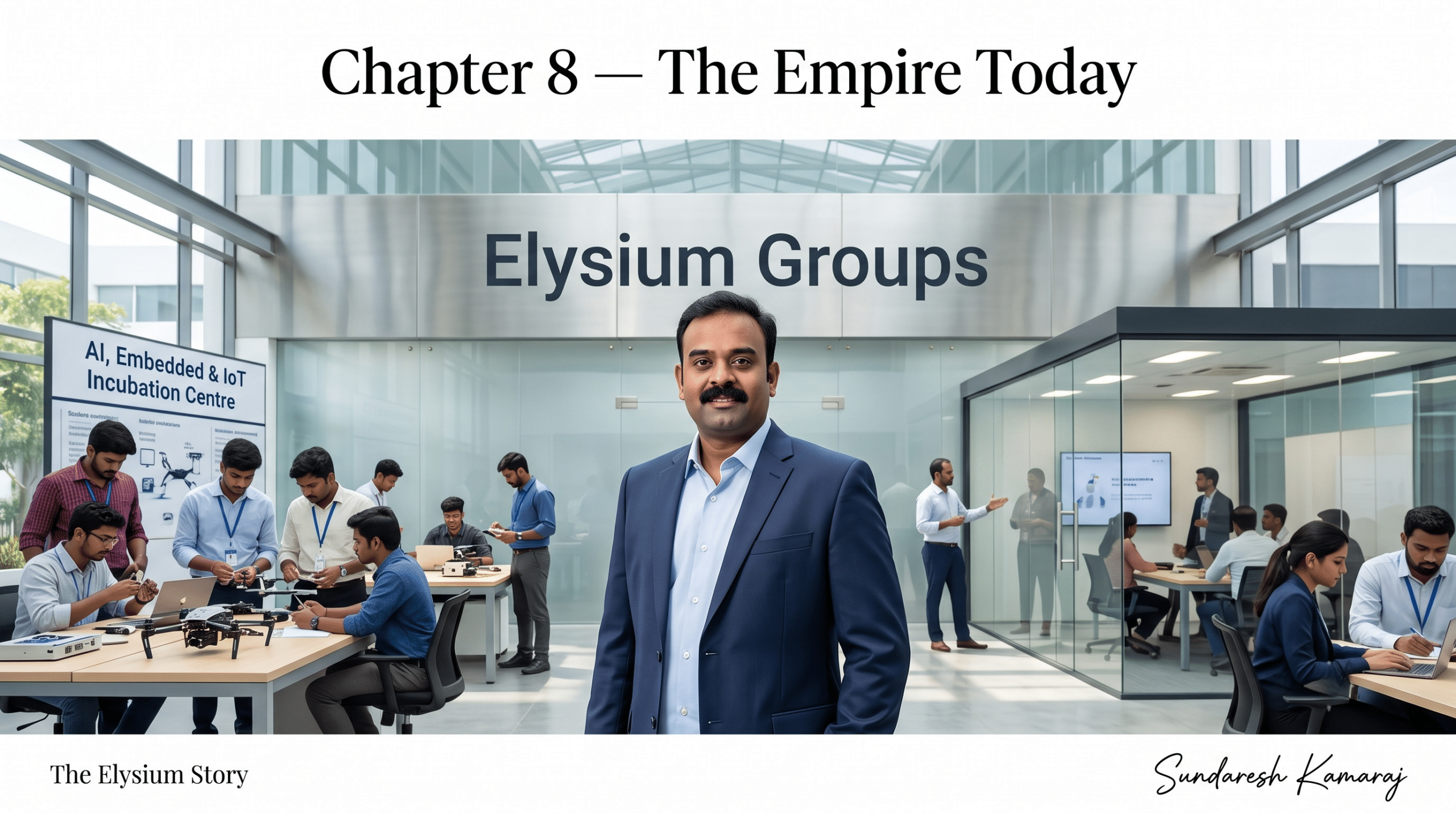
More than 25 years after he returned home with ₹20,000, Elysium Groups stands as a ₹100 crore value enterprise — built from Madurai, serving the world.
| Milestone | Today |
|---|---|
| Enterprise value | ₹100 crore+ |
| Private limited companies | 6 |
| Foundation | 1 |
| Total entities | 16 |
| Innovation infrastructure | AI, Embedded & IoT Incubation Centre |
| Team | 300+ employees |
| Legacy | 25+ years |
| Customers served | 3 lakh+ |
| Global reach | 130+ countries |
| Core focus | Tech Education • AI Solutions • Skill Development |
Behind every number is a human story. Three lakh customers means three lakh people who learned a new skill, completed a project, finished their research, launched a website or grew a business. Three hundred employees means three hundred families whose kitchens are warmer because of a decision made in 1999.
The AI, Embedded and IoT Incubation Centre is especially close to his heart. It is the place he wished existed when he was a young engineer — where students and innovators from ordinary backgrounds can turn ideas into products, and products into companies.
And the Foundation carries forward the deepest part of his journey: giving back to the communities, villages and young people who remind him of where he came from.
The boy who once carried milk to other people’s homes now builds opportunities that reach homes in more than 130 countries.
Chapter 9: A Passport of Purpose

There was a time when travelling from the village to Madurai city felt like a journey. Today, Sundaresh has travelled to more than 60 countries — including the USA, the United Kingdom, Japan, across Europe, South Africa, Singapore and Taiwan.
For him, travel has never been about sightseeing alone. Every country has been a classroom. In Japan, he studied discipline and quality. In the USA, the scale of innovation and startup culture. In Europe, design, heritage and long-term thinking. In Singapore and Taiwan, the power of technology-led economies. In South Africa, the resilience of emerging markets that reminded him of home.
Each journey brought back ideas, partnerships and perspectives that shaped Elysium’s growth into a global brand. And each time his flight touched down again in India, he returned with the same conviction: world-class is not a location. It is a standard.
There is a quiet emotion in these travels that few people see. Sometimes, standing in an airport lounge thousands of kilometres from home, he remembers the weight of a bag of milk packets swinging from a bicycle handlebar — and smiles at how far that bicycle has carried him.
Chapter 10: The Learner Who Never Stopped
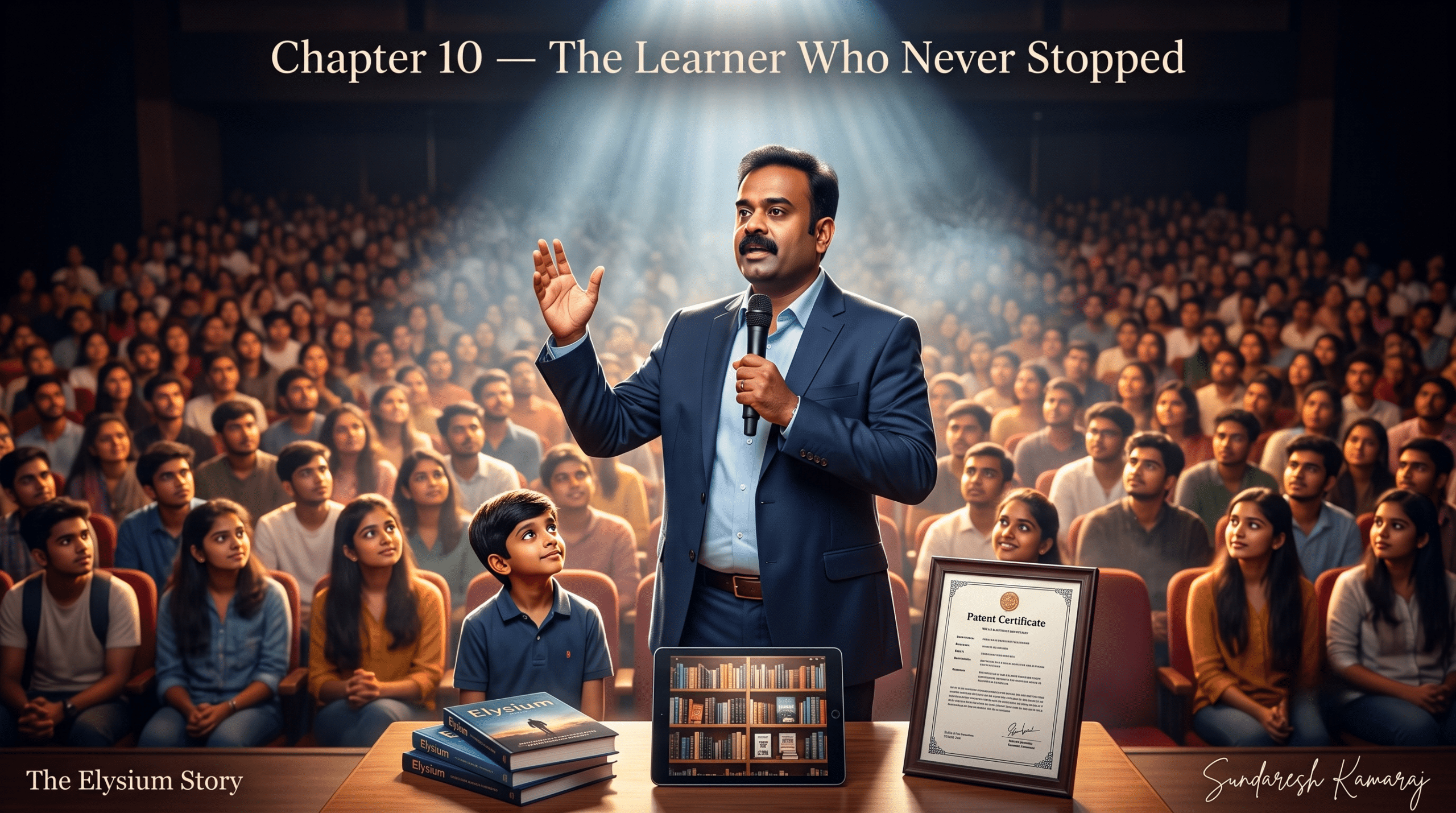
Even while building a growing enterprise, Sundaresh never stopped being a student. He completed his Master of Science in Information Technology (MS-IT) part-time — attending classes and writing exams while running companies, managing teams and meeting clients.
For him, learning was never a phase of life. It was a way of life. And what he learned, he shared.
| Contribution | Count |
|---|---|
| E-books released | 20+ |
| Physical books published | 2 |
| Patents | 7+ |
| Articles written | 500+ |
| Seminars & workshops delivered | 200+ |
His patients reflect the engineer who still loves to solve problems. His books and 500+ articles reflect the teacher who believes knowledge is meant to be given away. His 200+ seminars and workshops — in colleges, institutions and industry forums — reflect the motivator who wants every young person in the audience to believe that their background is not their boundary.
When he stands on a stage in front of students from small towns and villages, he often sees his younger self in the crowd. That is why he speaks with such fire. He is not just delivering a talk — he is keeping a promise to the boy he once was.
Chapter 11: The Many Hats
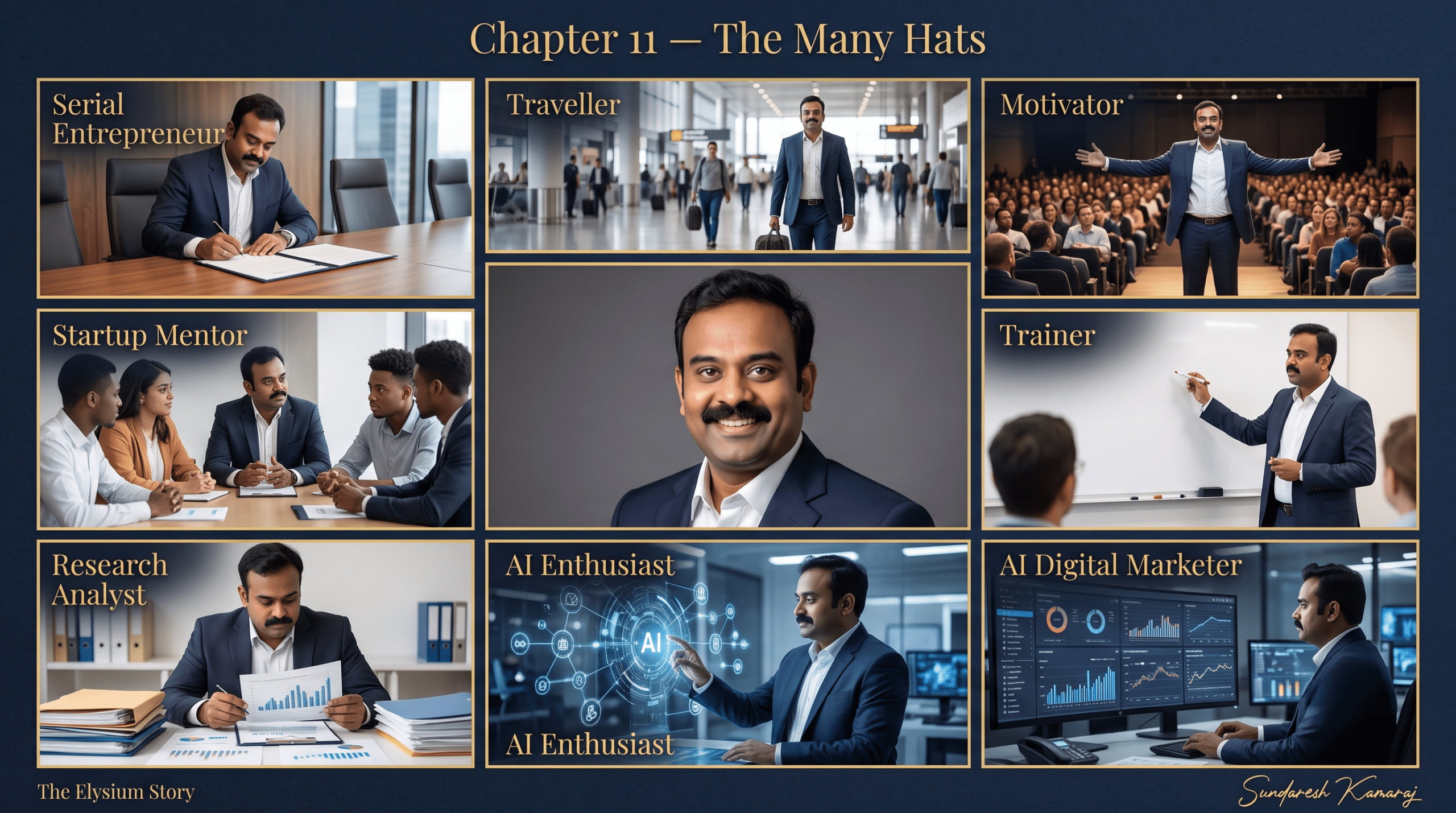
People who meet Sundaresh often struggle to describe him with a single title. That is because he has never been just one thing. His passions have become his identity:
Serial Entrepreneur
building not one company, but an ecosystem of sixteen entities.
Traveller
collecting ideas and friendships across 60+ countries
Motivator
lighting belief in young minds through 200+ seminars and workshops.
Trainer
personally shaping learners, teams and future leaders.
AI Digital Marketer
combining artificial intelligence with marketing to help brands grow.
AI Enthusiast
staying ahead of the technology that will define the next decade.
Research Analyst
reading deeply, questioning carefully, and turning data into decisions.
Startup Mentor
guiding young founders so they avoid the mistakes he had to learn alone.
Behind these roles lies a strong foundation of professional skills built over three decades — much of it first learned at a petty shop counter and on a milk-delivery route:
| Core skill | Where it began |
|---|---|
| Marketing | Knowing every customer on his delivery route |
| Sales | Earning trust across the shop counter |
| Startup building | Turning ₹20,000 into Elysium Technologies |
| HR management | Building a 300+ strong team from first-generation talent |
| Innovation | His father's repair bench and his own patents |
| Business strategy | Growing one company into a 16-entity group |
If there is one thread tying all these hats together, it is this: he loves to see people grow. Whether it is a student, an employee, a client or a young founder — their success is his favourite achievement.
Chapter 12: The Road to ₹1,000 Crore
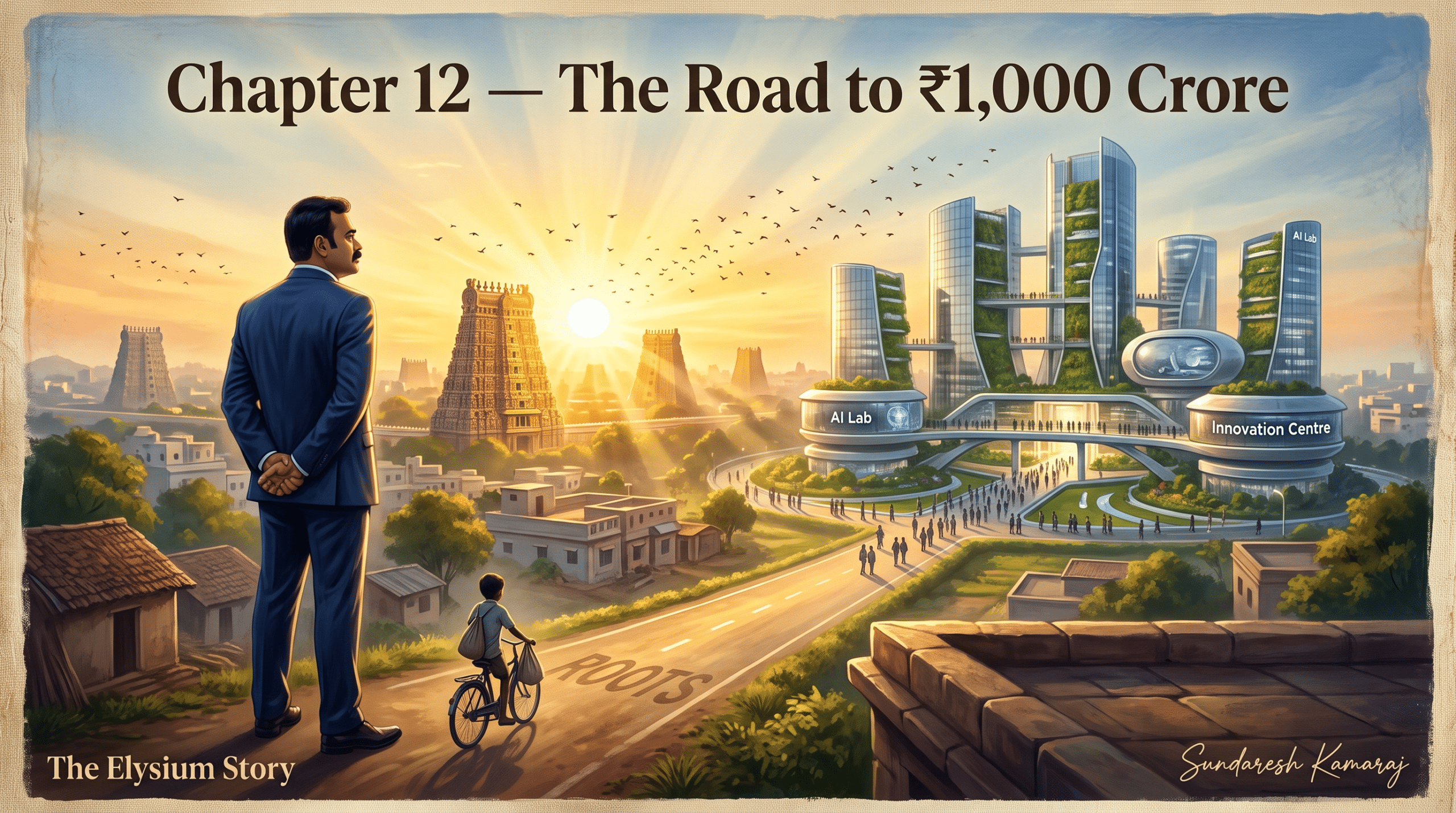
For most people, building a ₹100 crore enterprise from ₹20,000 would be the end of the story. For Sundaresh, it is only the end of the first chapter.
His vision is clear and bold: to grow Elysium Groups into a ₹1,000 crore company powered by 5,000+ people.
But the number is not the dream. The people are. Five thousand careers. Five thousand families. Countless students, researchers, innovators and businesses whose futures will be shaped by Elysium’s work in three areas that he believes will define the coming decades:
-
Tech Education
making world-class technology skills accessible to every learner, especially those from rural and first-generation backgrounds.
-
AI Solutions
helping businesses and institutions harness artificial intelligence responsibly and profitably.
-
Skill Development
equipping young people and communities with the practical abilities that lead to dignified livelihoods.
He dreams of a day when a child from a small village in Tamil Nadu can grow up knowing that global opportunity does not require leaving home — that it can be built right there, the way Elysium was.
“I built the first ₹100 crore with courage. I will build the next ₹900 crore with people.”
Dear young Sundaresh,
I know your hands are cold this morning. I know the bag of milk packets is heavy and the road is dark. I know you are tired before the school day has even begun, and that sometimes you wonder why life asked so much of you so early.
I want you to know that none of it is wasted.
The discipline you are learning on this bicycle will one day run six companies. The trust you are earning at that small shop counter will one day earn the trust of three lakh customers across 130 countries. The patience you learned watching Appa fix radios will one day help you fix problems for businesses around the world.
You will leave a good job with only ₹20,000, and people will doubt you. Let them. You will build something they cannot yet imagine. You will stand on stages and inspire thousands. You will travel to countries you have only seen on the television screens Appa repaired.
Most of all, you will open doors for people who come from places just like ours. That will be your real wealth.
So keep pedalling. The road is long, but it leads somewhere beautiful.
With pride and gratitude, — Sundaresh Kamaraj, Founder, Elysium Groups
Milestones at a Glance
| When | Milestone |
|---|---|
| Future | Vision: ₹1,000 crore company with 5,000+ people |
| Today | ₹100 crore value; 6 Pvt Ltds, 1 Foundation, 16 entities; 300+ employees; 3 lakh+ customers; 130+ countries |
| Across the years | Travelled 60+ countries; 20+ e-books, 2 physical books, 7+ patents, 500+ articles, 200+ seminars & workshops |
| Alongside Elysium | Completed MS (IT) part-time |
| 1999 onwards | Grew Elysium Technologies into Elysium Groups; launched AI, Embedded & IoT Incubation Centre |
| 1999 | Quit corporate career; returned home with ₹20,000 and founded Elysium Technologies as a solopreneur |
| Corporate years | Brief stints as Computer Network Engineer; Pioneer Groups and IBM Corporation — Network Architecture & Security |
| College years | Diploma in ECE, then B.E. in ECE through part-time study — while running the shop and working part-time as a Computer Networking Tutor |
| School to college | Ran a small petty shop (savouries, sweets, cool drinks) and milk distribution in front of home; handed both over to another person on joining the corporate world |
| Age 13 (8th Std) | Began milk and newspaper delivery before and after school at a Government High School |
| 10 July 1977 | Born in Madurai to an agricultural family; father a Radio & TV mechanic |