

PESTLE Analysis: The Complete Guide to Strategic Environmental Scanning
Every business operates within a web of external forces that can make or break its strategy. PESTLE Analysis is the proven strategic framework that helps organisations decode these forces and turn uncertainty into competitive advantage. Whether you are launching a startup, expanding into new markets, or navigating industry disruption, understanding the six macro-environmental dimensions of PESTLE Analysis is not optional—it is essential.
In this comprehensive guide, you will learn exactly what PESTLE Analysis is, why top strategists rely on it, how to conduct one step by step, and how to integrate the findings into your broader business strategy. By the end, you will have the knowledge and tools to perform a rigorous PESTLE Analysis that delivers actionable insights and measurable results.
Play the PESTLE Analysis Audio in Tamil
1. What Is PESTLE Analysis? Definition, Origin & Purpose
Key Insight
2. The Six Dimensions of PESTLE Analysis Explained
| Factor | What It Covers | Example Considerations |
|---|---|---|
| Political | Government policies, political stability, trade regulations, fiscal policy, and the overall regulatory framework. | Tax policy changes, trade tariffs, government stability, foreign trade restrictions, lobbying. |
| Economic | Macroeconomic conditions: GDP growth, inflation, interest rates, exchange rates, and employment levels. | Consumer spending, unemployment rates, currency strength, sector-specific commodity prices. |
| Social | Demographics, cultural trends, population attitudes, lifestyle shifts, and education levels. | Health consciousness, workforce diversity, cultural norms, consumer behaviour shifts. |
| Technological | Innovation pace, automation, R&D activity, digital transformation, and cybersecurity posture. | AI/ML adoption, cloud computing, automation trends, R&D investment levels. |
| Legal | Employment law, consumer protection, health & safety, intellectual property, and data privacy. | GDPR, antitrust legislation, product safety standards, employment law updates. |
| Environmental | Climate change, sustainability mandates, ESG reporting, carbon targets, and resource scarcity. | Carbon emission targets, waste management, sustainable sourcing, weather patterns. |
Political Factors
Political factors refer to the extent to which government actions and policies influence the economy, an industry, or an individual organisation. Government decisions create the rules of the game. A new trade agreement can open entirely new markets, while a change in corporate tax rates can reshape investment decisions across entire industries. Companies that monitor political factors proactively are better positioned to adjust supply chains before disruptions materialise and time market entries to coincide with supportive regulatory environments.
Economic Factors
Economic factors examine the broader conditions that affect business operations and decision-making. These include GDP growth, inflation rates, interest rates, exchange rates, and disposable income trends. Economic conditions determine whether consumers spend or save, whether businesses invest or retrench, and whether credit is accessible or constrained. Understanding these trends enables organisations to set realistic revenue forecasts, time capital investments strategically, and make informed decisions about geographic expansion.
Social Factors
Social factors encompass the cultural, demographic, and attitudinal characteristics of a population. Consumer behaviour is deeply influenced by social trends. The growing emphasis on health and wellness has driven exponential growth in organic food, fitness technology, and mental health services. Organisations that understand social dynamics can tailor their products, marketing messages, and workplace policies to resonate authentically with target audiences.
Technological Factors
Technology is the great disruptor. It can render existing business models obsolete within years, as seen in the music industry’s shift from physical media to streaming. Conversely, it can create entirely new markets and revenue streams. Proactive technology monitoring enables organisations to invest in the right innovations, build digital capabilities before they become table stakes, and anticipate shifts in customer expectations driven by new possibilities.
Legal Factors
Legal factors focus specifically on the regulatory requirements that businesses must comply with. Non-compliance can result in substantial fines, reputational damage, and operational disruptions. The introduction of regulations such as GDPR transformed how companies worldwide handle personal data, requiring significant investments in compliance infrastructure, process redesign, and employee training.
Environmental Factors
Environmental factors relate to ecological aspects influencing business operations. Climate change and environmental awareness are reshaping industries at an accelerating pace. Consumers increasingly prefer sustainable products, investors favour ESG-compliant companies, and regulators are imposing stricter environmental standards. Proactive environmental management helps organisations reduce operational costs through resource efficiency while building long-term resilience against climate-related risks.
3. Why PESTLE Analysis Matters in 2026
Why Now?
4. PESTLE Analysis: Key Facts & Statistics
- Organisations that use structured environmental scanning frameworks outperform peers in strategic agility by an average of 35%, according to strategic management research.
- Over 80% of Fortune 500 companies incorporate some form of macro-environmental analysis in their annual strategic planning cycle.
- Companies that conducted PESTLE Analysis before market entry reported 2.4 times faster regulatory compliance compared to those that did not.
- The most commonly under-assessed PESTLE dimension is Environmental, yet it has become the fastest-growing factor in investment decision-making since 2020.
- Cross-functional PESTLE teams identify 40% more external factors than single-department teams.
5. Step-by-Step Guide to Conducting a PESTLE Analysis
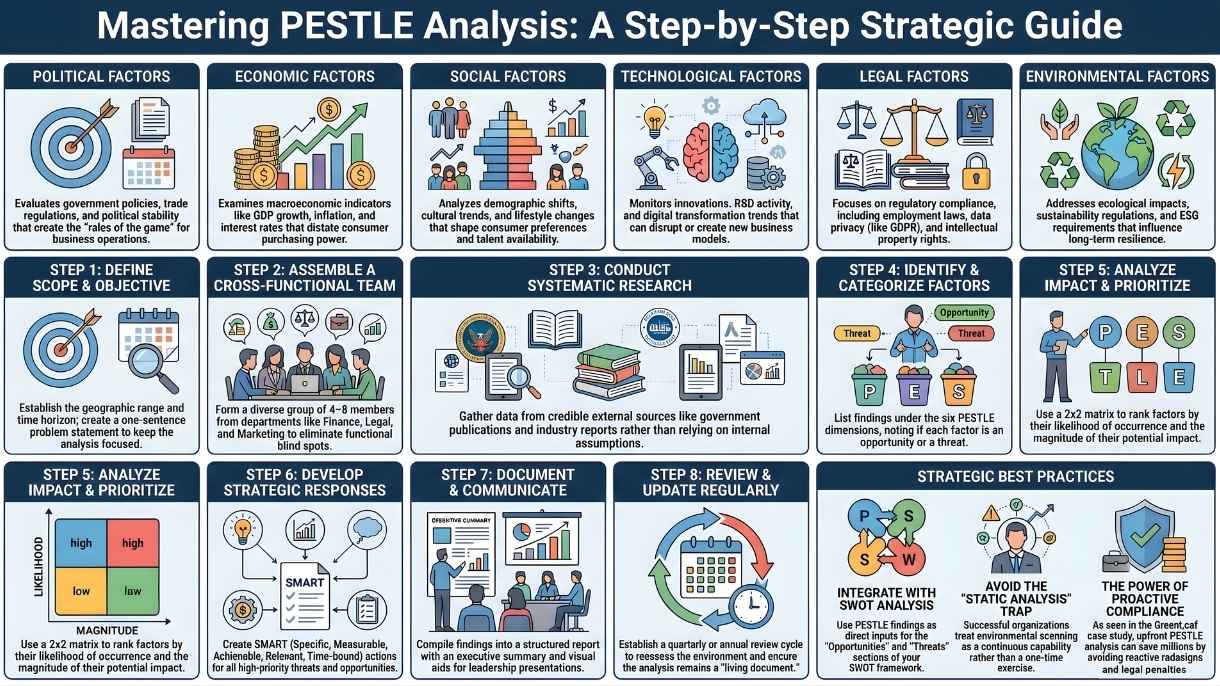
Follow these eight proven steps to conduct a thorough and actionable PESTLE Analysis. Each step is designed to be beginner-friendly while offering depth for experienced strategists.

01
Define the Scope and Objective
Clearly define what you are analysing and why. Establish the geographic scope, time horizon, and strategic question. Write a one-sentence problem statement to keep the analysis focused. Example: "Identify external factors affecting our fintech platform launch in Southeast Asia over three years."

02
Assemble a Cross-Functional Team
Bring together 4–8 members from strategy, finance, operations, legal, marketing, technology, and HR. Each function brings unique insights into different PESTLE dimensions. Diverse perspectives prevent blind spots.

03
Conduct Systematic Research
For each dimension, gather data from government publications, industry reports, academic journals, reputable news outlets, and expert interviews. Organise findings by dimension and note current state, trajectory, and potential impact.

04
Identify and Categorise Factors
List all factors and categorise them under the appropriate PESTLE dimension. For each, write a concise description, classify as opportunity or threat, and rate likelihood (1–5) and impact (1–5).

05
Analyse Impact and Prioritise
Use a prioritisation matrix to rank factors by likelihood and magnitude of impact. Focus strategic responses on high-likelihood, high-impact factors. Plot factors on a 2×2 matrix for visual clarity.

06
Develop Strategic Responses
For each high-priority factor, create a SMART response: Specific, Measurable, Achievable, Relevant, and Time-bound. Assign ownership, set timelines, and define success metrics.

07
Document and Communicate Findings
Compile your analysis into a structured report with an executive summary, detailed findings per dimension, the prioritisation matrix, and the strategic response plan. Use visual aids to make it engaging.

08
Review and Update Regularly
Establish a review cycle—quarterly, semi-annually, or annually. Assess which factors have changed, whether new factors have emerged, and whether your strategic responses remain appropriate.
Common Mistakes to Avoid
6. PESTLE Analysis Implementation Checklist
Preparation Phase
- Define the strategic objective and the specific question the analysis will address
- Establish the geographic scope and time horizon for the analysis
- Assemble a cross-functional team with 4–8 members from diverse business functions
- Assign a project lead to coordinate timelines and research allocation
- Prepare a research plan with credible sources for each PESTLE dimension
- Set a clear deadline for the research phase to prevent analysis paralysis
Execution Phase
- Research and document Political, Economic, Social, Technological, Legal, and Environmental factors
- Classify each factor as an opportunity or threat
- Rate each factor for likelihood (1–5) and impact (1–5)
- Create a prioritisation matrix ranking factors by likelihood × impact
- Identify the top 10–15 high-priority factors for strategic response
- Set a clear deadline for the research phase to prevent analysis paralysis
Response & Review Phase
- Develop SMART strategic responses for each high-priority factor
- Assign clear ownership and timelines for every response
- Compile findings into a structured report with executive summary
- Present findings and recommendations to relevant stakeholders
- Establish a regular review cycle aligned with your strategic planning calendar
- Scan for new or emerging factors at each review and update responses accordingly
7. Case Studies: PESTLE Analysis in Action
Industry: Organic Beverages | Challenge: International Market Entry | Investment: $15M
The Problem:
GreenLeaf Beverages, a US-based organic beverage company with $120M in annual revenue, wanted to expand into the EU. Previous international ventures by similar companies had failed due to unanticipated regulatory hurdles, pricing misalignment, and cultural missteps.
The PESTLE Approach: An 8-member cross-functional team conducted a 6-week PESTLE Analysis targeting Germany, France, and the Netherlands. They discovered that EU trade agreements favoured organic imports (Political), eurozone inflation was eroding purchasing power requiring careful pricing (Economic), German and Dutch consumers had the strongest organic preference (Social), advanced cold-chain logistics supported product quality (Technological), EU food labelling was far more stringent than US requirements (Legal), and the European Green Deal was increasing packaging sustainability pressure (Environmental).
The Result: Within 18 months of entry, GreenLeaf achieved €8.2M in European revenue, exceeding its first-year target by 14%. Zero regulatory penalties. Rated the second most trusted new organic beverage brand in Germany. The PESTLE-driven approach saved an estimated $2M in costs that would have resulted from reactive compliance and post-launch corrections.
Industry: Food & Bakery | Challenge: Multiple External Disruptions | Scale: Small Business
The Problem: Priya runs a small neighbourhood bakery that faced simultaneous external challenges: new nutritional labelling regulations (Political), a 20% flour price increase (Economic), rising demand for vegan and gluten-free products (Social), competitors launching online ordering (Technological), updated food safety standards (Legal), and a local plastic packaging reduction initiative (Environmental).
The PESTLE Approach: Instead of reacting to each challenge in isolation, Priya mapped every disruption across the six PESTLE dimensions. She identified patterns: the labelling and food safety requirements were both regulatory issues she could address together. The vegan demand and sustainable packaging trends reflected the same underlying shift toward health and environmental consciousness.
The Result: Priya introduced vegan and gluten-free products with compliant nutritional labels, packaged in biodegradable materials, and launched an online ordering system. Revenue grew by 30% within six months. She achieved full regulatory compliance before deadlines and earned a “Green Business” award from the neighbourhood council, generating positive press coverage.
8. Integrating PESTLE with Other Strategic Frameworks
PESTLE Analysis delivers the greatest returns when integrated with complementary strategic tools. Here is how it connects with the most widely used frameworks:
| Framework | What It Covers |
|---|---|
| SWOT Analysis | PESTLE feeds directly into the external dimensions of SWOT. Opportunities and threats identified through PESTLE become inputs for SWOT, combined with internal strengths and weaknesses for a complete strategic picture. |
| Porter’s Five Forces | While PESTLE examines the macro-environment, Porter’s Five Forces analyses competitive dynamics within the industry. Using both provides a layered understanding of broader forces and competitive micro-dynamics. |
| Scenario Planning | PESTLE factors serve as building blocks for scenario planning. By identifying the most uncertain and impactful factors, teams develop multiple plausible future scenarios and stress-test strategies against each. |
| Balanced Scorecard | PESTLE insights inform the external perspective within a Balanced Scorecard. Political and legal factors shape financial targets, social and tech factors influence customer and innovation perspectives. |
| Risk Management | Threats identified in PESTLE map directly onto the enterprise risk register. Likelihood and impact ratings create ready-made inputs for the risk management framework. |
9. Frequently Asked Questions About PESTLE Analysis
Below are the most commonly asked questions about PESTLE Analysis, optimised for quick reference and voice search.
What is PESTLE Analysis and why is it important?
What is the difference between PEST and PESTLE Analysis?
How often should you conduct a PESTLE Analysis?
Can small businesses use PESTLE Analysis?
What are the limitations of PESTLE Analysis?
How does PESTLE Analysis differ from SWOT Analysis?
10. Conclusion: Turn External Complexity into Strategic Clarity
By following the structured approach outlined in this guide—defining clear objectives, assembling diverse teams, conducting rigorous research, prioritising findings, and developing actionable responses—you can transform external complexity into strategic clarity. The organisations that will thrive in the years ahead are those that treat environmental scanning not as a box to check, but as a core strategic discipline.