
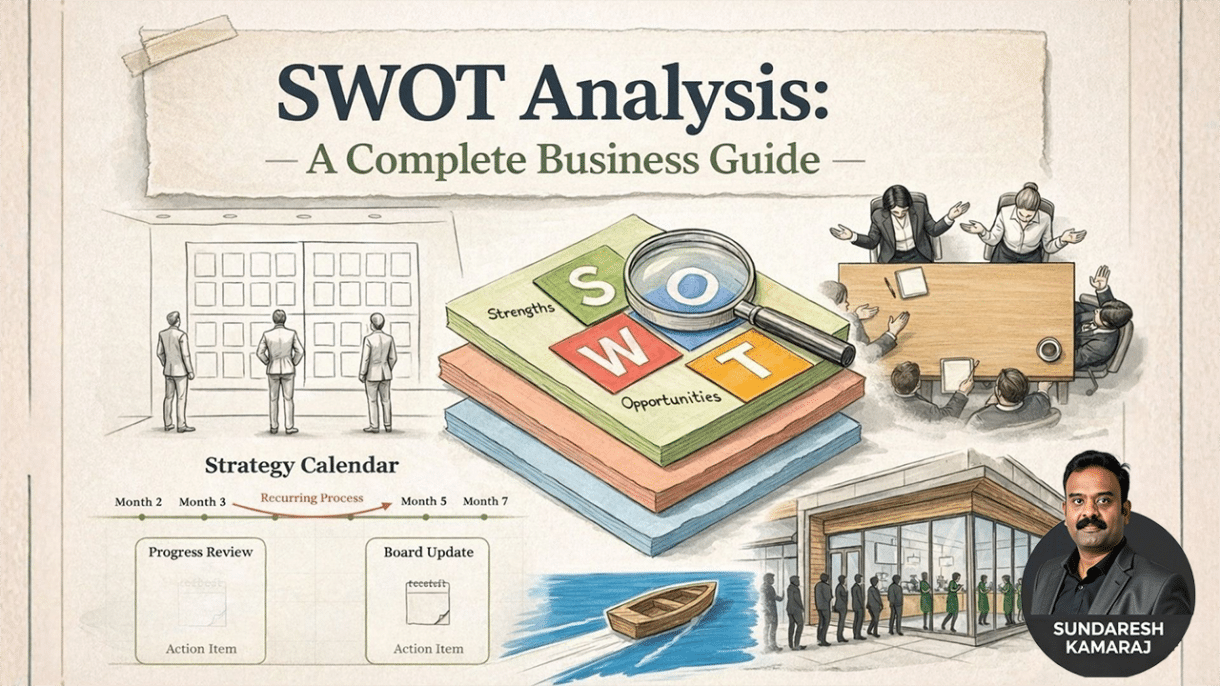

Introduction
SWOT Analysis is the strategic compass that separates successful businesses from those that merely survive. In a world where 70% of strategic initiatives fail due to poor planning, mastering this framework is not just valuable, it is essential for survival.
Whether you are a Fortune 500 executive steering a multinational corporation, a startup founder bootstrapping your first venture, or a project manager navigating complex initiatives, SWOT Analysis provides the structured clarity you need to make confident, data-driven decisions.
This comprehensive guide will walk you through everything from fundamental concepts to advanced implementation strategies, complete with real-world case studies, actionable templates, and expert insights that you will not find anywhere else.
Play the SWOT Analysis Audio in Tamil
1. What is SWOT Analysis?
SWOT Analysis stands for Strengths, Weaknesses, Opportunities, and Threats. It is a structured analytical framework developed in the 1960s at Stanford Research Institute that evaluates both internal and external factors affecting an organization, project, or initiative.
The framework operates on two fundamental dimensions:
Internal vs External
What you control vs. what the market controls
Positive vs Negative
Helpful factors vs. harmful factors
2. The Four Pillars: Strengths, Weaknesses, Opportunities, Threats

S - STRENGTHS
Internal Positive Factors
What do you do exceptionally well?
What unique resources do you possess?
What advantages do you have over competitors?

W - WEAKNESSES
Internal Negative Factors
Where are you falling short?
What do competitors do better?
What internal obstacles slow your progress?

O - OPPORTUNITIES
External Positive Factors
What market trends can you leverage?
What partnerships could accelerate growth?
What underserved markets exist?

T - THREATS
External Negative Factors
What competitors are gaining ground?
What regulations could impact you?
What economic risks are on the horizon?
3. Why SWOT Analysis Matters: Key Benefits
Strategic Benefits
Provides a clear snapshot of your current position
Aligns leadership teams around shared priorities
Uncovers blind spots and hidden opportunities
Supports data-driven strategic decision-making
Creates a foundation for business planning sessions
Operational Benefits
Quick to set up with no special tools required
Applicable to teams, projects, or entire organizations
Encourages cross-functional collaboration
Flexible for startups and large corporations alike
Creates a documented reference for future decisions
4. The 7-Step SWOT Analysis Framework
Follow this structured process to conduct a thorough and effective SWOT Analysis:
Define Your Objective
Clearly state what you are analyzing. A focused objective ensures your SWOT remains relevant and actionable. Write a one-sentence objective statement before starting.
Assemble the Right Team
Bring together 5-8 people from different departments, roles, and seniority levels. This diversity reduces blind spots and ensures comprehensive internal knowledge capture.
Gather Data and Context
Prepare background data including financial reports, customer feedback, market research, competitor analysis, and operational metrics. Rich input data equals insightful outputs.
Brainstorm Each Quadrant
Spend 10-15 minutes per quadrant using sticky notes or digital tools. Begin with Strengths to build momentum, then move through Weaknesses, Opportunities, and Threats.
Prioritize and Refine
Review all items, eliminate duplicates, and rank by impact. Focus on the top 3-5 items in each quadrant. Challenge vague entries and ensure each point is evidence-based.
Develop Strategic Actions
Apply the TOWS Matrix to generate strategies: S+O for offensive strategies, W+O for development, S+T for defensive measures, and W+T for contingency planning.
Brainstorm Each Quadrant
Spend 10-15 minutes per quadrant using sticky notes or digital tools. Begin with Strengths to build momentum, then move through Weaknesses, Opportunities, and Threats.
5. SWOT Analysis Implementation Checklist
PREPARE
- Define a clear, specific objective for the SWOT Analysis
- Define a clear, specific objective for the SWOT Analysis
- Define a clear, specific objective for the SWOT Analysis
- Define a clear, specific objective for the SWOT Analysis
- Prepare SWOT templates (physical or digital)
EXECUTE
- Brainstorm Strengths focusing on internal positives
- Brainstorm Weaknesses with honesty and evidence
- Brainstorm Opportunities focusing on external positives
- Brainstorm Threats identifying external risks
- Prioritize top 3-5 items in each quadrant by impact
- Apply TOWS Matrix to generate strategic actions
REVIEW
- Document the completed SWOT Analysis formally
- Share findings with all relevant stakeholders
- Assign ownership and deadlines to each strategic action
- Integrate SWOT insights into the business plan
- Schedule next SWOT review (every 3-6 months)
6.Facts and Statistics That Prove SWOT Works
70%
Of strategic initiatives fail due to poor planning and analysis
85%
Of Fortune 500 companies use SWOT Analysis in their strategic planning
3X
Faster decision-making reported by teams using structured SWOT frameworks
60%
Improvement in risk identification when SWOT is conducted quarterly
45%
Higher success rate for market expansions preceded by thorough SWOT Analysis
2 Hours
Average time to complete a comprehensive SWOT workshop
Data - Driven
Strategic planning backed by evidence delivers measurable results
7. Case Study: NovaTech Solutions
Using SWOT Analysis to Navigate a Competitive Market Entry
B2B Software Company | Manchester, UK | German Market Expansion
The Challenge
NovaTech Solutions, a mid-sized B2B software company with 120 UK clients, faced a critical strategic decision: Should they pursue German market expansion or focus on deepening UK market share? A failed international launch could drain reserves and damage morale, but hesitation could allow competitors to establish first-mover advantage.
Block 1: Customer Segments
Key Takeaway
The SWOT Analysis did not just validate the expansion decision, it shaped HOW the company entered the market. By identifying specific weaknesses and threats upfront, NovaTech avoided costly overcommitment and adopted a structured, evidence-based market entry strategy.
8. Case Study: Maya's Family Bakery
Small Business | Local Competition | Strategic Adaptation
Maya runs a beloved bakery with legendary croissants. When a large chain cafe opened nearby, she noticed customers walking past her shop. Her friend Ravi, a business student, suggested a simple SWOT Analysis on a napkin.
-
Strengths -
- Superior pastries with local ingredients
- Personal customer relationships
- Fresh-baked twice daily
-
Weaknesses
- Cash-only payments
- Outdated online presence
- No loyalty program
-
Opportunities
- New office building opening nearby
- Expanding Saturday market
- Corporate gift box potential
-
Threats
- Chain cafe with rewards app
- Rising rent costs
- Health-conscious food trends
Three months later
Maya’s Saturday queue is longer than ever. Two corporate offices place weekly orders. Her new healthy options outsell existing products. The chain is still there, but Maya knows exactly what she has, what to fix, where she is going, and what to watch out for.
9. TOWS Matrix: From Analysis to Action
The TOWS Matrix transforms descriptive SWOT insights into actionable strategies by pairing quadrants:
-
S + O = Offensive Strategy
Use strengths to capitalize on opportunities. Aggressive growth moves.
-
W + O = Development Strategy
Address weaknesses to unlock opportunities. Build capabilities.
-
S + T = Defensive Strategy
Leverage strengths to mitigate threats. Protect market position.
-
W + T = Contingency Strategy
Minimize weaknesses and avoid threats. Risk management.
10. Frequently Asked Questions
What is a SWOT Analysis and why is it important?
How often should I conduct a SWOT Analysis?
Best practice is to conduct a SWOT Analysis quarterly for dynamic industries, or at minimum every 6 months. Additionally, perform one whenever facing major strategic decisions like market entry, product launches, or organizational restructuring.
Who should be involved in a SWOT Analysis session?
Include 5-8 participants from diverse departments including operations, marketing, finance, and leadership. Cross-functional representation reduces blind spots and ensures comprehensive knowledge capture. Consider including an external facilitator for objectivity.
What is the difference between SWOT and TOWS Matrix?
SWOT identifies and categorizes factors, while TOWS generates strategic actions by pairing these factors. TOWS transforms SWOT from a descriptive exercise into an actionable strategy framework. Use SWOT first, then apply TOWS to develop strategies.
Can SWOT Analysis be used for personal career planning?
Absolutely. SWOT Analysis is highly effective for personal career development. Assess your professional strengths and skills gaps, identify industry opportunities and job market threats to create a focused career strategy.
What are common mistakes to avoid in SWOT Analysis?
Common mistakes include being vague instead of specific, confusing internal factors with external ones, failing to prioritize items, not backing claims with evidence, and stopping at analysis without developing action plans.
How do I connect SWOT Analysis to other business frameworks?
SWOT integrates naturally with PESTLE (for external factor analysis), Balanced Scorecard (for performance measurement), and OKRs (for goal setting). Use PESTLE to populate Opportunities and Threats, then convert SWOT strategies into measurable OKRs.
11. Conclusion and Next Steps
SWOT Analysis has stood the test of time because it addresses a universal need: the need to understand your situation clearly before you act. It is accessible yet rigorous, simple yet surprisingly deep when applied with care.
The real value of SWOT emerges when it transforms from a descriptive exercise into a catalyst for strategic action. When paired with the TOWS Matrix, integrated into your OKR framework, and revisited quarterly, SWOT becomes the foundation of a complete strategic planning system.
Your Next Step
Schedule your first SWOT Analysis workshop this week. Gather your team, define your objective, and use this guide as your roadmap. Strategy without analysis is guessing. Let SWOT guide your organization from where it is to where it deserves to be.