Hi, I’m Jone Lee a Content WitterSEO Marketer Writing Book
I use animation as a third dimension by which to simplify experiences and kuiding thro each and every interaction. I’m not adding motion just to spruce things up, but doing it in ways that.
Through a wide variety of mobile applications, we’ve developed a unique visual system and strategy that can be applied across the spectrum of available applications.
Lorem ipsum dolor sit amet, consectetur adipiscing elit, sed do eiusmod tempor incididunt ut labore et dolore magna aliqua. Quis ipsum suspendisse ultrices gravida. Risus commod viverra maecenas accumsan lacus vel facilisis. ut labore et dolore magna aliqua.
There are always some stocks, which illusively scale lofty heights in a given time period. However, the good show doesn’t last for these overblown toxic stocks as their current price is not justified by their fundamental strength.
Toxic companies are usually characterized by huge debt loads and are vulnerable to external shocks. Accurately identifying such bloated stocks and getting rid of them at the right time can protect your portfolio.
Overpricing of these toxic stocks can be attributed to either an irrational enthusiasm surrounding them or some serious fundamental drawbacks. If you own such bubble stocks for an inordinate period of time, you are bound to see a massive erosion of wealth.
However, if you can precisely spot such toxic stocks, you may gain by resorting to an investing strategy called short selling. This strategy allows one to sell a stock first and then buy it when the price falls.
While short selling excels in bear markets, it typically loses money in bull markets.
So, just like identifying stocks with growth potential, pinpointing toxic stocks and offloading them at the right time is crucial to guard one’s portfolio from big losses or make profits by short selling them. Heska Corporation HSKA, Tandem Diabetes Care, Inc. TNDM, Credit Suisse Group CS,Zalando SE ZLNDY and Las Vegas Sands LVS are a few such toxic stocks.Screening Criteria
Here is a winning strategy that will help you to identify overhyped toxic stocks:
Most recent Debt/Equity Ratio greater than the median industry average: High debt/equity ratio implies high leverage. High leverage indicates a huge level of repayment that the company has to make in connection with the debt amount.
Through a wide variety of mobile applications, we’ve developed a unique visual system and strategy that can be applied across the spectrum of available applications.
Lorem ipsum dolor sit amet, consectetur adipiscing elit, sed do eiusmod tempor incididunt ut labore et dolore magna aliqua. Quis ipsum suspendisse ultrices gravida. Risus commod viverra maecenas accumsan lacus vel facilisis. ut labore et dolore magna aliqua.
There are always some stocks, which illusively scale lofty heights in a given time period. However, the good show doesn’t last for these overblown toxic stocks as their current price is not justified by their fundamental strength.
Toxic companies are usually characterized by huge debt loads and are vulnerable to external shocks. Accurately identifying such bloated stocks and getting rid of them at the right time can protect your portfolio.
Overpricing of these toxic stocks can be attributed to either an irrational enthusiasm surrounding them or some serious fundamental drawbacks. If you own such bubble stocks for an inordinate period of time, you are bound to see a massive erosion of wealth.
However, if you can precisely spot such toxic stocks, you may gain by resorting to an investing strategy called short selling. This strategy allows one to sell a stock first and then buy it when the price falls.
While short selling excels in bear markets, it typically loses money in bull markets.
So, just like identifying stocks with growth potential, pinpointing toxic stocks and offloading them at the right time is crucial to guard one’s portfolio from big losses or make profits by short selling them. Heska Corporation HSKA, Tandem Diabetes Care, Inc. TNDM, Credit Suisse Group CS,Zalando SE ZLNDY and Las Vegas Sands LVS are a few such toxic stocks.Screening Criteria
Through a wide variety of mobile applications, we’ve developed a unique visual system and strategy that can be applied across the spectrum of available applications.
Lorem ipsum dolor sit amet, consectetur adipiscing elit, sed do eiusmod tempor incididunt ut labore et dolore magna aliqua. Quis ipsum suspendisse ultrices gravida. Risus commod viverra maecenas accumsan lacus vel facilisis. ut labore et dolore magna aliqua.
There are always some stocks, which illusively scale lofty heights in a given time period. However, the good show doesn’t last for these overblown toxic stocks as their current price is not justified by their fundamental strength.
Toxic companies are usually characterized by huge debt loads and are vulnerable to external shocks. Accurately identifying such bloated stocks and getting rid of them at the right time can protect your portfolio.
Overpricing of these toxic stocks can be attributed to either an irrational enthusiasm surrounding them or some serious fundamental drawbacks. If you own such bubble stocks for an inordinate period of time, you are bound to see a massive erosion of wealth.
However, if you can precisely spot such toxic stocks, you may gain by resorting to an investing strategy called short selling. This strategy allows one to sell a stock first and then buy it when the price falls.
While short selling excels in bear markets, it typically loses money in bull markets.
So, just like identifying stocks with growth potential, pinpointing toxic stocks and offloading them at the right time is crucial to guard one’s portfolio from big losses or make profits by short selling them. Heska Corporation HSKA, Tandem Diabetes Care, Inc. TNDM, Credit Suisse Group CS,Zalando SE ZLNDY and Las Vegas Sands LVS are a few such toxic stocks.Screening Criteria
The training provided by universities in order to prepare people to work in various sectors of the economy or areas of culture.
AS - Science & Information
SuperKing College (2001 - 2005)
4.75/5
Higher education is tertiary education leading to award of an academic degree. Higher education, also called post-secondary education.
Secondary School Education
Kingstar Secondary School (1998 - 2000)
5.00/5
Secondary education or post-primary education covers two phases on the International Standard Classification of Education scale.
2010 - 2022
Job Experience
Sr. Software Engineer
Google Out Tech - (2017 - Present)
USA
Google’s hiring process is an important part of our culture. Googlers care deeply about their teams and the people who make them up.
Web Developer & Trainer
Apple Developer Team - (2012 - 2016)
MALAYSIA
A popular destination with a growing number of highly qualified homegrown graduates, it's true that securing a role in Malaysia isn't easy.
Front-end Developer
Nike - (2020 - 2011)
INDIA
The India economy has grown strongly over recent years, having transformed itself from a producer and innovation-based economy.
Features
Design Skill
PHOTOSHOT
100%
FIGMA
95%
ADOBE XD.
60%
ADOBE ILLUSTRATOR
70%
DESIGN
90%
Features
Development Skill
HTML
100%
CSS
95%
JAVASCRIPT
60%
SOFTWARE
70%
PLUGIN
90%
2010 - 2022
Job Experience
Sr. Software Engineer
Google Out Tech - (2017 - Present)
USA
Google’s hiring process is an important part of our culture. Googlers care deeply about their teams and the people who make them up.
Web Developer & Trainer
Apple Developer Team - (2012 - 2016)
MALAYSIA
A popular destination with a growing number of highly qualified homegrown graduates, it's true that securing a role in Malaysia isn't easy.
Front-end Developer
Nike - (2020 - 2011)
INDIA
The India economy has grown strongly over recent years, having transformed itself from a producer and innovation-based economy.
2001 - 2020
Trainer Experience
Gym Instructor
Rainbow Gym Center (2015 - 2020)
DHAKA
The training provided by universities in order to prepare people to work in various sectors of the economy or areas of culture.
Web Developer and Instructor
SuperKing College (2010 - 2014)
CANADA
Higher education is tertiary education leading to award of an academic degree. Higher education, also called post-secondary education.
School Teacher
Kingstar Secondary School (2001 - 2010)
NEVADA
Secondary education or post-primary education covers two phases on the International Standard Classification of Education scale.
2007 - 2010
Company Experience
Personal Portfolio April Fools
University of DVI (1997 - 2001))
4.30/5
The education should be very interactual. Ut tincidunt est ac dolor aliquam sodales. Phasellus sed mauris hendrerit, laoreet sem in, lobortis mauris hendrerit ante.
Examples Of Personal Portfolio
University of DVI (1997 - 2001))
4.30/5
The education should be very interactual. Ut tincidunt est ac dolor aliquam sodales. Phasellus sed mauris hendrerit, laoreet sem in, lobortis mauris hendrerit ante.
Tips For Personal Portfolio
University of DVI (1997 - 2001))
4.30/5
The education should be very interactual. Ut tincidunt est ac dolor aliquam sodales. Phasellus sed mauris hendrerit, laoreet sem in, lobortis mauris hendrerit ante.
2007 - 2010
Job Experience
Personal Portfolio April Fools
University of DVI (1997 - 2001))
4.30/5
The education should be very interactual. Ut tincidunt est ac dolor aliquam sodales. Phasellus sed mauris hendrerit, laoreet sem in, lobortis mauris hendrerit ante.
Examples Of Personal Portfolio
University of DVI (1997 - 2001))
4.30/5
The education should be very interactual. Ut tincidunt est ac dolor aliquam sodales. Phasellus sed mauris hendrerit, laoreet sem in, lobortis mauris hendrerit ante.
Tips For Personal Portfolio
University of DVI (1997 - 2001))
4.30/5
The education should be very interactual. Ut tincidunt est ac dolor aliquam sodales. Phasellus sed mauris hendrerit, laoreet sem in, lobortis mauris hendrerit ante.
What Clients Say
Testimonial
Rainbow-Themes
Nevine Acotanza test
Chief Operating Officer
Android App Development
via Upwork - Mar 4, 2015 - Aug 30, 2021 test
Maecenas finibus nec sem ut imperdiet. Ut tincidunt est ac dolor aliquam
sodales. Phasellus sed mauris hendrerit, laoreet sem in, lobortis mauris
hendrerit ante. Ut tincidunt est ac dolor aliquam sodales phasellus smauris
Bound - Trolola
Jone Duone Joe
Operating Officer
Web App Development
Upwork - Mar 4, 2016 - Aug 30, 2021
Maecenas finibus nec sem ut imperdiet. Ut tincidunt est ac dolor aliquam
sodales. Phasellus sed mauris hendrerit, laoreet sem in, lobortis mauris
hendrerit ante. Ut tincidunt est ac dolor aliquam sodales phasellus smauris
Glassfisom
Nevine Dhawan
Operating Officer
Android App Design
Fiver - Mar 4, 2015 - Aug 30, 2021
Maecenas finibus nec sem ut imperdiet. Ut tincidunt est ac dolor aliquam
sodales. Phasellus sed mauris hendrerit, laoreet sem in, lobortis mauris
hendrerit ante. Ut tincidunt est ac dolor aliquam sodales phasellus smauris
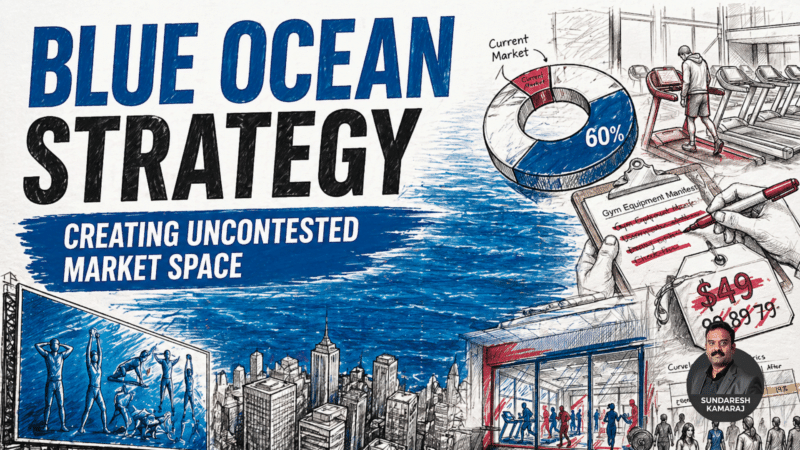
Blue Ocean Strategy: How to Create Uncontested Markets and Make Competition Irrelevant
Most companies are exhausted from fighting the wrong battle. They benchmark rivals, match features, slash prices, and watch their margins shrink anyway. Blue Ocean Strategy offers a smarter path — instead of competing in crowded markets, you create new ones where the rules of the game are still being written. This is the practical, end-to-end guide most founders, strategists, and marketers wish they had read on day one.
Built on more than a decade of research by W. Chan Kim and Renée Mauborgne at INSEAD, Blue Ocean Strategy reframes how you think about growth. Rather than treating differentiation and low cost as a trade-off, it treats them as a single, integrated pursuit called value innovation. In this guide, you will learn the full framework, the diagnostic tools, a step-by-step methodology, real case studies, and exactly how to apply it to your business — starting today.
Strategic Moves Studied
0
+
Industries Across 100+ Years
0
Higher Profit Impact in Blue Ocean Moves
0
X
Key Insight
Blue oceans are not built on technology alone. They are built when innovation is anchored to what buyers truly value, priced for the mass market, and supported by a cost structure that makes the strategy profitable and durable.
1. What Is Blue Ocean Strategy?
Blue Ocean Strategy is a strategic management framework that helps businesses create uncontested market space — “blue oceans” — instead of fighting in saturated, bloody-red competitive markets. The framework was introduced in the 2005 bestseller by W. Chan Kim and Renée Mauborgne after they studied more than 150 strategic moves spanning 30 industries and over 100 years. The central argument is simple but radical: lasting success does not come from beating the competition. It comes from making the competition irrelevant. Companies do this by reimagining industry boundaries, listening carefully to non-customers, and designing offerings that deliver a leap in value for both buyers and the business. In short, Blue Ocean Strategy is both a mindset and a toolkit. It teaches you to stop optimizing the existing game and start designing a new one.
Play the Blue Ocean Strategy Audio in Tamil
2. Red Ocean vs. Blue Ocean: The Core Difference
To grasp the framework, you first need to see the contrast clearly. Red oceans are the markets that exist today — known, mapped, and crowded. Blue oceans are the markets waiting to be created.
Dimension
Red Ocean
Blue Ocean
Market Space
Compete in existing, defined markets
Create new, uncontested market space
Competition
Beat existing rivals
Make competition irrelevant
Demand
Exploit existing demand
Create and capture new demand
Value vs. Cost
Choose differentiation OR low cost
Pursue differentiation AND low cost
Strategic Logic
Align with chosen trade-off
Align entire system to break the trade-off
Outcome
Shrinking margins, commoditization
Profitable growth, category leadership
3. Value Innovation – The Cornerstone Concept
Value innovation is the heartbeat of Blue Ocean Strategy. Traditional thinking forces a brutal choice — you can deliver more value at a higher cost, or less value at a lower cost. Blue Ocean Strategy rejects this trade-off entirely. It argues that buyer value can be lifted dramatically while costs are simultaneously slashed, creating a leap in value for both customers and the company. How? By reorganizing the entire system. You eliminate factors the industry over-invests in but customers do not actually value. You raise the factors customers care most about. You create new factors no one else offers. The result is a coherent strategy where utility, price, and cost all move together.
Why It Matters
Value without innovation is incremental — it improves what already exists but rarely breaks through. Innovation without value is technology for its own sake — buyers reject it. Value innovation is the rare alignment of utility, price, and cost that creates breakaway market leaders.
4. The Strategy Canvas Explained
The Strategy Canvas is the central diagnostic tool of Blue Ocean Strategy. It is a chart and a conversation starter. The horizontal axis lists the factors your industry competes on. The vertical axis shows how much of each factor buyers receive. Plot your company and your competitors, and you instantly see whether you are stuck in a red ocean.
The Three Signatures of a Winning Value Curve
Focus
The curve emphasizes a few high-impact factors rather than spreading thin across everything.
Divergence
The shape of the curve is visibly, obviously different from competitors
Compelling Tagline
The strategy can be communicated in one clear, memorable sentence.
Quick Test
If you cannot describe your strategy in one short, sharp tagline that excites a non-customer, you do not yet have a blue ocean. Keep iterating until the tagline writes itself. https://youtu.be/RKpxGHP0Zlo
5. The Four Actions Framework and ERRC Grid
Once you can see your industry on the canvas, the Four Actions Framework gives you the levers to redesign it. Every blue ocean strategy answers four questions in concrete, specific terms.
Common Mistake
Most teams populate only the Raise and Create columns because those feel exciting. A strategy without aggressive Eliminate and Reduce decisions inflates costs, blocks low pricing, and quietly drifts back into the red ocean. Use all four levers, every time.
Eliminate (Lower Cost)
Industry-standard factors no one truly values
Legacy features inherited from past competitive cycles
Costly add-ons that buyers ignore in surveys
Raise (Lift Buyer Value)
Pain points the industry has chronically under-served
Trust signals that make hesitant buyers commit
Quality dimensions that justify a premium feeling
Eliminate (Lower Cost)
Industry-standard factors no one truly values
Legacy features inherited from past competitive cycles
Costly add-ons that buyers ignore in surveys
Create (New Demand)
Entirely new factors no rival currently offers
Emotional or convenience layers buyers crave
Bridge experiences that pull in non-customers
6. The Six Paths Framework
Where do blue oceans come from? Not from staring harder at your competitors. Kim and Mauborgne identified six structured lenses for looking outside your industry’s accepted boundaries.
#
Path
What It Means in Practice
1
Look Across Alternative Industries
Compare products and services that solve the same underlying job (cinema vs. restaurants for an evening out).
2
Look Across Strategic Groups
Study why customers move between price tiers within the same industry (luxury vs. budget hotels).
3
Look Across the Chain of Buyers
Shift focus from the usual buyer to influencers, purchasers, or end users who are underserved.
4
Look Across Complementary Offerings
Capture value in the experience before, during, and after your product is used.
5
Look Across Functional vs. Emotional Appeal
Move an emotional industry toward function (or vice versa) to unlock new demand.
6
Look Across Time
Identify trends that will shape the market and design strategy around how they will play out.
7. The Three Tiers of Non-Customers
Most companies obsess over current customers. Blue Ocean Strategy flips this. The biggest growth often hides in non-customers — the people who tolerate, refuse, or have never even considered your industry. Three tiers map this hidden demand.
Tier
Description
Example
First Tier
Soon-to-be non-customers who use the offering minimally while waiting for something better.
Office workers who tolerate vending coffee but buy good coffee on the way to work.
Second Tier
Refusing non-customers who consciously reject your industry.
People who avoid gyms because they feel intimidating, expensive, or judgmental.
Third Tier
Unexplored non-customers in markets no one has considered serving.
Children, seniors, or rural buyers in a category aimed only at urban young adults.
Blue Ocean Strategy is not a brainstorm. It is a disciplined nine-step process that moves from market understanding to design to execution. Follow these steps in order.
Step 1: Assemble the Right Team
Form a small, cross-functional team (6–8 people) representing marketing, product, operations, finance, and front-line roles. Include at least one person who talks to customers daily and one who owns cost structure.
Step 2: Draw the As-Is Strategy Canvas
Identify 7–12 competing factors in your industry. Plot your company and major competitors. Most teams are stunned to see how identical their value curves actually are.
Step 3: Explore the Six Paths
Run structured workshops across all six paths. Send sub-teams to observe, interview, and return with raw provocations. The goal is divergence, not solutions — yet.
Step 4: Map the Three Tiers of Non-Customers
Interview 15–20 non-customers across all three tiers. Document why they reject or tolerate the industry, and what would change their minds.
Step 5: Apply the Four Actions Framework and Build the ERRC Grid
Translate insights from steps 3 and 4 into concrete factors to Eliminate, Reduce, Raise, and Create. Be specific — vague entries kill execution later.
Step 6: Draw the To-Be Strategy Canvas
Convert the ERRC Grid into a new value curve. Stress-test it for focus, divergence, and a compelling tagline. If your curve still resembles competitors, return to step 3.
Step 7: Test the Idea with Customers and Non-Customers
Build prototypes, run concept tests, and pilot in a small market. Listen to real reactions, not internal opinions, and iterate the curve accordingly.
Step 8: Run the Blue Ocean Sequence
Pass the four-part test in order: exceptional buyer utility, strategic price, target cost with healthy margin, and a clear plan to overcome adoption hurdles.
Step 9: Execute, Measure, and Renew
Align structure, incentives, and culture behind the new value curve. Use tipping point leadership, ensure fair process, and start scanning for the next blue ocean before this one is imitated.
9. Implementation Checklist
Use this practical checklist to keep your Blue Ocean Strategy initiative on track from preparation to renewal.
Preparation Phase
Executive sponsor identified with visible commitment
Cross-functional core team of 6–8 assembled
Scope defined: business unit, product line, or market in focus
Existing customer research, market data, and financials collated
8–12 week workshop calendar locked in
Analysis Phase
As-is Strategy Canvas drawn with 7–12 validated competing factors
At least three competitors plotted on the canvas
Six Paths Framework explored with documented observations
Three tiers of non-customers mapped with interview insights
Pain points, workarounds, and unmet needs catalogued
Set a clear deadline for the research phase to prevent analysis paralysis
Design Phase
ERRC Grid completed with concrete factors in all four quadrants
To-be Strategy Canvas drafted and compared against competitors
Focus, divergence, and tagline tests passed
Target customer segment and value proposition articulated
Business model implications mapped: revenue, cost, channels, partners
Validation Phase
Prototype or concept tested with real customers
Non-customer feedback gathered and incorporated
Exceptional buyer utility confirmed across the experience cycle
Strategic price point accepted by the target mass of buyers
Target cost achievable with healthy margins verified
Adoption hurdles identified with clear mitigation plans
Execution & Renewal Phase
Execution roadmap with owners, milestones, and KPIs published
Organizational structure and incentives aligned to new strategy
Tipping point leadership applied to high-impact levers
Fair process ensured: explanations given, expectations set
Strategy canvas reviewed at least annually
Next blue ocean exploration scheduled before current one matures
10. Real-World Case Studies
Theory is useful. Application is decisive. Here are two illustrative case studies — one fictional and detailed, one drawn from a familiar everyday context — that show Blue Ocean Strategy in action.
Curvelane Fitness — From Crowded Gym Wars to a New Category
Problem: Curvelane Fitness operated 14 mid-tier gyms across three Indian cities. It competed on the standard factors — equipment, hours, locations, celebrity trainers, discounts — yet monthly churn exceeded 8%, memberships were flat, and margins were squeezed. Of every 100 members, only 34 were still active after a year. Meanwhile, over 60% of urban adults in its cities had never held a gym membership.
Solution : A 12-week Blue Ocean Strategy initiative reframed the entire offering. Curvelane eliminated bodybuilding-style equipment zones and intimidating mirrored walls. It reduced equipment variety, location size, and contract length. It raised beginner-friendliness, structured coaching, hygiene, and community warmth. And it created 45-minute coach-led beginner classes, a “pause” feature, body-positive branding, and a buddy mentor system. The new tagline: “Fitness that meets you where you are.”
Result: Curvelane did not win by outspending rivals. It won by changing what it competed on — lowering cost while lifting value for an enormous, ignored audience. That is value innovation in practice.
Priya’s Place — A Cafe That Stopped Watching Its Rival
Problem: Two cafes sat across from each other on a busy high street. Bean Street Coffee, run by Anil, and Mocha Corner, run by Priya. For three years, every move was a copy of the other — same drinks, same prices, same Wi-Fi, same five pastries. Margins shrank, loyalty thinned, and both owners felt like they were drowning.
Solution: One Saturday, Priya stopped watching Anil and started watching the street. She noticed a young mother with a toddler walk away. A group of students looking for a study spot. An elderly gentleman drinking coffee from somewhere else. A delivery driver in a hurry. She realized she had been competing for the same small group while ignoring a much larger one. She redesigned Mocha Corner using the Four Actions Framework: she eliminated the bloated 40-drink menu, reduced table density and chronic discounting, raised cleanliness and signature-drink quality, and created a silent-study corner, a toddler nook, a window reader’s seat, and a 60-second takeaway counter.
Result: Priya relaunched as “Priya’s Place” with the tagline: “A seat for every kind of morning.” Prices rose modestly. Visit frequency, dwell time, and average revenue per customer all jumped. Students paid by the hour. Parents drove across town. The elderly reader had a favorite chair. The driver got his espresso in a minute. Anil tried to copy two study tables — but his layout, training, and atmosphere were built for casual coffee, not focused work. The copy fell flat. Priya did not beat Anil at his game; she changed the game
Curvelane Fitness — From Crowded Gym Wars to a New Category
Problem: Curvelane Fitness operated 14 mid-tier gyms across three Indian cities. It competed on the standard factors — equipment, hours, locations, celebrity trainers, discounts — yet monthly churn exceeded 8%, memberships were flat, and margins were squeezed. Of every 100 members, only 34 were still active after a year. Meanwhile, over 60% of urban adults in its cities had never held a gym membership.
Solution : A 12-week Blue Ocean Strategy initiative reframed the entire offering. Curvelane eliminated bodybuilding-style equipment zones and intimidating mirrored walls. It reduced equipment variety, location size, and contract length. It raised beginner-friendliness, structured coaching, hygiene, and community warmth. And it created 45-minute coach-led beginner classes, a “pause” feature, body-positive branding, and a buddy mentor system. The new tagline: “Fitness that meets you where you are.”
Result: Curvelane did not win by outspending rivals. It won by changing what it competed on — lowering cost while lifting value for an enormous, ignored audience. That is value innovation in practice.
Metric
Before
After (Year 2)
Active Members
3,200
18,400
Average Monthly Fee
₹3,200
₹1,490
12-Month Retention
34%
71%
Annual Revenue
₹12.3 Cr
₹32.8 Cr
Operating Margin
6%
19%
First-Time Gym-Goers (% of new joins)
8%
52%
Priya’s Place — A Cafe That Stopped Watching Its Rival
Problem: Two cafes sat across from each other on a busy high street. Bean Street Coffee, run by Anil, and Mocha Corner, run by Priya. For three years, every move was a copy of the other — same drinks, same prices, same Wi-Fi, same five pastries. Margins shrank, loyalty thinned, and both owners felt like they were drowning.
Solution: One Saturday, Priya stopped watching Anil and started watching the street. She noticed a young mother with a toddler walk away. A group of students looking for a study spot. An elderly gentleman drinking coffee from somewhere else. A delivery driver in a hurry. She realized she had been competing for the same small group while ignoring a much larger one. She redesigned Mocha Corner using the Four Actions Framework: she eliminated the bloated 40-drink menu, reduced table density and chronic discounting, raised cleanliness and signature-drink quality, and created a silent-study corner, a toddler nook, a window reader’s seat, and a 60-second takeaway counter.
Result: Priya relaunched as “Priya’s Place” with the tagline: “A seat for every kind of morning.” Prices rose modestly. Visit frequency, dwell time, and average revenue per customer all jumped. Students paid by the hour. Parents drove across town. The elderly reader had a favorite chair. The driver got his espresso in a minute. Anil tried to copy two study tables — but his layout, training, and atmosphere were built for casual coffee, not focused work. The copy fell flat. Priya did not beat Anil at his game; she changed the game
11. Connecting with Other Business Frameworks
Blue Ocean Strategy is most powerful when integrated with complementary frameworks. Used alone, it can produce a beautiful plan that never gets executed. Used in concert, it becomes the spine of a coherent growth agenda.
Framework
How It Connects
Best Use Together
Porter's Five Forces
Diagnoses why the current red ocean is unprofitable.
Run Five Forces first to confirm the pain, then apply Blue Ocean to escape it.
PESTLE Analysis
Surfaces macro trends that feed the Six Paths (especially Path 6).
Use PESTLE to inform the "Look Across Time" path and long-range design.
SWOT Analysis
Reveals strengths to leverage and weaknesses to fix.
Use SWOT after the to-be canvas to pressure-test execution capability.
Business Model Canvas
Translates the new value curve into a coherent operating model.
Apply right after the ERRC Grid to convert strategy into a workable business.
Value Proposition Canvas
Sharpens understanding of jobs, pains, and gains for target buyers.
Use it to validate exceptional buyer utility in the Blue Ocean Sequence.
Jobs-To-Be-Done
Reveals what non-customers "hire" alternatives to do.
Power Six Paths and non-customer interviews with JTBD discovery.
OKRs / Balanced Scorecard
Provides execution discipline behind the new strategy.
Set OKRs against the factors raised and created on the new value curve.
12. Common Mistakes to Avoid
Even disciplined teams fall into predictable traps. Recognize these early and you will avoid the most common reasons Blue Ocean initiatives stall or fail.
Treating it as a brainstorm. Blue Ocean Strategy is a disciplined process, not a creativity workshop. Skipping the canvas, paths, or sequence almost always leads to weak strategies.
Skipping non-customers. If your interviews only include current customers, you will miss the largest pools of demand. Talk to people who have rejected or ignored your category.
Loading only Raise and Create. Without aggressive Eliminate and Reduce decisions, your cost structure bloats and the strategy fails the price-and-cost tests.
Confusing differentiation with blue ocean. Differentiation alone is still red ocean play. A true blue ocean breaks the value-cost trade-off.
Underinvesting in execution. Beautiful strategies die in old org charts, old incentives, and old habits. Tipping point leadership and fair process are non-negotiable.
Forgetting blue oceans turn red. Imitators always arrive. Build a permanent practice of scanning the canvas and exploring the next blue ocean.
13. Frequently Asked Questions
These are the questions readers, founders, and strategy teams ask most often about Blue Ocean Strategy. Each answer is concise, snippet-friendly, and FAQ-schema ready.
What is Blue Ocean Strategy in simple terms?
Blue Ocean Strategy is a business framework that helps companies grow by creating new, uncontested markets instead of competing in crowded ones. It pursues differentiation and low cost at the same time, making competition irrelevant.
Who created Blue Ocean Strategy?
Blue Ocean Strategy was developed by INSEAD professors W. Chan Kim and Renée Mauborgne, based on a study of more than 150 strategic moves across 30 industries spanning over 100 years. Their landmark book was published in 2005.
What is the difference between a red ocean and a blue ocean?
Red oceans are existing markets where rivals fight for the same demand and margins shrink over time. Blue oceans are new market spaces where demand is created, growth is profitable, and competition is largely irrelevant.
What is value innovation in Blue Ocean Strategy?
Value innovation is the simultaneous pursuit of differentiation and low cost. It rejects the traditional trade-off and aligns utility, price, and cost so the company delivers a leap in value for buyers while keeping costs low.
Blue Ocean Strategy is a business framework that helps companies grow by creating new, uncontested markets instead of competing in crowded ones. It pursues differentiation and low cost at the same time, making competition irrelevant.Blue Ocean Strategy was developed by INSEAD professors W. Chan Kim and Renée Mauborgne, based on a study of more than 150 strategic moves across 30 industries spanning over 100 years. Their landmark book was published in 2005.Red oceans are existing markets where rivals fight for the same demand and margins shrink over time. Blue oceans are new market spaces where demand is created, growth is profitable, and competition is largely irrelevant.Value innovation is the simultaneous pursuit of differentiation and low cost. It rejects the traditional trade-off and aligns utility, price, and cost so the company delivers a leap in value for buyers while keeping costs low.
What is the ERRC Grid and how do I use it?
The ERRC Grid is a worksheet for the Four Actions Framework. You list factors to Eliminate, Reduce, Raise, and Create relative to industry standards. The first two reduce cost; the last two lift buyer value and unlock new demand.
How is Blue Ocean Strategy different from differentiation?
Differentiation alone is still a red ocean strategy, often achieved by adding cost. Blue Ocean Strategy goes further by simultaneously eliminating and reducing factors, which lowers cost while raising and creating value the industry has ignored.
Can small businesses use Blue Ocean Strategy?
Yes. Blue Ocean Strategy works at every scale. Small businesses often have an advantage because they can move fast, observe non-customers closely, and redesign their offering without legacy constraints holding them back.
How long does a Blue Ocean Strategy project take?
A focused initiative typically takes 8 to 12 weeks for analysis and design, followed by prototyping and pilots over the next 2 to 6 months. Full execution and renewal is an ongoing organizational capability, not a one-time project.
The ERRC Grid is a worksheet for the Four Actions Framework. You list factors to Eliminate, Reduce, Raise, and Create relative to industry standards. The first two reduce cost; the last two lift buyer value and unlock new demand.Differentiation alone is still a red ocean strategy, often achieved by adding cost. Blue Ocean Strategy goes further by simultaneously eliminating and reducing factors, which lowers cost while raising and creating value the industry has ignored.Yes. Blue Ocean Strategy works at every scale. Small businesses often have an advantage because they can move fast, observe non-customers closely, and redesign their offering without legacy constraints holding them back.A focused initiative typically takes 8 to 12 weeks for analysis and design, followed by prototyping and pilots over the next 2 to 6 months. Full execution and renewal is an ongoing organizational capability, not a one-time project.
14. Conclusion: Stop Fighting. Start Creating.
Blue Ocean Strategy is, at its heart, a disciplined act of imagination. It asks leaders to look up from the daily competitive scrum, study the wider landscape of customers and non-customers, and design an offering that creates a leap in value — for buyers and for the business at the same time. The framework’s tools, from the Strategy Canvas to the ERRC Grid to the Six Paths, give that imagination the structure it needs to become real.
What makes the framework so durable in 2026 is its insistence on the integrated whole. Technology alone does not create blue oceans. Creativity alone does not. Lower prices alone do not. Blue oceans are created when utility, price, cost, and organizational capability are designed together in service of a single, compelling strategic choice.
The companies that thrive over decades almost always do two things at once: they run a disciplined operation in the red oceans they occupy today, and they patiently build the blue oceans that will define their tomorrow. This guide has given you the vocabulary, the tools, and the process. The next move belongs to you.
Your Next Step
Pick one product, service, or business unit. Block four hours this week. Draw the As-Is Strategy Canvas with your team. That single act will reveal more about your competitive position than a year of dashboards — and it is the first real step into your next blue ocean.
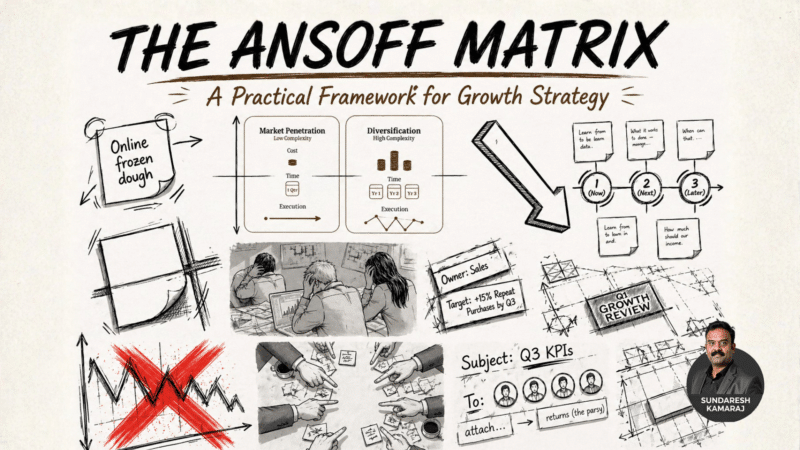
Every founder, CEO, and product leader eventually hits the same wall — what should we grow next, and how risky is that move? The Ansoff Matrix is the simplest and most trusted way to answer that question. In one clean two-by-two grid, this classic growth framework forces a business to declare exactly what kind of expansion it is pursuing and what level of risk it is accepting in return.
Created by Russian-American strategist H. Igor Ansoff in 1957, the Ansoff Matrix has guided everything from corner bakeries to Fortune 500 boardrooms for nearly seventy years. In this comprehensive guide, you will learn how to apply the framework step by step, see two real-world case studies, get a copy-ready implementation checklist, and discover how to combine the matrix with SWOT, PESTLE, Porter’s Five Forces, and the BCG Matrix for a complete strategic system.
Play the Ansoff Matrix Audio in Tamil
1. What Is the Ansoff Matrix? Definition and Origin
The Ansoff Matrix — also called the Product/Market Expansion Grid — is a strategic planning tool that maps four growth options against two simple variables: products and markets. Each variable splits into existing or new, producing four distinct growth strategies arranged in a two-by-two grid.
Igor Ansoff introduced this framework in his landmark 1957 Harvard Business Review article, “Strategies for Diversification.” Nearly seven decades later, the model remains a staple of MBA curricula and corporate strategy offsites worldwide. Its enduring power comes from a single design principle: it converts vague growth ambitions into a disciplined conversation about risk.
Why the Ansoff Matrix Still Matters in 2026
Modern markets reward speed, but speed without direction is dangerous. The Ansoff Matrix is equally useful for a two-person startup deciding what to build next and a multinational planning a ten-year roadmap. It scales because it asks the right question — not “how big can we get?” but “how new is this move, and are we ready for it?”
2. The Four Quadrants of the Ansoff Matrix
Each of the four Ansoff Matrix quadrants represents a fundamentally different growth bet. Understanding them well requires more than memorizing labels — each quadrant has its own logic, playbook, and characteristic failure modes. Let’s break them down one by one.
https://youtu.be/9R_YbD7LI_Y
2.1 Market Penetration — Lowest Risk
Market penetration means selling more of what you already sell, to the customers you already serve. Both the product and the market are familiar, so this is the safest quadrant on the grid. It is the natural starting point for almost every growth conversation.
Common tactics:
Price adjustments, discounts, and promotional offers
Loyalty programs and customer referral incentives
Upselling and cross-selling to current accounts
Heavier advertising and tighter distribution
Taking share from competitors via superior service
Penetration has a ceiling, however. Once a business nears market saturation, each additional point of share becomes disproportionately expensive. Over-reliance on this quadrant leaves a business exposed when its core market stops growing.
2.2 Market Development — Moderate Risk
Market development takes an existing, proven product into a new market. “New market” is broader than it sounds — it can mean a new geography, a new customer segment, a new distribution channel, or even a new use case for the same product.
Common tactics:
Expanding into new cities, states, or countries
Targeting a new demographic, such as moving from B2C to B2B
Launching on new channels, like e-commerce or marketplaces
Repositioning the product for a different use case
The biggest trap here is assuming new markets behave like old ones. Cultural norms, regulations, pricing power, and competitive intensity rarely transfer cleanly across borders or segments. Strong market development always begins with research, not optimism.
2.3 Product Development — Moderate Risk
Product development creates something new for customers you already know. The market is familiar; the offering is not. This quadrant is powerful because it leans on existing trust and distribution — your customers are more willing to try a new product from a brand they already buy from.
Common tactics:
Launching line extensions, variants, or new SKUs
Introducing premium, budget, or specialty versions
Adding complementary products or services
Significant feature upgrades or next-generation versions
Be warned: most new products fail commercially. Companies that chase novelty without a clear customer insight end up with cluttered portfolios and diluted brand equity. Product development demands real R&D capability, not just enthusiasm.
2.4 Diversification — Highest Risk
Diversification is the boldest quadrant — new products for new markets. Both sides of the equation are unknown, which is why this strategy carries the highest failure rate of the four. It can also unlock the largest payoffs when it works.
Two forms of diversification:
Related diversification — moving into an adjacent business that shares technology, customers, or capabilities. Lower risk, easier synergies.
Unrelated diversification — entering a completely different industry. Higher risk, usually pursued for portfolio balance or bold reinvention.
Diversification consumes management attention, capital, and cultural bandwidth all at once. Use it selectively, and only when the strategic logic is clear — for example, when a technology platform genuinely unlocks adjacent industries.
Innovation, line extensions, feature upgrades, R&D
Moderate
Diversification
New products, new markets
New business units, acquisitions, new ventures
High
3. Visual Breakdown: The Ansoff Growth Grid
Risk in the Ansoff Matrix rises diagonally — Market Penetration is the safest quadrant, while Diversification is the most dangerous. The visual below shows how the four growth strategies map across products and markets.
EXISTING PRODUCTS
NEW PRODUCTS
EXISTING MARKETS
Market Penetration Lowest Risk
• Sell more to current customers
• Boost share, frequency, and loyalty
• Use pricing, promos, and referrals
Product Development Moderate Risk
• Launch new products to known customers
• Leverage trust and distribution
• Requires R&D and innovation muscle
NEW MARKETS
Market Development Moderate Risk
• Take proven products to new markets
• Expand geographies, channels, segments
• Needs research and localizatio
Diversification Highest Risk
• New products for entirely new markets
• Related or unrelated diversification
• Highest reward, highest failure rate
The Risk Gradient
A sensible growth portfolio leans heavily on the first three quadrants and uses Diversification selectively, with clear strategic rationale. The further a move sits from the business’s current products and markets, the harder and more expensive it will be to execute successfully.
4. Step-by-Step Guide to Applying the Ansoff Matrix
Applying the Ansoff Matrix is not about dropping ideas into boxes. It is a structured process that connects diagnosis, choice, and execution. The seven steps below are the sequence experienced strategists actually follow.
Step 1: Clarify Your Starting Point
Document where the business stands today — current products, customer segments, geographic footprint, and recent growth performance. Without a clear baseline, the “existing” side of the matrix is ambiguous and every downstream decision inherits that ambiguity.
Step 2: Define What Counts as “New”
Teams frequently disagree on whether a slightly different product or a neighboring segment counts as new. Settle this early. A useful rule: if the business needs fresh capabilities, a new value proposition, or a different go-to-market motion, it is effectively new.
Step 3: Generate Growth Options
Brainstorm initiatives across all four quadrants. Aim for breadth, not polish. Generate at least two or three candidates per quadrant to avoid anchoring on a favorite option too early in the process.
Step 4: Place Each Option in the Matrix
Map every candidate initiative into one of the four quadrants. If an option seems to sit on a boundary, articulate why — boundary cases often reveal unclear thinking about scope or definitions.
Step 5: Assess Risk and Capability Fit
For each option, evaluate market attractiveness, competitive dynamics, required investment, and execution capability. A great opportunity that the business cannot execute is a liability, not an asset.
Step 6: Prioritize and Sequence
Choose a balanced portfolio. Most healthy strategies combine one or two penetration or development moves (to fund the business) with a small number of bolder bets (to open new futures). Sequence them so early wins fund later bets.
Step 7: Define Success Metrics and Review
For every chosen initiative, define measurable outcomes — revenue, share, retention, margin, or strategic milestones — and set a review cadence. Strategy without review is just a wish list.
5. Implementation Checklist
Use the checklists below as practical companions whenever the matrix is being applied — in a strategy offsite, a product planning cycle, or an annual review. Each phase has its own non-negotiables.
✅ Phase 1 — Preparation
Current product portfolio documented and categorized
Existing markets and customer segments clearly defined
Recent revenue, growth, and share data gathered
SWOT or equivalent internal capability audit completed
External environment scan (PESTLE / competitor scan) available
Cross-functional stakeholders identified and invited
✅ Phase 2 — Execution
Definitions of “existing” and “new” explicitly agreed
Candidate growth initiatives brainstormed across all four quadrants
Each initiative placed in the correct quadrant with documented rationale
Risk level and capability fit scored for each initiative
Financial estimates attached where possible (investment, payback, risk-adjusted return)
Final portfolio selected and balanced across risk tiers
Execution owners and timelines assigned
✅ Phase 3 — Review & Iterate
KPIs or OKRs defined for every initiative
Review cadence scheduled (quarterly recommended)
Early warning indicators identified for the riskier quadrants
Exit or pivot criteria defined for underperforming initiatives
Learnings documented and fed back into the next planning cycle
6. Key Facts and Statistics About Growth Strategy
Numbers help anchor strategic discussions. The figures below — a mix of widely cited industry research and patterns observed across decades of corporate strategy work — give the Ansoff Matrix real weight in any boardroom.
of new product launches fail commercially
0
%+
year the Ansoff Matrix was created
higher failure rate for diversification vs. penetration
x
more cost to acquire vs. retain a customer
0
x
of strategies fail due to poor execution, not poor strategy
0
%
the simplest, most adopted growth grid in business
0
x2
The takeaway is clear: the closer a growth move stays to your current products and customers, the higher its probability of success. The Ansoff Matrix is so durable because it makes that probability visible before capital is committed.
7. Case Study 1: FieldFresh Organics
Note: FieldFresh Organics is an illustrative case built for this guide. The numbers reflect typical outcomes when a mid-sized brand executes a balanced Ansoff-driven plan well.
The Business Problem
FieldFresh Organics is a mid-sized organic food brand based in Pune, India, selling cold-pressed juices, plant-based dairy alternatives, and pantry staples through retail outlets in Pune and Mumbai. By Year 5, the company had reached ₹42 crore in annual revenue, but growth had slowed to single digits.
Its two-city retail network was approaching saturation. Competitors were moving aggressively onto major supermarket shelves. Several growth ideas were circulating — a wellness café chain, European exports, a pet-food line, new juice flavors — but there was no shared framework for evaluating them.
Applying the Ansoff Matrix
The leadership team ran a two-day strategy workshop with the Ansoff Matrix as its central tool. Every circulating idea was mapped into one of the four quadrants and stress-tested against capability, capital, and risk.
Market Penetration ideas:
Loyalty program tied to in-store purchases
Bundled offers to lift average basket size
Market Development ideas:
Expand to Bengaluru, Hyderabad, Delhi, and Chennai
List core SKUs on major e-commerce and quick-commerce platforms
Product Development ideas:
Plant-based protein range for existing health-conscious customers
Seasonal limited-edition juice and snack variants
Diversification ideas:
Wellness café chain — new product, new market
European export line — new channel, unfamiliar regulations
Organic pet-food line — new product, new customer base
The Decision and the Results
After structured debate, the team picked a deliberately balanced portfolio — anchored on penetration, fueled by market development, and limited to one focused product launch. All three diversification ideas were deferred for at least eighteen months.
Metric
Before (Year 0)
After (Year 2)
Annual Revenue
₹42 crore
₹71 crore
Active Customer Base
18,000
34,500
Repeat Purchase Rate
31%
48%
Geographic Markets
2 cities
6 cities
Product SKUs
24
41
Gross Margin
38%
42%
What the Matrix Actually Changed
The Ansoff Matrix did not generate the ideas — those already existed. It forced each idea to be classified honestly, compared fairly, and stress-tested against capacity. The team’s most valuable decision was the one it chose not to make: the unfunded café concept would have absorbed the exact capital that funded the successful e-commerce launch.
8. Case Study 2: Anita’s Bakery in Coimbatore
Sometimes the easiest way to grasp a framework is through a familiar scene. Meet Anita.
Anita runs a small neighborhood bakery in Coimbatore. For three years, she has been famous for one thing — her butter cookies. Regulars come in every Saturday morning, leave with a box, and tell their friends. Business is steady. But Anita wants to grow, and she has been losing sleep over how. .
One afternoon her cousin Ravi, who works in corporate strategy, drops by. Over coffee, Anita lists her ideas: a WhatsApp message to regulars offering buy-three-get-one; a second counter at the new tech park; selling brownies and chocolate chip cookies; or — her most exciting thought — launching an online store that ships frozen ready-to-bake dough across the state.
Ravi pulls out a paper napkin and draws a two-by-two grid.
Anita’s Four Options Mapped on the Napkin
WhatsApp promotion → Market Penetration (safest, modest lift). New flavors for regulars → Product Development (medium risk, customers already trust her). Tech-park counter → Market Development (medium risk, new crowd). Frozen dough shipped statewide → Diversification (highest risk, completely different business with logistics, cold chain, and food-safety challenges).
By the time the coffee is finished, Anita has a real plan. Next month: the WhatsApp offer. This quarter: a small brownie trial on weekends. Next year: the tech-park counter. The frozen dough idea goes on a list titled “Not yet — revisit in eighteen months.”
The bakery story contains every lesson of the Ansoff Matrix. The framework did not invent the ideas. It organized them, made the risks visible, and gave Anita a sequence she could actually execute. That is the quiet power of the tool — it turns ambition into a plan.
9. Connecting the Ansoff Matrix With Other Frameworks
The Ansoff Matrix is powerful on its own, but it becomes far more valuable when combined with the other tools in a strategist’s toolkit. Used together, they form an integrated system for diagnosing the situation, choosing the direction, and executing with discipline.
Complementary Tool
How It Connects to the Ansoff Matrix
Practical Benefit
SWOT Analysis
Reveals internal capabilities and market conditions before choosing a quadrant
Grounds growth choices in real strengths
PESTLE Analysis
Scans macro factors that shape market attractiveness
Signals which markets are politically and economically viable
Porter's Five Forces
Measures profitability and competitive pressure in the target market
Prevents entry into structurally unattractive markets
BCG Matrix
Classifies the current portfolio into Stars, Cash Cows, Question Marks, Dogs
Tells you which products can fund new moves
Customer Segmentation
Identifies underserved segments for development or diversification
Sharpens targeting so launches resonate
OKRs and KPIs
Translates chosen strategies into measurable quarterly goals
Keeps execution accountable
In a mature planning process, the Ansoff Matrix typically occupies the middle of the workflow:
Where the Matrix Sits in a Mature Planning Cycle
Diagnose
SWOT, PESTLE, and Porter’s Five Forces clarify where the business stands and what forces are acting on it.
Choose
the Ansoff Matrix is used to generate, classify, and prioritize growth options across the four quadrants.
Allocate
the BCG Matrix and portfolio tools decide which current products fund which new moves.
Execute
OKRs, KPIs, and roadmaps translate chosen initiatives into quarterly delivery targets.
Review
performance reviews feed lessons back into the next diagnostic cycle.
10. Common Mistakes to Avoid
Even experienced teams stumble when applying the Ansoff Matrix. The pitfalls below appear repeatedly in real-world strategy sessions — and each one is preventable.
Five Mistakes That Quietly Sink Ansoff Matrix Sessions
Mistake #1 – Treating diversification as glamorous by default — it is the riskiest path, not the most sophisticated.
Mistake #2 – Ignoring execution capacity and pursuing too many initiatives at once.
Mistake #3 – Using the matrix in isolation rather than alongside SWOT, PESTLE, or customer research.
Mistake #4 – Mistaking a line extension for genuine innovation.
Mistake #5 -Forgetting that “doing nothing” is also a choice — and one that deserves explicit comparison.
11. Frequently Asked Questions About the Ansoff Matrix
These FAQ entries are formatted for FAQPage schema markup, helping each answer qualify for Google rich results and voice-search snippets.
What is the Ansoff Matrix in simple terms?
The Ansoff Matrix is a strategic planning tool that maps four growth options — market penetration, market development, product development, and diversification — across two dimensions: existing or new products, and existing or new markets. It helps businesses choose a growth path while clearly understanding the risk involved.
Who created the Ansoff Matrix and when?
The Ansoff Matrix was developed by Russian-American mathematician and strategist H. Igor Ansoff. He introduced the framework in his 1957 Harvard Business Review article titled “Strategies for Diversification.” It has been a cornerstone of strategic management ever since.
What are the four quadrants of the Ansoff Matrix?
The four quadrants are market penetration (existing products to existing markets, lowest risk), market development (existing products to new markets, moderate risk), product development (new products to existing markets, moderate risk), and diversification (new products to new markets, highest risk).
Which Ansoff Matrix strategy is the riskiest?
Diversification is the riskiest strategy because it involves launching new products into new markets — both sides of the equation are unfamiliar. It also has the highest failure rate, but when it works, it can unlock the largest new revenue streams and reduce dependence on a single market.
When should a business use market penetration?
Use market penetration when the existing market is still growing, when the business has untapped share or unused capacity, when competitors look vulnerable, or when resources for bigger bets are limited. It is the natural default and the lowest-risk path to growth.
How is the Ansoff Matrix different from SWOT analysis?
SWOT analysis evaluates a company’s internal strengths and weaknesses alongside external opportunities and threats. The Ansoff Matrix focuses specifically on growth strategy by classifying options into four quadrants based on product and market newness. SWOT diagnoses; Ansoff decides. They work best together.
Can startups use the Ansoff Matrix?
Yes. Although designed for established firms, the Ansoff Matrix is highly useful for startups deciding what to build next, which segment to enter, or whether to diversify. For early-stage companies, it surfaces hidden risk in expansion plans before precious capital is committed.
Is the Ansoff Matrix still relevant in 2026?
Absolutely. Despite being nearly seventy years old, the Ansoff Matrix remains widely used because it cuts through complexity. Modern teams apply it alongside data analytics, customer research, and portfolio dashboards to make growth strategy a continuous, evidence-based discipline rather than an annual paper exercise.
The Ansoff Matrix is a strategic planning tool that maps four growth options — market penetration, market development, product development, and diversification — across two dimensions: existing or new products, and existing or new markets. It helps businesses choose a growth path while clearly understanding the risk involved.
The Ansoff Matrix was developed by Russian-American mathematician and strategist H. Igor Ansoff. He introduced the framework in his 1957 Harvard Business Review article titled “Strategies for Diversification.” It has been a cornerstone of strategic management ever since.
The four quadrants are market penetration (existing products to existing markets, lowest risk), market development (existing products to new markets, moderate risk), product development (new products to existing markets, moderate risk), and diversification (new products to new markets, highest risk).
Diversification is the riskiest strategy because it involves launching new products into new markets — both sides of the equation are unfamiliar. It also has the highest failure rate, but when it works, it can unlock the largest new revenue streams and reduce dependence on a single market.
Use market penetration when the existing market is still growing, when the business has untapped share or unused capacity, when competitors look vulnerable, or when resources for bigger bets are limited. It is the natural default and the lowest-risk path to growth.
SWOT analysis evaluates a company’s internal strengths and weaknesses alongside external opportunities and threats. The Ansoff Matrix focuses specifically on growth strategy by classifying options into four quadrants based on product and market newness. SWOT diagnoses; Ansoff decides. They work best together.
Yes. Although designed for established firms, the Ansoff Matrix is highly useful for startups deciding what to build next, which segment to enter, or whether to diversify. For early-stage companies, it surfaces hidden risk in expansion plans before precious capital is committed.
Absolutely. Despite being nearly seventy years old, the Ansoff Matrix remains widely used because it cuts through complexity. Modern teams apply it alongside data analytics, customer research, and portfolio dashboards to make growth strategy a continuous, evidence-based discipline rather than an annual paper exercise.
12. Conclusion: Turn Growth Ambition Into a Real Plan
The Ansoff Matrix is one of those rare strategic tools whose simplicity is the source of its strength. Four quadrants, two dimensions, and a single clarifying question: how much newness is this growth move really introducing, and are we ready for the risk that comes with it?
Key Takeaways
Growth has four basic shapes — every initiative fits into one of the four quadrants of the Ansoff Matrix.
Risk rises as familiarity falls — the further from your current products and markets, the harder execution becomes.
A healthy strategy is a portfolio — combine penetration and development bets with selective diversification, never the other way around.
The matrix is a communication tool — it translates complex options into a picture every stakeholder can debate.
Diagnosis comes before placement — the matrix only works when “existing” and “new” are clearly defined.
Integration multiplies value — the matrix performs best alongside SWOT, PESTLE, Porter’s Five Forces, and the BCG Matrix.
Growth decisions shape capital allocation, organizational design, brand identity, and competitive position for years to come. The Ansoff Matrix does not remove the difficulty of those decisions — no framework can — but it makes the difficulty visible. It forces leaders to name the risk, compare alternatives on even ground, and build plans that match both ambition and capability.
Your Next Move
Open a blank document. List every growth idea on your team’s whiteboard. Place each one into a quadrant. Score it for capability fit and risk. Pick the balanced portfolio that fits your capital and people. Then revisit it in ninety days. That is the entire discipline — and the companies that practice it grow on purpose, not by accident.
The Balanced Scorecard: A Complete Guide to Strategy That Actually Works
The Balanced Scorecard is the single most influential strategy framework of the last three decades — and for good reason. When your company reports strong quarterly profits but loses key employees, disappoints customers, or falls behind on innovation, you are flying with a broken instrument panel. You see one dial, and you miss the rest.
Developed by Harvard’s Dr. Robert Kaplan and Dr. David Norton in the early 1990s, the Balanced Scorecard transformed how organizations measure success. Instead of relying on financial numbers alone, it guides leaders through four complementary perspectives: Financial, Customer, Internal Processes, and Learning and Growth. Together, these perspectives reveal whether your business is winning today — and whether it is building the muscles to win tomorrow.
This in-depth guide walks you through everything you need to implement the Balanced Scorecard framework with confidence. You will discover the four perspectives in detail, learn how to build a strategy map, follow a ten-step implementation roadmap, and see two case studies that show the framework in action. By the end, you will have the clarity to turn your strategy into measurable, everyday results.
Play the Balanced Scorecard Audio in Tamil
Of strategies fail due to poor execution, not poor ideas
0
%
Of Fortune 1000 companies use the Balanced Scorecard
0
%
Perspectives every leader must balance to win
0
Higher strategy success rate with formal measurement
0
X
What Is the Balanced Scorecard?
The Balanced Scorecard is a strategic planning and performance management framework that translates an organization’s vision and strategy into a coherent set of objectives and measures across four perspectives. Think of it as both a measurement system and a management system — one that shows you where you stand today while guiding your choices about tomorrow.
At its heart, the Balanced Scorecard answers a deceptively simple question: How do we know our strategy is working? Traditional financial statements tell you what happened last quarter, but they rarely explain why. The Balanced Scorecard bridges that gap by combining lagging indicators (like profit and revenue) with leading indicators (like employee skills and process quality) that actually drive future financial results.
Key Insight
A Balanced Scorecard is not a dashboard full of metrics. It is a carefully chosen set of measures, linked by cause and effect, that tells the story of how your organization creates value — from people, to processes, to customers, to profit.
The 4 Perspectives of the Balanced Scorecard
The four perspectives of the Balanced Scorecard work together like the four legs of a table — remove one, and everything wobbles. Each perspective asks a different strategic question, targets different objectives, and uses different measures. Let’s explore each in depth.
Quick Reference: The Four Perspectives
Perspective
Strategic Question
Example KPIs
Financial
How do we look to shareholders?
Revenue, ROI, net margin, cash flow
Customer
How do customers see us?
NPS, CSAT, retention rate, market share
Internal Processes
What must we excel at?
Cycle time, defect rate, on-time delivery
Learning & Growth
Can we keep improving?
Training hours, engagement, skill coverage
1. The Financial Perspective
The Financial Perspective answers the ultimate shareholder question: Are we delivering value to the owners of the business? For most for-profit organizations, financial outcomes remain the final proof that strategy is working. This perspective focuses on revenue growth, profitability, cost management, and capital efficiency.
However, the Balanced Scorecard does not treat financial measures as drivers — it treats them as outcomes. You cannot simply wish for higher revenue. Revenue grows because customers love you, processes run smoothly, and employees innovate. That is why the financial perspective sits at the top of the strategic chain, representing the destination rather than the engine.
Typical Financial Objectives:
Revenue Growth — expanding market reach, launching new products, or entering new segments.
Profitability — improving gross and net margins through pricing, mix, and cost control.
Asset Utilization — improving return on invested capital and working capital efficiency.
https://youtu.be/vTWTl5U5DQE
2. The Customer Perspective
The Customer Perspective forces leaders to step outside their internal view and see the business through the eyes of the market. It covers four critical areas: customer acquisition, retention, satisfaction, and profitability. Done well, it defines the target segments and the specific value proposition offered to each.
A common trap is to confuse this perspective with marketing metrics alone. Customer experience is much broader — it includes product quality, service responsiveness, brand perception, and the total value customers receive compared with alternatives.
Typical Customer Objectives:
Customer Satisfaction — ensuring interactions meet or exceed expectations (measured via CSAT or NPS).
Customer Acquisition — attracting new customers efficiently through targeted campaigns and referrals.
Market Share — growing the share of spend within chosen segments relative to competitors.
3. The Internal Processes Perspective
The Internal Processes Perspective focuses on the operational capabilities that deliver the customer value proposition. It asks: Which processes must we excel at to satisfy our customers and shareholders? These processes generally fall into four categories — operations, customer management, innovation, and compliance.
The distinctive feature of this perspective is that it encourages leaders to design new processes at which the organization must excel, not merely to measure existing activities. A company competing on speed might introduce an expedited-fulfillment process, while one competing on innovation might build a structured idea-to-market pipeline.
Customer Management — acquiring, retaining, and growing target customers through tailored processes.
Innovation — developing new products, services, and business models ahead of demand.
Compliance & Sustainability — meeting regulatory, environmental, and social responsibility commitments.
4. The Learning and Growth Perspective
The Learning and Growth Perspective — sometimes called the People Perspective — focuses on the intangible assets that fuel every other part of the scorecard: human capital, information capital, and organizational capital. It answers: Are we building the capabilities we will need to sustain performance in the future?
This perspective is the most neglected in practice because returns appear in the long term. Yet it is arguably the most important. A skilled, engaged workforce supported by strong systems and a healthy culture can consistently improve processes, delight customers, and generate financial results. No amount of marketing can compensate for disengaged employees.
Typical Learning & Growth Objectives:
Human Capital — closing skill gaps, building leadership pipelines, and investing in training.
Information Capital — deploying technology, data platforms, and digital tools that support decisions.
Organizational Capital — shaping culture, values, teamwork, and knowledge sharing for execution.
Employee Engagement — measuring and improving motivation, satisfaction, and retention.
Why the Balanced Scorecard Still Dominates Strategy
More than three decades after its invention, the Balanced Scorecard remains the world’s most widely adopted strategy framework. It has stood the test of time because it solves three enduring business problems that no amount of digital transformation can eliminate.
Most measurement systems reward quarterly performance at the expense of long-term health. The Balanced Scorecard forces leaders to invest in people, processes, and innovation — even when markets demand immediate results.
02
It Aligns Diverse Teams Around a Shared Strategy
When every department tracks its own metrics, strategy becomes a Tower of Babel. The Balanced Scorecard gives leaders a common language, so finance, operations, and HR discuss the same priorities in the same meetings.
03
It Translates Vision Into Measurable Action
Mission statements inspire but rarely guide daily decisions. The Balanced Scorecard converts abstract ambition into concrete objectives, KPIs, targets, and initiatives — the ingredients of real execution.
A Balanced Scorecard is most powerful when paired with a Strategy Map — a one-page visual representation of how objectives across the four perspectives cause and reinforce one another. A well-constructed strategy map reads like a logical argument.
Improving employee skills (Learning and Growth) enables faster problem resolution (Internal Processes). Faster resolution increases customer satisfaction (Customer). Happier customers drive revenue growth (Financial). This cause-and-effect chain is the central contribution of the Balanced Scorecard to modern management thinking.
THE GOLDEN RULE OF STRATEGY MAPS
If you cannot connect an objective to any other objective with a clear cause-and-effect arrow, that objective probably does not belong on your scorecard. Every element should be part of the value-creation story.
Step-by-Step Guide to Building a Balanced Scorecard
Building a Balanced Scorecard is not an overnight exercise. It is a structured journey that begins with strategy clarity and ends with a rhythm of review. The following ten steps have been refined through thousands of successful implementations worldwide.
Step 1: Clarify the Vision and Strategy
Before measuring anything, the leadership team must agree on where the organization is going. Review existing mission, vision, and strategy statements. If they are vague, sharpen them first. Ask: What does winning look like in three to five years?
Pro Tip: Run a facilitated workshop to surface assumptions. Disagreement at the strategy stage is far cheaper than disagreement at execution.
Step 2: Identify Strategic Themes
Translate your strategy into three to five strategic themes — broad priorities like Operational Excellence, Customer Intimacy, or Innovation Leadership. Themes bridge the gap between abstract vision and specific objectives.
Common Mistake: Choosing too many themes. If everything is a priority, nothing is.
Step 3: Define Objectives for Each Perspective
For each perspective, articulate three to five objectives that support your themes. Objectives should be short, action-oriented statements like Increase customer retention or Build data analytics capability.
Best Practice: Use verbs that imply movement — increase, reduce, build, improve — so objectives feel dynamic.
Step 4: Construct the Strategy Map
Arrange objectives on a single page with the four perspectives stacked vertically — Financial at the top, Learning and Growth at the bottom. Draw arrows showing how lower perspectives drive outcomes in higher ones.
Pro Tip: If an objective cannot be linked with a cause-and-effect arrow, reconsider whether it belongs on the scorecard.
Step 5: Select Key Performance Indicators (KPIs)
For each objective, choose one or two measures. Use a mix of lagging indicators (outcomes) and leading indicators (drivers) so the scorecard tells you what has happened and what is likely to happen next.
Common Mistake: Measuring what is easy rather than what matters. Resist copying generic KPIs from templates.
Step 6: Set Targets
For each KPI, define a realistic but ambitious target and a target date. Good targets are stretch goals — demanding enough to drive focus, but not so unrealistic that they demotivate teams.
Pro Tip: Set targets at multiple horizons — annual, quarterly, and monthly — so progress can be corrected in time.
Step 7: Define Strategic Initiatives
For each objective, determine the projects and programs that will close the performance gap. Initiatives are the action programs that turn targets into reality. Assign owners, budgets, and timelines to every one.
Best Practice: Rank initiatives by strategic impact and fund the highest-impact ones first.
Step 8: Cascade the Scorecard
Translate the corporate scorecard into department-level and team-level versions. Each should stay aligned with corporate objectives while adapting KPIs to what the team can actually influence.
Common Mistake: Copying the corporate scorecard verbatim to every department. Cascading requires adaptation.
Step 9: Implement Review Rhythms
Establish a disciplined cadence — monthly for operational reviews and quarterly for strategic reviews. The scorecard becomes powerful when it shapes the agenda of senior leadership meetings.
Pro Tip: Focus reviews on learning, not blame. The goal is to understand the data, not to punish missed targets.
Step 10: Refine and Evolve
A Balanced Scorecard is a living tool. As strategy evolves and capabilities mature, objectives and KPIs must evolve with them. Conduct an annual deep review to retire outdated measures and validate alignment.
Best Practice: Treat refinement as a strategic activity, not an administrative one. Executives should lead it.
Balanced Scorecard Implementation Checklist
Use this practical checklist to guide your implementation. Tick items as they are completed and revisit the list periodically to maintain rigor across all four phases.
Preparation Phase
Executive sponsor identified and fully committed
Cross-functional Balanced Scorecard team assembled
Vision, mission, and strategy documents reviewed and refreshed
Strategic themes agreed (three to five)
Stakeholder expectations documented and aligned
Implementation timeline and budget approved
Communication plan drafted to introduce the framework
Design Phase
Objectives drafted for each of the four perspectives
Objectives tested for alignment with strategic themes
Strategy map created with clear cause-and-effect linkages
KPIs selected (lagging and leading mix)
Data sources identified and validated for each KPI
Targets set with appropriate ambition and realism
Strategic initiatives scoped, prioritized, and funded
Owners assigned for every objective, KPI, and initiative
Deployment Phase
Corporate scorecard approved and published
Department and team scorecards cascaded
Performance dashboards built and automated where possible
Employees briefed on how their work connects to strategy
Managers trained to run effective scorecard reviews
Rewards and recognition aligned with scorecard priorities
Review and Improvement Phase
Monthly operational reviews scheduled and calendared
Quarterly strategy reviews scheduled with senior leadership
Review templates and meeting agendas standardized
Variances analyzed with root-cause discussion, not blame
Corrective actions assigned with clear deadlines
Lessons learned documented and shared
Annual scorecard refresh scheduled and executed
QUALITY CHECK BEFORE LAUNCH
Answer these five questions honestly: Does the strategy map tell a coherent story? Can every employee see where they fit? Do the KPIs measure what truly matters? Are targets ambitious enough to drive change? Has leadership personally committed to a regular review cadence? If any answer is weak, invest more time before full deployment.
Data & Facts: What Research Reveals
The Balanced Scorecard’s endurance is not just anecdotal — decades of management research and industry surveys confirm its impact. Here are the key data points every strategist should know.
Years as the leading strategy framework
0
+
Report improved strategic alignment
0
%
Perspectives that balance any strategy
0
Research consistently shows that organizations using a structured strategy framework like the Balanced Scorecard outperform peers on strategy execution and cross-functional alignment. Harvard Business Review named it one of the most influential management ideas of the past seventy-five years — a recognition backed by adoption in thousands of companies, governments, nonprofits, and universities worldwide.
The framework is particularly valued because it reduces the typical gap between strategy formulation and execution, a gap often cited as the reason the majority of well-designed strategies fail to deliver results. By forcing leaders to measure leading indicators alongside lagging ones, it turns strategy from a once-a-year document into a daily operating rhythm.
Real-World Case Studies
Theory is useful, but real decisions come alive in real examples. The following two case studies illustrate how the Balanced Scorecard transforms struggling organizations into market leaders. Names are illustrative but scenarios reflect common patterns seen in real implementations.
The Problem: MeridianHealth Clinics, a regional network of twenty-four outpatient centers, had grown through acquisitions but never integrated operations. Patient satisfaction had fallen below industry averages, physician turnover had climbed to eighteen percent, same-day appointment availability had collapsed, and operating margins had shrunk for three consecutive years. Worse, each functional leader tracked a different set of metrics, so weekly leadership meetings devolved into debates about which numbers mattered most.
The Solution: Over twelve weeks, the leadership team built its first Balanced Scorecard around three themes: Exceptional Patient Experience, Operational Reliability, and Engaged Clinical Teams. The team defined twelve objectives, built a one-page strategy map, and selected just twenty-two KPIs — a deliberate choice to avoid measurement overload. Sample targets included
The Result: Within eighteen months, patient NPS climbed from 28 to 52 (top quartile), same-day slot fill rate rose from 61 percent to 93 percent, and physician turnover dropped from 18 percent to 9 percent. Operating margin expanded from 6.2 percent to 10.4 percent, and revenue grew at twice the prior-year rate. The cause-and-effect chain worked exactly as the strategy map predicted.
The Problem: Priya owned a small pottery studio called Clay and Craft. For years, she measured success by a single number: monthly revenue. When revenue was strong, she felt successful. When it dipped, she panicked. One month revenue peaked, but her head potter quit. The next month, long-time customers complained about delayed orders. By the third month, revenue had crashed, and Priya could not explain why.
The Solution: A friend introduced her to the Balanced Scorecard. Together they built a simple version for Clay and Craft: Financial (monthly revenue, cash on hand), Customer (repeat orders, complaints, referrals), Internal Processes (order fulfillment time, quality defect rate), and Learning and Growth (team training hours, skill coverage, retention). For the first time, Priya could see her entire business on a single page.
The Result: Within six months, Priya’s customer complaints dropped by seventy percent, repeat orders grew by forty percent, and revenue stabilized while growing steadily. More importantly, Priya replaced anxiety with clarity. Even micro-businesses benefit from balancing perspectives — the Balanced Scorecard framework scales from multinational corporations to family-run studios.
The Problem: MeridianHealth Clinics, a regional network of twenty-four outpatient centers, had grown through acquisitions but never integrated operations. Patient satisfaction had fallen below industry averages, physician turnover had climbed to eighteen percent, same-day appointment availability had collapsed, and operating margins had shrunk for three consecutive years. Worse, each functional leader tracked a different set of metrics, so weekly leadership meetings devolved into debates about which numbers mattered most.
Perspective
Objective
Target
Financial
Restore operating margin
From 6.2% to 11.0% in 24 months
Customer
Top-rated clinic network
Raise NPS from 28 to 60 in 18 months
Internal Processes
Same-day appointment availability
Reach 95% in 12 months
Learning & Growth
Engaged clinical workforce
Reduce turnover from 18% to under 8%
The Solution: Over twelve weeks, the leadership team built its first Balanced Scorecard around three themes: Exceptional Patient Experience, Operational Reliability, and Engaged Clinical Teams. The team defined twelve objectives, built a one-page strategy map, and selected just twenty-two KPIs — a deliberate choice to avoid measurement overload. Sample targets included
The Result: Within eighteen months, patient NPS climbed from 28 to 52 (top quartile), same-day slot fill rate rose from 61 percent to 93 percent, and physician turnover dropped from 18 percent to 9 percent. Operating margin expanded from 6.2 percent to 10.4 percent, and revenue grew at twice the prior-year rate. The cause-and-effect chain worked exactly as the strategy map predicted.
The Problem: Priya owned a small pottery studio called Clay and Craft. For years, she measured success by a single number: monthly revenue. When revenue was strong, she felt successful. When it dipped, she panicked. One month revenue peaked, but her head potter quit. The next month, long-time customers complained about delayed orders. By the third month, revenue had crashed, and Priya could not explain why.
The Solution: A friend introduced her to the Balanced Scorecard. Together they built a simple version for Clay and Craft: Financial (monthly revenue, cash on hand), Customer (repeat orders, complaints, referrals), Internal Processes (order fulfillment time, quality defect rate), and Learning and Growth (team training hours, skill coverage, retention). For the first time, Priya could see her entire business on a single page.
The Result: Within six months, Priya’s customer complaints dropped by seventy percent, repeat orders grew by forty percent, and revenue stabilized while growing steadily. More importantly, Priya replaced anxiety with clarity. Even micro-businesses benefit from balancing perspectives — the Balanced Scorecard framework scales from multinational corporations to family-run studios.
Balanced Scorecard vs Other Strategy Frameworks
How does the Balanced Scorecard compare with other popular strategy tools? Each framework has a role, and the best leaders combine them. Here’s a quick comparison to help you choose the right tool for the right job.
Framework
Primary Purpose
Best Used For
Balanced Scorecard
Strategy execution & measurement
Turning vision into daily action
SWOT Analysis
Situation assessment
Early-stage strategic diagnosis
Porter's Five Forces
Industry analysis
Evaluating competitive intensity
PESTLE Analysis
Macro-environment scan
Anticipating external shifts
OKRs
Goal-setting cadence
Aligning short-term quarterly focus
Business Model Canvas
Business model design
Mapping how value is created
INTEGRATION TIP
The Balanced Scorecard pairs beautifully with SWOT, PESTLE, and Porter’s Five Forces (for diagnosis) and with OKRs (for quarterly execution). Use SWOT and PESTLE to inform your strategy, then use the Balanced Scorecard to execute it.
Common Mistakes and How to Avoid Them
Even the best framework fails in the wrong hands. Here are the most frequent Balanced Scorecard mistakes — and how to sidestep each one.
Mistake #1 – Treating the scorecard as a dashboard, not a management system. Metrics without meetings are just decoration.
Mistake #2 – Measuring too many things. A scorecard with eighty KPIs is noise, not strategy. Aim for fifteen to twenty-five.
Mistake #3 – Skipping the strategy map. Without cause and effect, you have a list of metrics, not a story of value creation.
Mistake #4 – Cascading by copy-paste. Every team must adapt KPIs to what they can actually influence.
Mistake #5 – Ignoring the Learning and Growth perspective. Long-term capability always seems less urgent than short-term results — until it isn’t.
Mistake #6 – Using reviews to punish rather than learn. Blame cultures kill honest data, and dishonest data kills strategy.
Frequently Asked Questions
Below are the most common questions leaders ask about the Balanced Scorecard framework. Answers are structured for both readers and search engines — optimized for voice search and featured snippets.
What is the Balanced Scorecard in simple terms?
The Balanced Scorecard is a strategy framework that measures business performance across four perspectives — Financial, Customer, Internal Processes, and Learning and Growth — so leaders see the full picture of their organization rather than just financial results.
Who invented the Balanced Scorecard?
The Balanced Scorecard was developed in the early 1990s by Dr. Robert S. Kaplan of Harvard Business School and Dr. David P. Norton. Their goal was to help leaders translate strategy into measurable action across financial and non-financial perspectives.
What are the four perspectives of the Balanced Scorecard?
The four perspectives are Financial (shareholder value), Customer (market perception), Internal Processes (operational excellence), and Learning and Growth (people and capabilities). Each perspective asks a different strategic question and uses its own KPIs.
Can small businesses use the Balanced Scorecard?
Absolutely. Small businesses benefit enormously from the Balanced Scorecard because it prevents over-reliance on revenue alone. Even a five-person team can use a simplified scorecard to balance customer experience, processes, people, and finances.
The Balanced Scorecard is a strategy framework that measures business performance across four perspectives — Financial, Customer, Internal Processes, and Learning and Growth — so leaders see the full picture of their organization rather than just financial results.
The Balanced Scorecard was developed in the early 1990s by Dr. Robert S. Kaplan of Harvard Business School and Dr. David P. Norton. Their goal was to help leaders translate strategy into measurable action across financial and non-financial perspectives.
The four perspectives are Financial (shareholder value), Customer (market perception), Internal Processes (operational excellence), and Learning and Growth (people and capabilities). Each perspective asks a different strategic question and uses its own KPIs.
Absolutely. Small businesses benefit enormously from the Balanced Scorecard because it prevents over-reliance on revenue alone. Even a five-person team can use a simplified scorecard to balance customer experience, processes, people, and finances.
How do you build a Balanced Scorecard?
Start by clarifying your strategy, pick three to five strategic themes, define objectives for each perspective, build a strategy map, select KPIs, set targets, fund initiatives, cascade the scorecard, and review it on a monthly and quarterly cadence.
Is the Balanced Scorecard still relevant in 2026?
Yes. The Balanced Scorecard remains highly relevant in 2026 because it solves problems that technology cannot — aligning diverse teams around shared strategy and balancing short-term results with long-term capability. Thousands of organizations still use it as their primary strategy framework.
What is the difference between a Balanced Scorecard and KPIs?
KPIs are individual metrics, while a Balanced Scorecard is a structured framework that organizes KPIs into four perspectives linked by cause and effect. A scorecard tells a story; KPIs alone are just numbers.
What is a strategy map in the Balanced Scorecard?
A strategy map is a one-page visual that connects objectives across the four perspectives with cause-and-effect arrows. It shows how improvements in people and processes ultimately drive customer and financial outcomes, turning the scorecard into a story of value creation.
Start by clarifying your strategy, pick three to five strategic themes, define objectives for each perspective, build a strategy map, select KPIs, set targets, fund initiatives, cascade the scorecard, and review it on a monthly and quarterly cadence.
Yes. The Balanced Scorecard remains highly relevant in 2026 because it solves problems that technology cannot — aligning diverse teams around shared strategy and balancing short-term results with long-term capability. Thousands of organizations still use it as their primary strategy framework.
KPIs are individual metrics, while a Balanced Scorecard is a structured framework that organizes KPIs into four perspectives linked by cause and effect. A scorecard tells a story; KPIs alone are just numbers.
A strategy map is a one-page visual that connects objectives across the four perspectives with cause-and-effect arrows. It shows how improvements in people and processes ultimately drive customer and financial outcomes, turning the scorecard into a story of value creation.
Final Thoughts and Your Next Move
The Balanced Scorecard is more than a measurement tool — it is a discipline for turning strategy into daily action. By forcing leaders to see their business across four perspectives, it ends the false debate between financial results and long-term health. Instead, it shows that healthy people, healthy processes, and happy customers are the engines of financial success.
If your organization struggles with misaligned teams, metric overload, or strategies that never reach the front line, the Balanced Scorecard offers a proven path forward. Start small, stay disciplined, and evolve as you learn. The goal is not a perfect scorecard on day one — the goal is a living framework that gets sharper every quarter.
YOUR NEXT STEP
Pick one strategic theme this week. Draft three objectives under each of the four perspectives. Sketch a simple strategy map on a single page. Then share it with your leadership team and invite challenge. That single conversation may be the most valuable hour you spend this quarter.
Contact
Contact With Me
Nevine Acotanza
Chief Operating Officer
I am available for freelance work. Connect with me via and call in to my account.